365 Data Science is an online educational career website that offers the incredible opportunity to find your way into the data science world no matter your previous knowledge and experience.
Certain industries, such as medicine and finance, are sensitive to false positives. Using human input in the model inference loop can increase the final precision and recall. Here, we describe how to incorporate human feedback at inference time, so that Machines + Humans = Higher Precision & Recall.
If you have ever developed a Conversational AI agent using NLU, you know how often users don’t follow the happy path.
They may say or type responses that make perfect sense however their responses still fall outside of any intent.
For example, if a user asks about a refund, by typing just their order number, what happens?
What is the intent of that message?
Obviously, the order number is an entity but since there isn’t a clear intent that it’s mapped to, it will trigger a retrieval action that combines all of your intents into a single FAQ and in this way we have already moved past intents and right into context!
RASA is taking this insight to the next level and on May 25th, Alan Nickole, the co-founder and CTO or Rasa will share how RASA is moving beyond intents and using context!
In this talk, Alan will share how RASA is going beyond Intents and Entities.
Very exciting talk as we are seeing NLP/NLU going through a major revolution.
Develop your own AI Agent in our Certified NLU Workshop
NLU Certification
Join our NLU Workshop on May 27th you can create you own Conversational Agent in our full day workshop and get certified in Conversational AI Development.
Edge cases occur for three basic reasons: Bias – the ML system is too ‘simple’; Variance – the ML system is too ‘inexperienced’; Unpredictability – the ML system operates in an environment full of surprises. How do we recognize these edge cases situations, and what can we do about them?
Deep Learning could be super fascinating if you’re already in love with other ML algorithms. DL is all about huge neural networks, with numerous parameters, different layers which perform specific tasks.
This checklist will provide you with a smooth start ( and also a safer start ) with Deep Learning in TensorFlow.
Warning: This story uses some dreaded terminology. Readers who have jumped directly into DL, thereby skipping basic ML algos, are advised.
Artificial Neural Networks are systems inspired by biological neurons and are used to solve complex problems, as they have the unique ability to approximate functions, which map the inputs to their labels.
☠️ Your attention here, please. The following topic which DL folks call “backpropagation” is a serial killer for many ML beginners. It roams around with creepy weapons like partial derivatives, chain rule, so beginners with weak mathematics are advised.
ML: Theory vs. PracticeBig Data Jobs
? Backpropagation
Backpropagation is used to optimize the parameters of ML models, which aims to find a minimum for the given cost function. Having a strong understanding of how backpropagation works under the hood, is essential in deep learning.
Although the TensorFlow website is enough for a beginner to get started, I would like to focus on some important topics.
? Dataset
This is an important class, which helps us load huge datasets easily and feed them to our NNs. The Dataset class has a bunch of useful methods. Using the dataset.map() method along with various methods in tf.image module, we can perform a number of operations on images from our data.
TensorBoard will help you visualize the values of various metrics used during the training of our model. It could be the accuracy of our model or the MAE ( Mean Absolute Error ) in case of a regression problem.
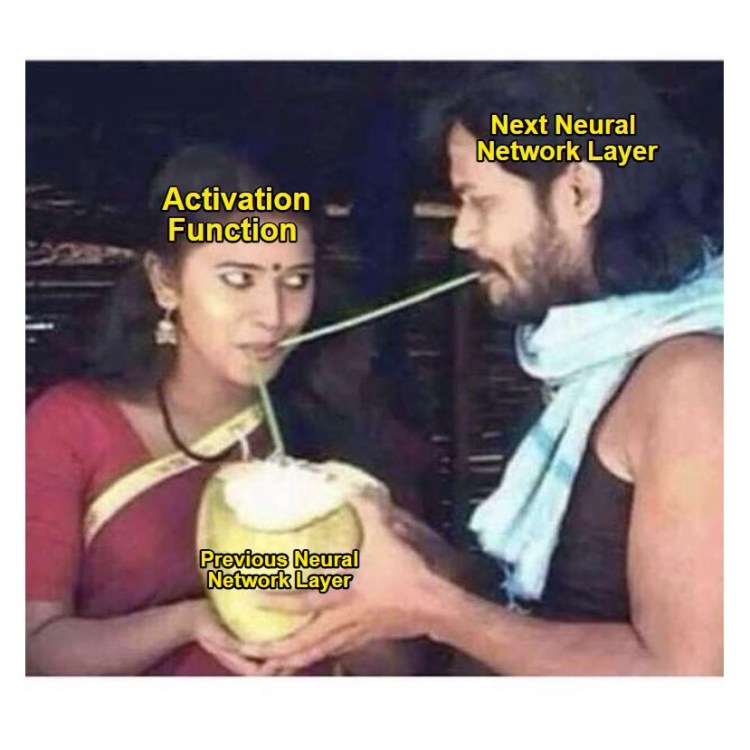
Activation functions introduce non-linearity in our NN, so as to approximate the function which would map our input data with the labels. Every activation function has its own pros and cons, so the choice will always depend on your use case.
Dense layers are quite important in every possible NN. You’ll find them in every architecture whether it is for text classification, image classification or GANs. Here’s a good read, by Hunter Heidenreich, about tf.keras.layers.Dense to have a better understanding,
Dropout is widely used in NNs, as it fights efficiently against overfitting. It randomly sets activations to 0, given a dropout_rate which is the probability of activation being set to 0.
Its always better to start with a question in mind,
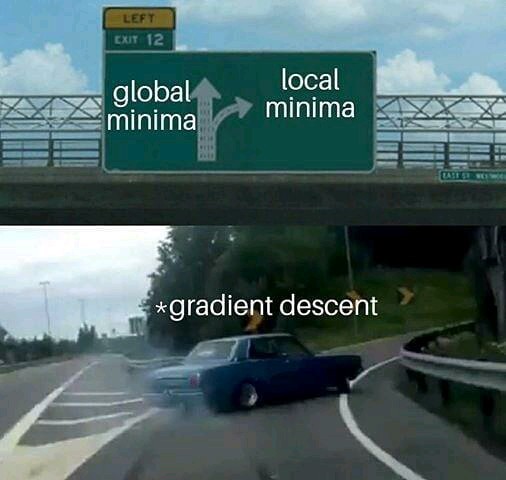
Considering Dense layers, the parameters W and b i.e the weights and the biases, are randomly initialized. They are then optimized by Gradient Descent ( backpropagation ). But there are some smart ways to initialize these parameters so that the loss function could quickly each the minima. Some good reads are,
A number of different optimizers are available in the tf.keras.optimizers module. Each optimizer is a variant or improvement to the gradient descent algorithm.
Cost functions ( synonymously called loss functions ) penalize the model for incorrect predictions. It measures how good the model is, and decides how much improvement is needed. Different loss functions have different use-cases, which are detailed thoroughly in the stories below,
By practice, the learning rate of a NN model should be decreased over time. As the value of the loss function decreases, or as the loss function is close to minima, we take smaller steps. Note, the learning rate decides the step size of gradient descent.
Early stopping is a technique wherein we stop the training of our model when a given metric stops improving. So, we stop the training of our model, before it overfits, thereby avoiding any excessive training which can worsen the results.
? Batch Size ( and Epochs vs. Iterations vs. Batch Size )
Batch size is the number of samples present in a mini-batch. Each batch is sent through the NN and the errors are averaged across the samples. So, for each batch, the parameters of the NN are optimized. Also, see Mini-Batch Gradient Descent.
Metrics are functions whose value is evaluated to see how good a model is. The primary difference between a metric and a cost function is that the cost function is used to optimize the parameters of the model in order to reach the minima. A metric could be calculated at each epoch or step in order to keep track of the model’s efficiency.
Sometimes, we may require some metrics which aren’t available in the tf.keras.metrics module. In this case, a custom metric should be implemented, as described in this blog,
A super big read, right? Did you find some other blog/video/book useful, which could be super-cool for others as well? Well, you’re at the right place! Send an email at equipintelligence@gmail.com to showcase your resource in this story ( the credits would of course go with you! ).
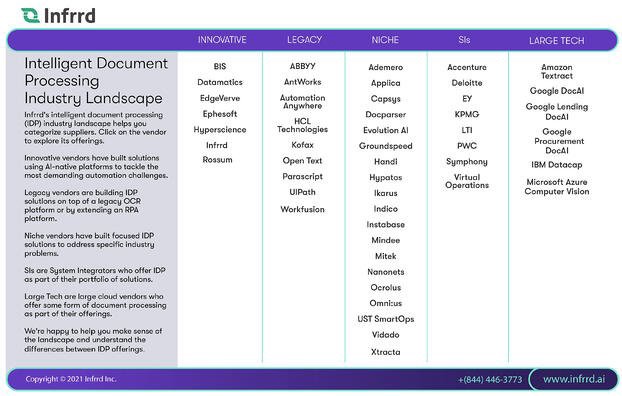
IDP Vendor Landscape Update December 2020: Holy smokes we’ve reached 46 IDP solutions on the landscape. In this update, we’re adding 13 more IDP vendors/solutions to the list. These are IDP vendors that we get questions about as enterprises and partners try to figure out what’s what and who’s who.
Remember, if you need help navigating this landscape, we’re happy to be your guide.
We welcome the newest IDP vendors to the landscape:
Many vendors offer IDP products, but they’re all quite different so the landscape isn’t easy to navigate. The category itself can go by different names. Some call it Cognitive Document Processing. Others call it Intelligent Document Capture (IDC). Some even refer to IDP solutions as OCR or Machine Learning OCR … which is very misleading. To keep it simple, we’ll stick with IDP in this post so we can help you make sense of it all.
Big Data Jobs
Making Sense of the IDP Vendor Landscape
IDP solutions automatically extract data from unstructured complex documents, then feed that data into business systems so a whole process can be automated. If you don’t have IDP, you’re extracting this data manually because it’s too difficult for older technologies like OCR to handle it accurately.
True IDP is very difficult, and few vendors actually do it well. Many vendors claim to have IDP solutions, but the scope of what their IDP can do varies A LOT. Choosing the right vendors for your shortlist depends on how the problem you need to solve aligns with the scope of each vendor’s IDP capability.
Five Categories of IDP Vendors
To help you navigate the landscape we group the vendors into five categories:
Innovative IDP vendors
Legacy IDP vendors
Niche IDP vendors
Systems Integrators with IDP offerings
Technology providers with IDP components
Vendors in each category tend to view the IDP challenge through a different lens and have therefore developed solutions that are different from one another.
This list is based on vendors we often compete against, vendors we see in the market, and vendors covered by analysts. Our list includes only vendors that support enterprise-grade requirements and operations. If you want a solution for a small office or a single desktop, this list isn’t for you.
Vendors in each category below are listed in alphabetical order.Innovative IDP Vendors
This a younger group of up-and-coming vendors who have built solutions using AI-native platforms to tackle the most demanding automation challenges. Generally, Innovative vendors can handle documents that are more complex or have greater variation. As a result, they often can deliver a greater business impact than older technologies. Since these vendors are free from legacy technical debt, it’s easier for them to build next-gen, future-oriented solutions. Some vendors in this group have a more narrow focus than others, so be sure to make sure their expertise aligns with your use cases.
Tip: If your use case involves complex, unstructured, messy documents, then take a good look at these vendors. We at Infrrd believe we’re the leader among these innovators, but don’t take our word for it — check out our IDP platform and decide for yourself.
Legacy (OCR or RPA) vendors
Legacy vendors are typically building IDP solutions on top of a legacy platform. To make this work, a vendor may bolt some AI or Machine Learning onto its legacy OCR or RPA products. Typically, these vendors have a broader portfolio of automation offerings and are not laser-focused on the IDP challenge. These IDP solutions may not be as agnostic to a multi-vendor environment as other segments, though many have established partnerships with vendors who offer complementary capabilities. Also, OCR-centric solutions tend to be good when you have large volumes of relatively simple documents that don’t have a lot of variation.
Tip: If you are using one of these vendors’ products already, it makes sense to put their IDP offerings on your shortlist. But the real challenge is to get a sense of whether your problem requires a better OCR solution or a true AI-native IDP solution.
Niche IDP vendors
This group includes vendors that are just getting started or those with a particular focus or disruptive solutions to narrow problems. As these vendors may be smaller, pay particular attention to their ability to deliver enterprise-grade performance that meets your requirements.
Tip: Consider these vendors if you have a niche use case that is a good application fit.
IDP System Integrators
System Integrators may offer IDP as part of their portfolio of solutions. Their IDP offering may be a solution from another IDP vendor or developed in-house. Some of these vendors use Infrrd’s IDP platform, for example.
Tip: SIs can help you develop and deploy business and system-level strategies that leverage the transformative power of IDP.
IDP Technology Suppliers
The major technology platforms offer general-purpose technology components such as OCR and computer vision. Since these components are not full IDP solutions we only mention them in this post because some enterprises prefer to develop capabilities internally based on available technology components.
Tip: You will need a strong IT group with a data science team to build out all the functionality needed for a production solution based on these components.
Sources: The IDP vendor list was developed with data from The Everest Group, NelsonHall, and Infrrd’s research. At the time of this post, neither Gartner nor Forrester had a research that covered the IDP market landscape.
How should you navigate the IDP landscape?
Our experience is that most enterprises run this gauntlet more than once. You will likely define and redefine requirements as you better understand vendor capabilities and the scope of your own business process challenges.
One thing we have learned from conversations and deployments with many enterprises is that IDP is clearly a disruptive innovation. Many of our enterprise customers had expectations anchored by years of experience with OCR. They were surprised to learn that a true IDP solution can deliver automation they once thought was impossible. So if you haven’t explored this exciting new vendor landscape, you might be surprised too.
Tip: Define your requirements using your most complex use case. If IDP can solve the most complex challenge, then the rest of your use cases are easy peasy lemon squeezy. You end up with one platform that does it all instead of multiple OCR or specialized solutions that become a challenge to maintain and optimize
Understanding the process of A/B testing and knowing how to discuss this approach during data science job interviews can give you a leg up over other candidates. This mock interview provides a step-by-step guide through how to demonstrate your mastery of the key concepts and logical considerations.
New to data science? Interested in the must-know machine learning algorithms in the field? Check out the first part of our list and introductory descriptions of the top 10 algorithms for data scientists to know.















 365 Data Science