

Machine Learning to Delve Deeper into Business Community
I am optimistic — like never before — that this moment is the rock-bottom on which we can lay a new foundation. Many things are happening that fill me with gratitude and show me nothing but opportunity. I see many signs that a “rebound” is on the way. It won’t feel like a return to normal, but it will be our hopeful “new normal” where we can shift from survival to growth. Anticipating when and how this might happen has occupied my recent efforts in the MyTri 2030 Prosperity Council.

Prosperity in Tri-Cities
Since June 2019, I’ve been one of the local Tri-Cities community leaders lucky enough to be a part of MyTri 2030 — an effort to make a regional vision for Tri-Cities across key areas like Life, Energy, and Education. My opportunity area is “Prosperity”, where we focus on business, entrepreneurship, and economic vitality. We had our first kick-off in February, where I was lucky to be named one of three co-chairs of the council primarily to represent the community of Fuse.
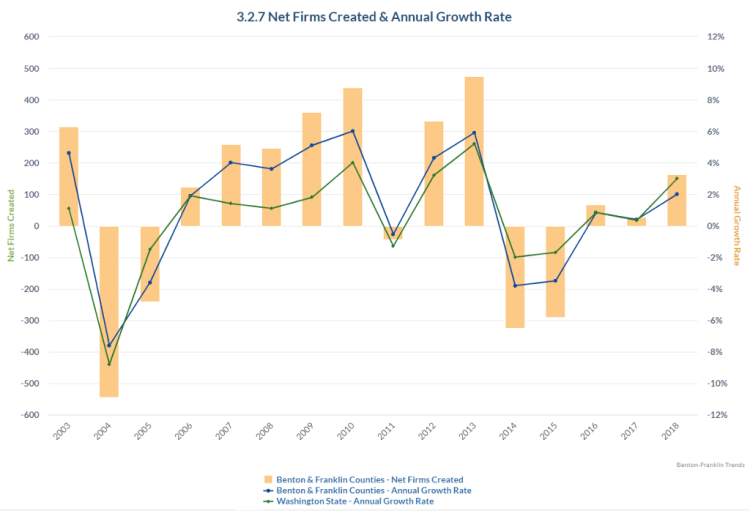
Despite the backdrop of a looming international crisis, when we started we were committed to the idea that our job would be continuing to grow the vibrant business community of Tri-Cities. Step one was to assess current state economics in the region. Not only through the qualitative lens of current mood, but looking for numbers — such as the Economic Vitality numbers on the Benton-Franklin trends website. While the site itself is great, the data on it is unfortunately 2 years old — it’s beyond challenging to find real-time economic data. Just as we were getting started, the COVID crisis hit home, the economy shuttered, and plans changed.
Top 4 Most Popular Ai Articles:
3. Real vs Fake Tweet Detection using a BERT Transformer Model in few lines of code
The Pivot
Across March and April, we had to pivot into rescue and recovery mode as we tried to assess how to help our community. MyTri 2030 partner organizations immediately sprang into action: Tri-Cities Regional Chamber of Commerce has a constantly updating, 37-page guide of resources for business. TRIDEC started connecting business owners with grants and loans.
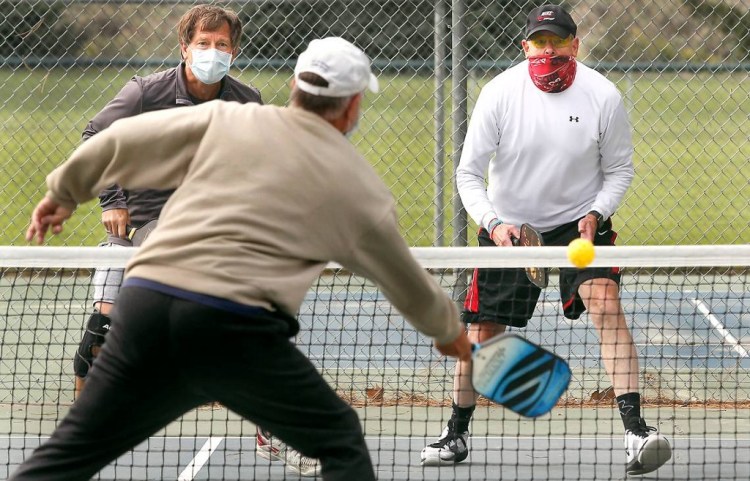
Grassroots groups also started swarming the challenges of Tri-Cities: As health advocacy became a need, we saw the Flatten the Curve Tri-Cities Facebook group spring up to fill the gap. As Non-Profits struggled, the All In Tri-Cities Facebook group started raising money. Other individuals in the community are hoping to put together further action, including Adam Avenir lobbying for additional stimulus targeting small businesses and Dave Fritch forming a nascent coalition to assist small businesses — starting with renegotiating their commercial leases.
If you’ve seen more helpers in action here in Tri-Cities trying to preserve the culture or commerce in Tri-Cities, please tell me in the comments below!
While we tried our best to track and connect with each movement, the Prosperity council itself has been on the lookout to find gaps to fill with our limited resources. One area we identified was how organizations were checking in with their constituents. We not only wanted more of a pulse on the 8,000 businesses around Tri-Cities, but we also wanted a higher-resolution view and as much of an avenue toward actionable insights as we could achieve. This was an area where my background in technology could become a vital catalyst.
ReboundAI
I was able to obtain 679 survey responses from a local economic development group. Given a total of 8,000 businesses in the region, this sample would evaluate to about a 4% margin of error and a 95% confidence level. Using Microsoft’s Azure Cognitive Services, I was able to bring together cutting-edge cloud technology on my humble spreadsheet, yielding intriguing results.
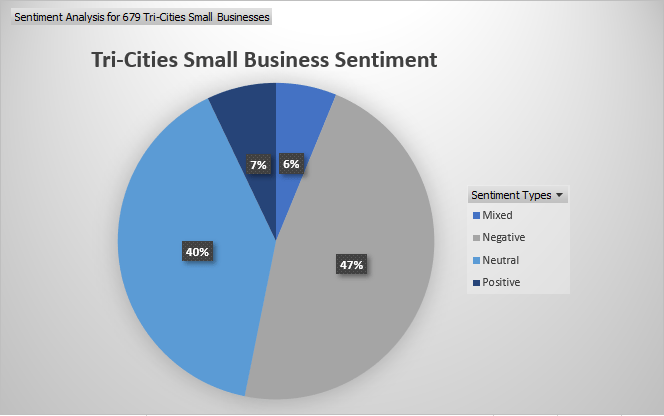
Step one was a basic sentiment analysis — categorizing responses as positive, negative, neutral, or mixed — based on the connotation of words in their response. This revealed an unsurprisingly overwhelmingly negative outlook amongst the business community. While not useful in isolation, we believe that repeating this analysis over time with many surveys, tracking the delta of sentiment, will give an indicator around when the “mood” of business in Tri-Cities rebounds. We speculate an uplift in sentiment will arrive much sooner than any report on revenue or sales, enabling us to predict recovery and create a sense of undeniable hope for the region.
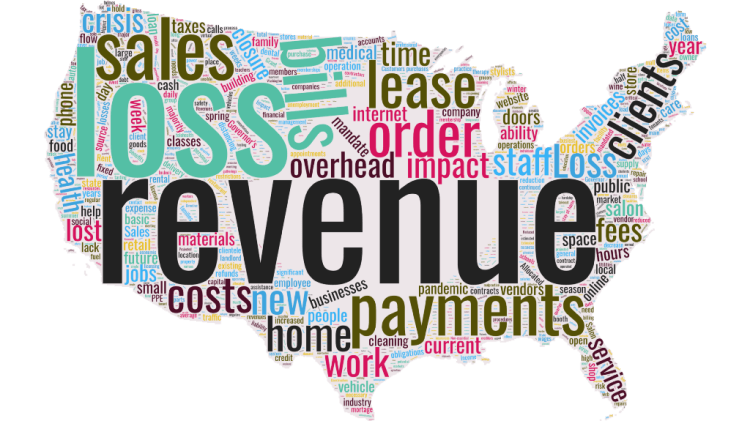
To dive deeper, we started pulling apart the data with key phrase analysis. This extracts the semantically substantive phrases in a document, enabling one to understand the meaningful contents. Based on these phrases, actions like building workshops and resources to address a topic could be made (such as doing a class on payments with uncertain cashflow), plus quantitative arguments for actions in the community (like addressing commercial leases given it’s so much on the mind of business owners).
Given these core capabilities, we are working on making deeper correlations — such as splitting the phrases based on sentiment such that we could tell you what topics are relevant to the hardest-hit businesses. Through engagement with the community and further evolution of the technology, I believe we can discover key insights that allow for real-time economic evaluation in our region. If you have data you would consider sharing to help with gauging the mood of business in Eastern Washington, please post a comment or find me on LinkedIn.
To further share this work with the world, I have open-sourced the code on GitHub under the name “ReboundAI”. The tool is built on Microsoft technology’s AI technology and currently handles universal comma-separated value (CSV) file formats. Any services able to make a CSV (Google Forms, SurveyMonkey, etc) can have its data processed by ReboundAI. Thanks to Microsoft’s generosity, any community in the world can process sentiment for up to 5,000 businesses a month at zero cost.
Conclusion
This moment has many reasons to fear for our health, our income, and our country. Despite the prevailing gloom and the odds that things may still get worse before they get better, today I am optimistic. In my city, I see unstoppable forces helping lift the spirits of the people and sales of local businesses. If we can all find a way to keep holding on a little longer, we’ll see the day where our community rebounds into a “new normal” and under every mask will be a confident smile that the worst is behind and a bright future is ahead.

Erik Ralston is an innovator with 13 years of experience, 5 years in leadership at the fastest growing tech company in Australia, a BS in Computer Science from Washington State University, and too many ventures to mention in one biography. Erik is also co-founder of Fuse Accelerator in Tri-Cities, WA where he works on connecting people and sharing knowledge to turn new ideas into growing startups. You can find him on LinkedIn, Twitter, or the next Fuse event — once Benton county hits its milestones for Phase 2
Don’t forget to give us your ? !



ReboundAI: Measuring Economic Mood at Scale was originally published in Becoming Human: Artificial Intelligence Magazine on Medium, where people are continuing the conversation by highlighting and responding to this story.
 365 Data Science