
You’ll never get confused about Type-I and Type-II errors again !

A lot of us get confused about Type-I and Type-II errors. I genuinely hope that this blog will end the confusion for once and for all.
Before diving into the details, let’s define what is ground truth. As the name suggests, Ground Truth is basically the actual value of some information that we may or may not know. For example, let’s think about the volume of water that exist in our planet. The information is unknown to us , but if proper investigation and research was done, we might be able to figure out the exact amount of water present. That is the ground truth.

Let’s take an example of a lie detector machine. In an ideal world, when someone lies, the lie detector goes buzzing and if they speak the truth then there’s no reaction. But there can be two other cases, the lie detector don’t buzz when someone lies and it starts buzzing even when someone speaks the truth.
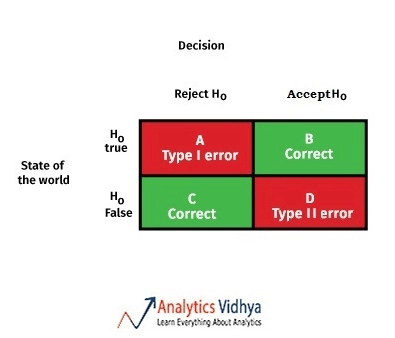
Now we can dive into Type-I and Type-II errors, often mentioned as false positives and false negatives. Let’s take the previous example. The two other cases I mentioned earlier are nothing but Type-I and Type-II errors. When the lie detector buzz when someone speaks the truth, that’s a false positive or Type-I error. And when it doesn’t buzz even when someone lies, that’s a false negative or Type-II error.
Trending AI Articles:
1. How to automatically deskew (straighten) a text image using OpenCV
3. 5 Best Artificial Intelligence Online Courses for Beginners in 2020
4. A Non Mathematical guide to the mathematics behind Machine Learning
Try understanding this analogy clearly and apply it to different scenarios to assess whether you completely understand it or not. Repeat the process with different arbitrary situations and that you’ll never get confused again. That’s how it became clear to me, try it yourself.
Thanks for reading so far. Leave a feedback if you found this useful 🙂
Don’t forget to give us your ? !




You’ll never get confused about Type-I and Type-II errors again ! was originally published in Becoming Human: Artificial Intelligence Magazine on Medium, where people are continuing the conversation by highlighting and responding to this story.
 365 Data Science