
Cellular Automata Applications and Acceleration
For people with passing familiarity with the idea of cellular automata (CA), the first thing that comes to mind is probably John Horton Conway’s Game of Life. After Martin Gardner described Conway’s Game of Life (often abbreviated to Life, GOL, or similar) in his mathematical games column of Scientific American in 1970, the game developed into its own niche, attracting formal research and casual tinkering alike. With a significant population of dedicated hobbyists as well as researchers, it wasn’t long before people discovered and invented all sorts of dynamic machines implemented in the GOL. These can be quite complicated and include universal computers, some that can self-replicate. Other famous CA include Stephen Woflram’s Rule 110, proven to be Turing complete, capable of universal computation by Matthew Cook in 1998.
While Conway’s GOL is the most famous set of CA rules, the concept seems to have origins in conversations between John Von Neumann and Stanislaw Ulam in the 1940s when they both worked at Los Alamos National Laboratory. This eventually yielded a 29-state CA system which laid the foundations for Von Neumann’s universal constructor, a machine that operates in Neumann’s CA world and can make identical copies of itself.

What Are Cellular Automata?
Cellular automata can be generally described as a collection of cells, each with a state or states that change according to some rules based on each cell’s local context. Although cells are often arranged in rectangular 2D grids, the arrangement can be arbitrary, and while states are most often discrete, rules and states can also be continuously valued and even differentiable (more on that later). Many of the most interesting CA universes bear a striking resemblance to physical phenomena such as growth, diffusion, and flow, and CA have been described as the computer scientist’s discretized version of the physicist’s concept of fields. They are often used as the basis for physics models, and at least one prominent researcher thinks the resemblance is more than superficial.
Tiny Universes: Simulating Physics and Building Machines in Cellular Automata
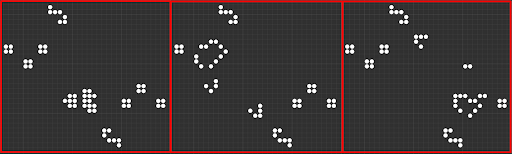
A glider generating pattern known as a Simkin glider gun. Here two “fish hooks,” stable patterns that destroy incident cells, consume the gliders before they travel to the edge of the grid. This example was simulated in Golly.
Trending AI Articles:
1. How to automatically deskew (straighten) a text image using OpenCV
3. 5 Best Artificial Intelligence Online Courses for Beginners in 2020
4. A Non Mathematical guide to the mathematics behind Machine Learning
There has been significant research enthusiasm for CA beginning in the 1960s, and the field has seen steady growth in the number of papers published each year. They’ve been used to model everything from chemical reactions and diffusion, to turbulence, to epidemiology, and they are a cornerstone of fundamental complexity research. Given the visual similarity to a wide range of natural phenomena (remember, GOL rules were developed specifically to mimic life-like characteristics of growth and self-organization), it’s not surprising that CA have found so many applications in modeling and simulation. As mentioned above, cellular automata rules can often result in systems capable of universal computation, i.e. they can compute any algorithm that can be programmed. This holds true for the exceedingly simple 1D Rule 110 all the way up to the comparatively complicated 29-state Von Neumann system.
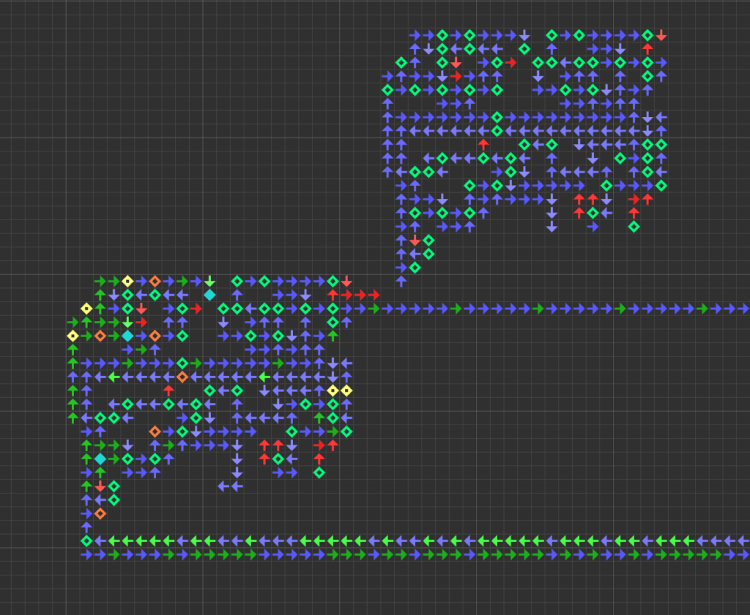
A small self-replicating constructor in Von Neumann’s CA universe. The constructor has built a copy of itself and is now copying the instruction sequence (the mostly blue line of arrows trailing off to the right) for the new machine. This example was simulated in Golly.
We’ve also seen both Turing complete computers and self-replicating universal constructors implemented in CA universes. Somewhat counterintuitively, Turing completeness is surprisingly easy to stumble upon by accident when building any system of sufficient complexity. However, we want to build not only computational systems but intelligent ones as well. We know they can compute, but can they learn?
Cellular Automata That Learn
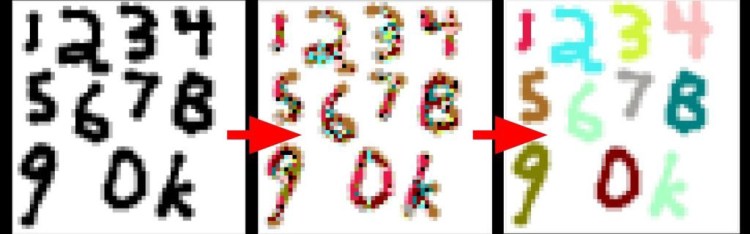
The interactive machine learning journal Distill.pub has a nascent research thread: “differentiable self-organizing systems.” They’ve only published two articles in this thread so far: a demonstration of self-generating and self-repairing graphical sprites, and self-classifying MNIST digits. Both articles are built around interactive visualizations and demonstrations with code, which is well worth a look for machine learning and cellular automata enthusiasts alike.
In the MNIST article, repeated application of CA rules eventually cause the cells to settle on a consensus classification (designated by color) for a given starting digit. Applying n updates to an image according to a set of CA rules is not altogether dissimilar to feeding that same image through an n-layer convolutional network, and so it is not surprising that one can use CA to solve a classic conv-net demo problem. In fact, as we’ll see later, CA rules can be implemented effectively as convolutions which means we can take advantage of the substantial development efforts in software, hardware, and systems for deep learning.
CA can do a lot more than “just” simulate physics, however the nature of CA computation doesn’t lend itself to conventional, serial computation on Von Neumann style architectures. To get good performance high-throughput parallelism is required. Luckily, while bespoke, single-purpose accelerators may offer some benefits, we don’t need to develop new accelerators from scratch. We can use many of the same software and hardware tools used to accelerate deep learning to get similar speedups with cellular automata universes.
Must Go Faster: Accelerating Cellular Automata
It’s useful to keep in mind that Von Neumann developed his 29-state CA using pen and paper, while Conway developed the 2-state GOL by playing with the stones and grid on a Go board. While it would probably be comparatively simple to use a computational search to discover new rules that satisfy the growth-like characteristics Conway was going for in Life, the simple tools used by Neumann and Conway in their work on cellular automata are a nice reminder that Moore’s law is not responsible for every inch of progress.
CA systems, like neural networks, are not particularly well-suited to implementation on typical general purpose computers. These tend to be based on the Von Neumann architecture (although multiple cores and cache memory do stretch the original concept), compute instructions sequentially, and emphasize low latency over parallelism. A cellular automaton universe, on the other hand, is inherently parallel and often massively so. Each individual cell must make identical computations based only on its local context.
The utility of CA systems led to several projects for dedicated CA processors, much like modern interest in deep learning has motivated the development of numerous neural coprocessors and dedicated accelerators. The specialized computers are sometimes called cellular automata machines (CAMs ). In the 1980s and 1990s CAMs were likely to be custom-designed for specific, often one-off purposes. The CAM-brain was an attempt to build a system using a Field Programmable Gate Array (FPGA) to evolve CA structures in order to simulate neurons and neural circuits. Systolic arrays, basically a mosaic of small processors that transform and transport data from and to one another, would seem to be an ideal substrate for implementing CA and indeed there have been several projects (including Google’s TPU) to take this approach. Systolic arrays sidestep one of the most often overlooked hurdles in high-performance computing, that of communications bottlenecks (the motivation behind Nvidia’s NVLink for multi-GPU systems and AMD’s Infinity Fabric.
Notable Projects for Building CA Acceleration Hardware
There have also been algorithmic speed-ups for the most popular CA rules: Hashlife, developed by Bill Gosper in the 1980s, uses memorization to speed up CA computations by remembering previously seen patterns. Just like special purpose accelerators for deep learning (e.g. Graphcore’s IPU or Cerebras’ massive wafer-scale accelerator), single-purpose accelerators for CA computations trade flexibility for speed.
Notable projects for building CA acceleration hardware include the cellular automata machine (CAM) by Norman Margolus and Tommasso Toffoli, which underwent several iterations in the 1980s. The first CAM prototype, described in 1984, could update a grid of 256 by 256 cells at a rate of 60 frames per second, in other words computing nearly 4 million updates a second. This was about a thousand times faster than execution on a comparable general purpose computer at the time. The speed-up was largely accomplished by mapping CA rules to memory and scanning over the grid rather than genuine parallelization. For comparison, the GPU PyTorch implementation in the next section updates more than 128 million cells each second on a personal workstation.
The supercomputer company Thinking Machines also devoted substantial efforts to building a massively parallel architecture for scientific computing. The so-called Connection Machine line of supercomputers were built with thousands of parallel processors arranged in a fashion akin to CA, but they were hardly the sort of computer one might purchase on a whim. The CA-based architecture made Connection Machines well-suited for many challenging scientific computing problems, but the company filed for bankruptcy in 1994.
Another project specifically for simulating neuronal circuits in CA (with the goal of efficiently controlling a robotic cat) was the CAM-brain project spearheaded by Hugo De Garis. The project went on for nearly a decade, building various prototype CA machines amenable to genetic programming and implemented in FPGAs, a sort of programmable hardware. While the project never got as far as their stated goal of controlling a robotic pet, they did develop a spiking neural model called CoDI and published a suite of preliminary experiments in 2001.
Hardware & Software Developments in Deep Learning
The examples mentioned so far have been pretty exotic. Not every researcher is ready to park a room-sized supercomputer in their office, and hard-wired solutions like application-specific integrated circuits (ASICs) are likely to be too static and inflexible for open-ended research. Luckily, as we’ve seen in the work on learning CA published in Distill, we can take advantage of the substantial hardware and software development efforts dedicated to deep learning. Luckily the deep learning tech stack is essentially interchangeable with research and development with cellular automata.
For flexible applications and exploratory development, CA implementations can take advantage of more general purpose GPUs and multicore CPUs for a significant speedup. We’ll investigate a simple demonstration of speeding up a CA system using the deep learning library PyTorch in the final section of this article.
Speeding up Life with PyTorch
In this simple benchmark we implement Conway’s Game of Life using convolution primitives in PyTorch. We’ll compare the PyTorch implementation on both GPU and CPU devices to a naïve loop-based implementation.
The PyTorch update function defaults to running a single step on the CPU, but these options can be specified by the user:
def gol_step(grid, n=1, device=”cpu”):
if torch.cuda.is_available():
device = device
else:
device = “cpu”
my_kernel = torch.tensor([[1,1,1], [1,0,1], [1,1,,1]])
my_kernel = my_kernel.unsqueeze(0).unsqueeze(0).float().to(device)
old_grid = grid.float().to(device)
while n > 0:
temp_grid = F.conv2d(old_grid, my_kernel, padding=1)#[:,:,1:-1,1:-1]
new_grid = torch.zeros_like(old_grid)
new_grid[temp_grid == 3] = 1
new_grid[old_grid*temp_grid == 2] = 1
old_grid = new_grid.clone()
n -= 1
return new_grid.to(“cpu”)
The naïve implementation scans through the grid using two loops, and it’s the sort of exercise you might implement as a simple “Hello World” when learning a new language. Unsurprisingly, it is very slow.
def gol_loop(grid, n=1):
old_grid = grid.squeeze().int()
dim_x, dim_y = old_grid.shape
my_kernel = torch.tensor([[1,1,1], [1,0,1], [1,1,1]]).int()
while n > 0:
new_grid = torch.zeros_like(old_grid)
temp_grid = torch.zeros_like(old_grid)
for xx in range(dim_x):
for yy in range(dim_y):
temp_sum = 0
y_stop = 3 if yy < (dim_y-1) else -1
x_stop = 3 if xx < (dim_x-1) else -1
temp_sum = torch.sum(my_kernel[\
1*(not(xx>0)):x_stop,\
1*(not(yy>0)):y_stop] \
* old_grid[\
max(0, xx-1):min(dim_x, xx+2),\
max(0, yy-1):min(dim_y, yy+2)])
temp_grid[xx,yy] = temp_sum
new_grid[temp_grid == 3] = 1
new_grid[old_grid*temp_grid == 2] = 1
old_grid = new_grid.clone()
n -= 1
return new_grid
A simple benchmark script iterates GOL updates ranging from 1 to 6000 steps, but you should feel free to write your own benchmarks script to compare the implementations on your own machine. Also note that I chose a grid size of 256 by 256 to match the 1984 CAM demo, but additional speedup is to be expected with larger grids.
import numpy as np
import time
import torch
import torch.nn as nn
import torch.nn.functional as F
for num_steps in [1, 6, 60, 600, 6000]:
grid = 1.0 * (torch.rand(1,1,64,64) > 0.50)
# naive implementation
if num_steps < 601:
t0 = time.time()
grid = gol_loop(grid, n=num_steps)
t1 = time.time()
print(“time for {} gol_loop steps = {:.2e}”.format(num_steps, t1-t0))
grid = 1.0 * (torch.rand(1,1,256,256) > 0.50)
# implementation with PyTorch (CPU)
t2 = time.time()
grid = gol_step(grid, n=num_steps)
t3 = time.time()
print(“time for {} gol steps = {:.2e}”.format(num_steps, t3-t2))
if num_steps < 601:
print(“loop/pt = {:.4e}”.format((t1-t0) / (t3-t2)))
grid = 1.0 * (torch.rand(1,1,256,256) > 0.50)
# implementation with PyTorch (GPU)
t4 = time.time()
grid = gol_step(grid, n=num_steps, device=”cuda”)
t5 = time.time()
print(“time for {} gol steps = {:.2e}”.format(num_steps, t5-t4))
if num_steps < 601:
print(“loop/pt = {:.4e}, loop/gpupt = {:.4e} pt/gpupt = {:.4e}”\
.format((t1-t0) / (t3-t2), (t1-t0) / (t5-t4), (t3-t2) / (t5-t4) ))
else:
print(“pt/gpupt = {:.4e}”.format((t3-t2) / (t5-t4) ))
Don’t forget to give us your ? !




Universes that Learn: Cellular Automata Applications and Acceleration was originally published in Becoming Human: Artificial Intelligence Magazine on Medium, where people are continuing the conversation by highlighting and responding to this story.
 365 Data Science