
How AI / ML is pioneering a new wave of innovation in the sales org

Digital transformation is accelerating across companies and data has become the number one asset as teams look for competitive advantages, growth avenues, or cost-cutting opportunities. This is permeating throughout organizations and impacting how leaders manage business units and prioritize strategic initiatives, buying decisions, and human capital. Coinciding with this growing data-driven mentality is the adoption of artificial intelligence, which is enabling software applications to learn from, act on, and disseminate information created by businesses’ customers and employees. The combination of these two trends are key drivers in implementing and adopting intelligent software — data provides the fuel and the machine intelligence provide the outsized value. As a result, teams are leveraging these solutions to augment their capabilities, leading to better outcomes and rapid growth ??
These intelligent products have historically been categorized / built for technical data science and development roles, but in the past several years, we have seen a democratization of these tools to more business-centric departments, particularly sales organizations. Sales has long been talked about as one of the most relevant roles that could benefit from AI / Automation given the manual, data-oriented nature of the job. Sales reps have been burdened with prospecting leads in ZoomInfo, transcribing spreadsheet information manually into their system of record, leveraging Outreach to customize follow-ups and scheduling, and building out pipeline / forecast approximating with non-functional software (excel) — all leading to the majority of their time not actually focused on selling. Sales managers have been left to guess the likelihood of revenue targets being met, where to best allocate their time, or how to best align their respective teams.

As organizations generate increasing amounts of data, sales teams are beginning to see the benefits of being able to aggregate, govern and leverage this information for insights into both past and future sales efforts, helping them better understand customer needs and their own strengths and weaknesses. A large part of this can be attributed to the integration of intelligent sales technologies into critical workflows across the entire selling process, increasing efficiency and ultimately, allowing members to spend more time on selling. Sales reps are able to better understand when and how to best communicate with customers, learn in real-time what to say to increase the likelihood of closing prospects, and access relevant information to equip them with the right tools for the entire customer journey. Sales managers now have the opportunity to repeatedly build sales pipelines and forecast team’s deals, monitor rep performance and areas of improvement, and optimize sales playbooks to coach with data rather than emotion.
Trending AI Articles:
1. How to automatically deskew (straighten) a text image using OpenCV
3. 5 Best Artificial Intelligence Online Courses for Beginners in 2020
4. A Non Mathematical guide to the mathematics behind Machine Learning
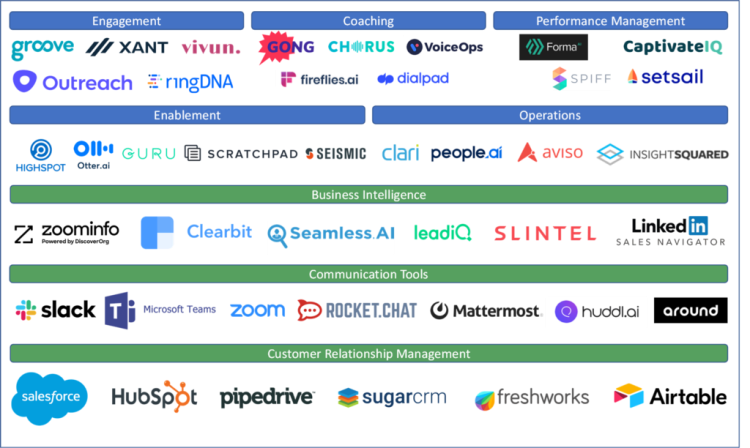
As a result, we are starting to see a new set of tools — the Intelligent Sales Stack — used by sales teams to acquire and retain customers as well as manage forecasts and commissions. Each layer in the stack is dependent on the other and all require deep integration to maximize the ability to understand customer preferences, sentiment, and actions. This is not an entirely new category — the CRM is still the single source of truth for customer interactions. However, this category has emerged as teams become more data-driven and look to segment the selling process into several disparate key actions.
Key Tailwinds Driving Sales Innovation
1) Explosion of SaaS Applications ???
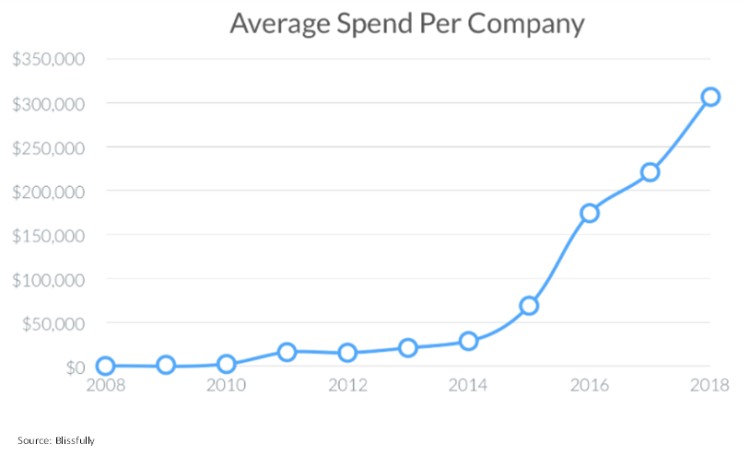
One of the biggest trends we’ve seen over the past few years has been the number of software applications available to knowledge workers. Through the combination of a shift from on-premise to cloud and decreasing barriers to entry, it has never been easier, quicker, or cheaper to create and launch a SaaS product. Because of the ubiquity of these applications, organizations can buy products for very niche aspects of their business. Rather than choose a specific platform that covers all essential functions, teams are now moving towards a best-of-breed model to uniquely address and augment every aspect of their respective function.
2) Democratization of Buying Power ???
As mentioned in past posts, there has been a shift in the buying power at most organizations from the CIO level down to the individual end user, where employees are able to sample, test, and discover which applications are best suited for their specific needs. In turn, CIOs now advise and empower business units rather than drive purchasing decisions. This has been driven partly by the abundance of applications mentioned above. However, a primary driver of this shift is that SaaS offerings enable a frictionless, affordable, product-led GTM strategy. This strategy significantly decreases the cost of ownership for these products, allowing users to easily switch from one to the other without having to get executive approval. Given the multi-faceted job of sales reps, this provides them with the ability to potentially have a unique application for evert aspect of their job, regardless of its relevance to other functions or even other sales reps!

3) Increased Reliance on Data ?
Like almost every other sector of business, sales organizations are embracing data. This increased reliance on data is driven from a rising level of trust in these software applications, the growing amount of data from general cloud adoption, and the continued benefits of data network effects. Sales organizations are charting a clear path forward by using data to identify and target the strongest industries, geographies, and accounts and to analyze and improve performance. According to the LinkedIn State of Sales Report, more than half of respondents say their companies are using data to assess the performance of salespeople and drive decisions across the sales org.

Drivers of Value
1) Dissemination of Best Practices
Training and ramping new sales hires costs money and takes time away from managers. Firing underperforming reps costs even more time and money while putting the company at a disadvantage by not operating at full capacity. By leveraging various intelligent sales tools like Gong and Otter, teams are able to record and analyze conversations with customers, capturing relevant and important data points from certain individuals that can be used to their advantage. For example, the actions of top performers can be taken and disseminated across the sales team to advocate best practices, teach new hires the proper tactics, and develop a playbook that gives reps an easy and understandable way to succeed. Additionally, sales engagement tools like Outreach not only give reps relevant and timely information, but also nudge them to act at times most critical to closing prospects. These solutions provide reps with information that spur best practices and allow new hires to ramp faster and more effectively.
2) Personalization is Expected not Rewarded
The consumerization of the enterprise is pushing customer expectations to all-time highs, and sales organizations are constantly trying to keep up. Enterprise prospects expect a personalized, consumer-like experience that reflects a deep understanding of their interests, problems, and future needs. As a result, teams are turning to more data-centric sales approaches, primarily driven by AI / ML, to promote cross-functional collaboration, surface and understand all relevant information, and coach them to be most effective. Intelligent software solutions provide behavioral, sales and profile data that can help deepen customer relationships, thus providing a better experience overall for customers and increasing their propensity to buy
3) Break Down Information Barriers
For these solutions to leverage intelligent applications or, at the very least, enable them, they need access to customer data generated from touchpoints across all customer-facing departments — marketing, sales, product, support, and customer success. However, as companies digitally transform, many times these organizations create unwanted data silos in each department that act as bottlenecks from getting the wholistic picture of the customer or opportunity. Fortunately, the emergence of sales enablement and revenue operations tools like Salesloft and Clari act as intermediaries or system connectors that allow various niche applications to speak to one another. They enable teams to communicate and, importantly, align across goals and timing, while automating various manual sales workflows in the process.
4) Realignment of Priorities / Focus Areas — Deeper not Wider
In the same way we’re seeing the rise of new roles including revenue operations, we’re also seeing a rise of new tools that take a narrow focus within the sales workflow. Part of this can be attributed to barriers of building software being lower than ever before, but it is mainly due to a shift from platform to best of breed mentioned earlier. Previously, teams were handicapped to a solution like Salesforce that was the central source of information, where automated workflows could be triggered in-app only. Now, because of enhanced API integrations and disparate workflow automation platforms like Tray.io or Workato, teams are able to turn to a best of breed approach where solutions are more customizable, flexible, and specific to a certain action without worrying about data quality or breadth of automations. Subsequently, knowledge workers are enabled to have a more quantifiable impact on their specific responsibilities without sacrificing information quality or productivity gains.
Sales involves a mix of creativity, hustle, and strategy — all areas that require human intelligence. However, as more companies digitally transform and vast amounts of relevant data are created daily, there becomes an obvious need for AI — primarily to better understand your end customer, know how to efficiently manage and identify prospects, and for more precise forecasting sales for upcoming quarters. We are seeing the continued adoption of AI / ML products in the sales department, a trend that we believe will only continue as teams realize the productivity gains and data network effects that come from relying on an Intelligent solution.
For a more in-depth overview of each category within the technology stack, view the full post here

Don’t forget to give us your ? !




The New Intelligent Sales Stack was originally published in Becoming Human: Artificial Intelligence Magazine on Medium, where people are continuing the conversation by highlighting and responding to this story.
Via https://becominghuman.ai/the-new-intelligent-sales-stack-7c7075a59c36?source=rss—-5e5bef33608a—4
source https://365datascience.weebly.com/the-best-data-science-blog-2020/the-new-intelligent-sales-stack
 365 Data Science