

It’s Monday afternoon in the office. An email pops up in my Gmail from an international student organization. They’re asking me to give a keynote lecture about “innovation in technology.” Referred by the Israeli Embassy? Well, there’s nothing I enjoy more than representing the motherland — I press reply all:
“I am in.”
In my last couple of years as the CEO of Spartans and Jenna.ai, I’ve done dozens of these tech keynotes. But their broad topic — innovation in technology — makes things a bit more difficult. Is it worth it to do the normal AI spiel?
Buzzwords and trends come and go in the tech world. Years ago it was Big Data, and then Chatbots & Blockchain, and now it’s AI all around. Quantum Computing is getting warmer.
That’s great, but…
What would a hungry-to-learn crowd of future tech entrepreneurs find actually interesting? That’s the question I asked myself when I started trying to build presentations. I abandoned a few before I settled, finally, on one topic.
Augmented Intelligence.

The Basics
“Augmented Intelligence,” “Intelligence Amplification,” or “Enhanced Intelligence.” Even if you haven’t heard these terms before, you’ve probably used the tech. They all mean the same thing: the empowerment of human intelligence using technology. It’s a broad field, and it’s growing fast.
According to Wikipedia, early computer pioneers first proposed the idea in the 1950s and 1960s. That’s quite a long time ago — so why this renaissance all the sudden?
Simple answer: Artificial Intelligence failed to deliver.
Now, hold your horses and put down your burning torches ??. AI is amazing, and it can be a great tool. Without it, some companies wouldn’t exist at all. Here’s a personal anecdote. In the last almost 4 years, we at Spartans have worked with AI on a daily basis. Trust me, I know all about it.
But we can’t forget that AI has its limitations. Sometimes, it just can’t replace brick-and-mortar human operation. AI gets a lot of hype, and it might not meet your expectations. There’s nothing worse than the mismatch between the need and tech.
So, what has Augmented Intelligence got to do with it?
Trending AI Articles:
1. How to automatically deskew (straighten) a text image using OpenCV
3. 5 Best Artificial Intelligence Online Courses for Beginners in 2020
4. A Non Mathematical guide to the mathematics behind Machine Learning
Augmented Intelligence vs Artificial Intelligence

What is AI, anyway? Let’s start with the obvious. When we refer to Artificial Intelligence, we refer to a ton of capabilities. In a nutshell, AI’s intention is to replace a certain function human are currently doing. Fields like Machine Learning, Computer Vision, Deep Learning, and others all use AI.
What is Augmented Intelligence, and how is it different? Augmented Intelligence references an approach, rather than a specific mode of tech. It enriches human capabilities and supports the process of decision making or action. Augmented Intelligence isn’t here to replace the human factor, but enhance it.
But, let’s be a bit more precise, shall we?
Human and Machine by Definition
Augmented Intelligence is the design pattern for a human-centred partnership. People and AI work together to enhance human cognitive performance. This means AI can help us with learning, decision making, and new experiences.
So yes, Augmented Intelligence is a reference to AI, but specifically human-centric AI. Augmentation is growing to be the most popular type of AI implementation. Don’t believe me? You don’t have to. Just check out this chart.
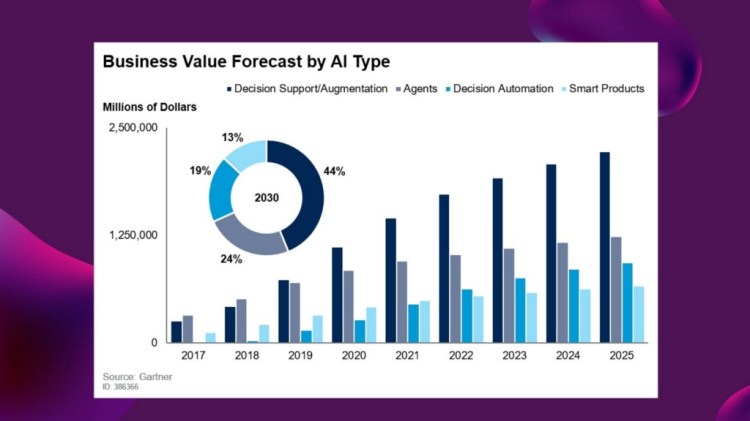
So yes, the modern reference to Augmented Intelligence is a reference to AI but human-centric AI. This type of AI that is in some cases referred simply as Augmentation will be the most popular type of AI implementation. Don’t believe me? you don’t have to — check the chart above.
So that’s it? well not exactly.
When referring to the product/implementation cycle, we see some difference in the flow of work to support the approach…
Pipeline in Augmented Intelligence
The Augmented Intelligence pipeline is built specifically to support humans. It’s designed to “enjoy” and learn from its feedback from humans.

We have 3 main actors in this process:
- Historical and new data
- The human factor
- Artificial Intelligence
The symbiosis begins with the AI’s initial training. We feed the AI structured and unstructured historical data from human operations.
The more data, the merrier.
Once the AI module becomes relatively accurate, we move to testing and deployment. Then we can take a look at the direct impact of the AI solution. How effective will it be for the team or person using it?
And here come those humans again.
The human team constantly interacts with both the data and the Augmented Intelligence. When the AI works correctly, the human team receives insights to help them work better and faster. Everyone contributes by inputting passive and active feedback into the system.
What is passive feedback? All humans need to do is use the system in their own way. When we make a decision to use, or not use, a certain recommendation, the AI knows what it needs to improve.
What is active feedback? In some systems, humans can give feedback by directly telling the AI how it’s doing. Does the AI’s score or answer make sense? How much? Even a thumbs up or thumbs down can give a lot of actionable input.
Augmented Intelligence in Real Life
Here are some common examples of Augmented Intelligence. You’ve probably used it before, even if you weren’t aware at the time — most people have.
Gmail — Fast Reply Recommendations
You might already be familiar with this example. Google launched “Smart Reply” in their Inbox app, and it became a huge success. The AI suggests email replies based on your past activity, and you can choose with just one click. This feature is fast, easy, and intuitive.
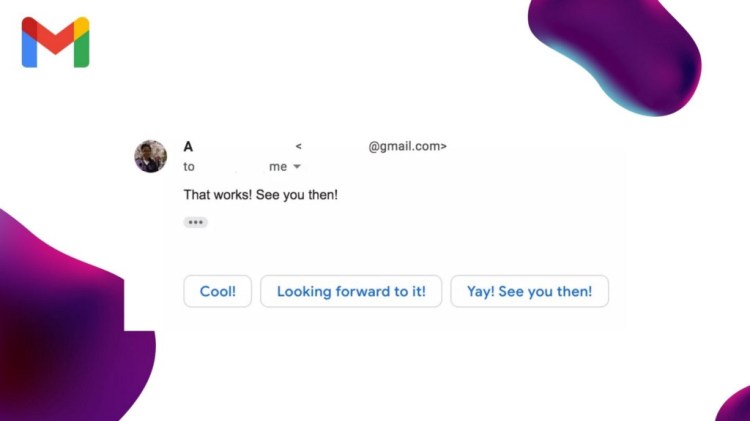
- The data — an unimaginable amount of historical emails
- The AI — Trained Neural Network
- Human — well, you
Jenna —Candidate Screening & Scoring
The second example, Jenna.ai, is one of our daughter ventures at Spartans. So yes, I am definitely biased, but that doesn’t mean it’s not a great system.
The platform interacts textually or vocally by using NLP/U with potential job candidates. It gathers the relevant information about each one and then predicts if they’re a good fit. Jenna also conducts fully autonomous decisions to filter irrelevant candidates.
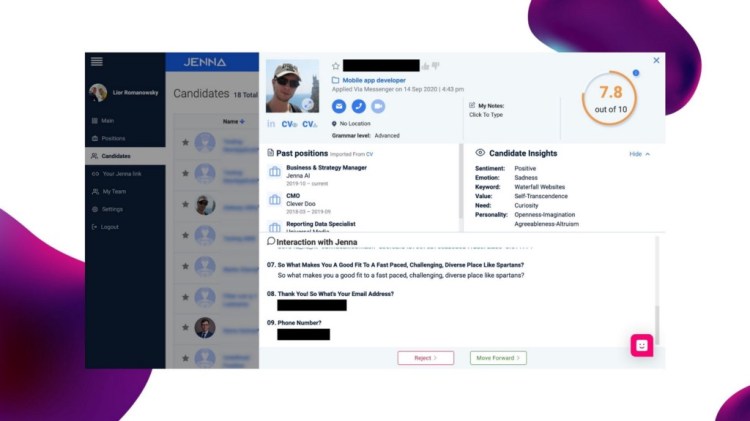
Jenna provides the human staff with ML-based insights and data. It gives them the tools to make the decision or action that is best for the company. With a simple thumbs up and thumbs down, recruiters can give Jenna feedback on what to improve.
- The data: Pre-gen berated data set + newly generated data loop
- The AI: Series of ML modules and NLP/U engine
- Human: The recruiter team and the relevant candidates
Gong — Candidate Screening & Scoring
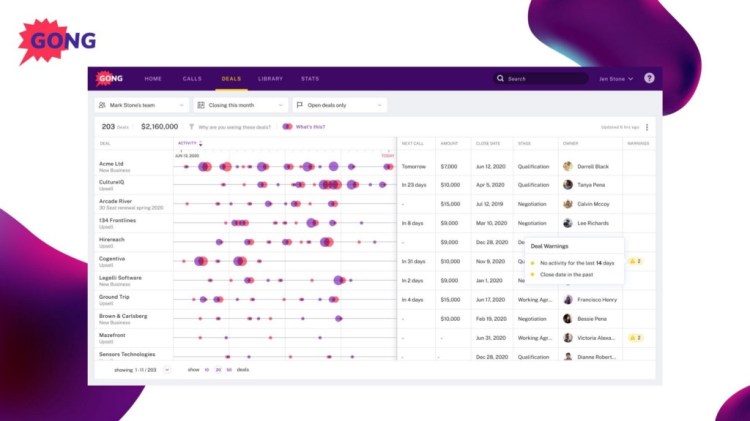
Sales intelligence platform “Gong” recently raised $200 million (show.me.the money!). The platform offers AI-driven insights for sales teams around the world with key clients such as Linkedin, Pinterest and others.
The platform provides a series of critical insights to and about the sales process with a clear goal to increase win % and ROI.
No replacement of the human sales reps (at least for now) but an ongoing human-AI relationship which includes analysis of calls and textual communication to generate actionable insights for the sales cycle.
Main takeaways
You made it to the bottom line. As promised, you deserve the TL;DR version, so here it goes:
- Augmented Intelligence is an approach and point of view, not a specific technology.
- It doesn’t want to replace humans, but help them get better at certain tasks.
- Most AI implementations today are Augmentations.
- Some examples include Gmail’s reply suggestions and Jenna.ai’s employee screening process.
- There are three components in the product chain → Data, Humans, AI
- Humans and AI working well together → Big success. I like! (Read aloud like Borat)

Augmented Intelligence, in many ways, is the healthiest way to look at our relationship with AI. It’s collaborative tech, and it doesn’t have the same unrealistic goal of simply replacing humans. We can acknowledge the strengths and weaknesses of both AI and humans, and use that to our advantage. Disruptive innovation can start right here.
The base assumption for Artificial or Augmented Intelligence is just that: Intelligence. So use it wisely.
Not too bad of a keynote is it?
Don’t forget to give us your ? !



Augmented Intelligence for Intelligent Entrepreneurs TL;DR was originally published in Becoming Human: Artificial Intelligence Magazine on Medium, where people are continuing the conversation by highlighting and responding to this story.
 365 Data Science