
PyTroch—a promising framework for DL
Read time: 3 min
This is a part my mid-term report of the course PyTorch and Machine Learning in NCCU. The original report:
https://drive.google.com/drive/u/2/folders/1Haknut4yGujlWP-QKpJnFWwRJE1xtf9Y
Outline
(1) Architecture of PyTorch & Tensorflow
(2) Performance of PyTorch & Tensorflow
(3) Popularity of PyTorch & Tensorflow
(4) Conclusion
(5) Reference

(1) Architecture of PyTorch & Tensorflow
Let’s check the architecture (or so-called anatomy) of PyTorch & Tensorflow.
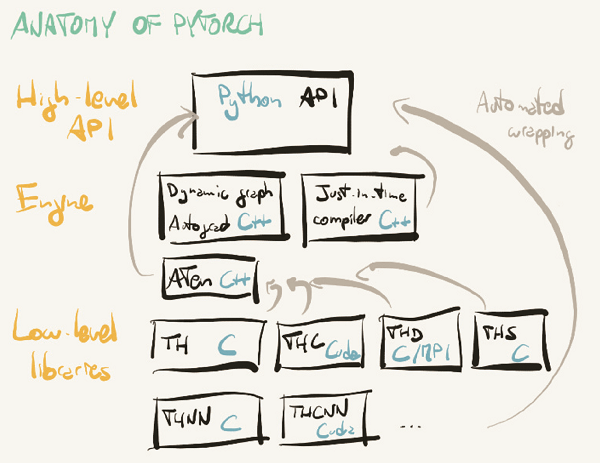
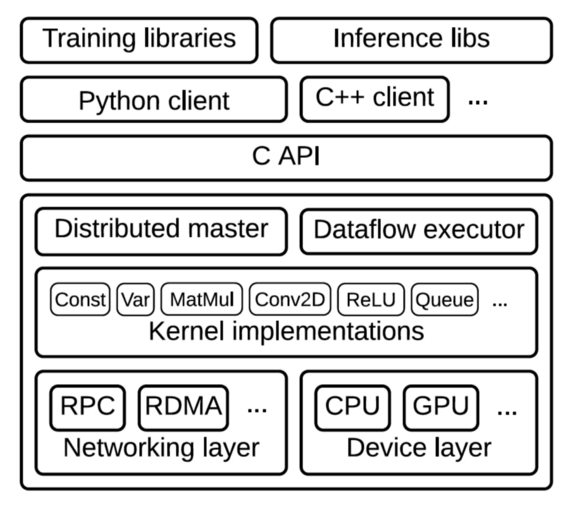
Figure 2: The layered TensorFlow architecture
The engine and low-level library of PyTorch and Tensorflow are pretty similar and they are basically built by C & C++, so theoretically they shall have similar speed. Then, Let’s shift our attention to the comparisons of PyTorch and Tensorflow in all dimensions.
Trending AI Articles:
(2) Performance of PyTorch & Tensorflow

The green cells in table 1 represent the apparent superiority. Furthermore, since we know the dynamic computation graph of PyTorch would make it more flexible and easier to debug compared to Tensorflow, some of the facts in the figure are quite easy to guess.
However, just like Python have more flexibility and debugging capabilities than C/C++, but Python loses in speed. Would PyTorch have slower speed ? Surprisingly, PyTorch’s performances equal to Tensorflow in dimensions like speed and dataset compatibility !
(3) Popularity of PyTorch & Tensorflow
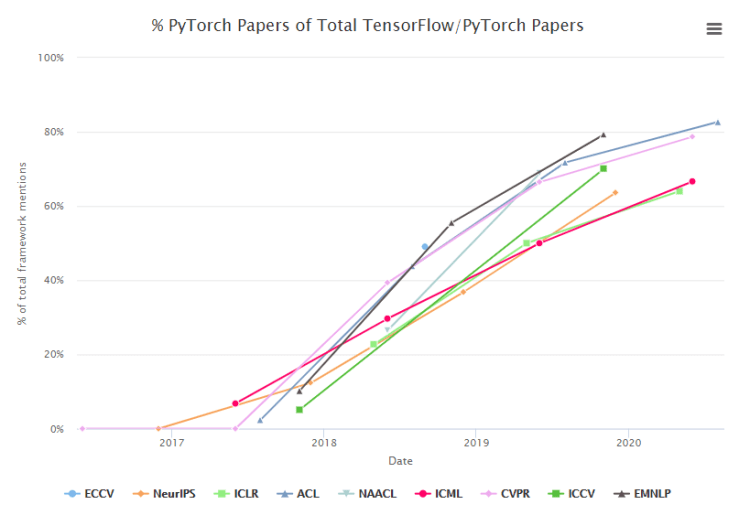
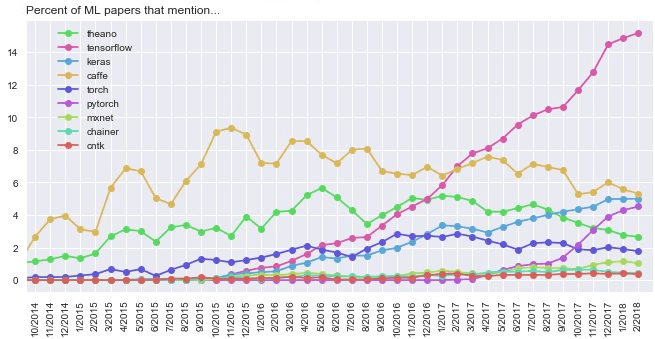
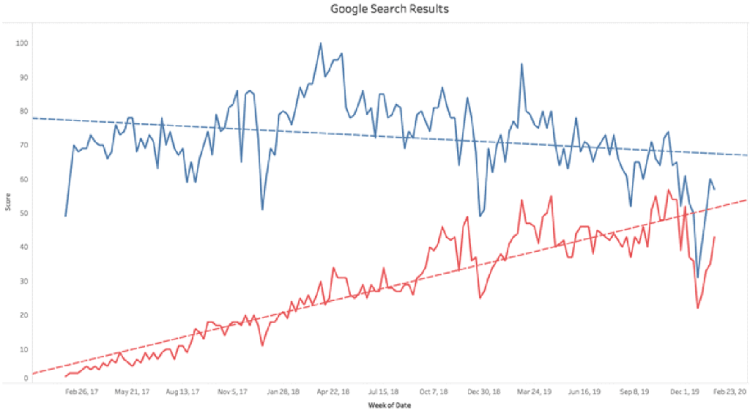
Additionally, these 3 figures above show how popular PyTorch was lately, and the growing numbers of adopting PyTroch indicating the promising future of PyTroch.
(4) Conclusion
Whether evaluating PyTorch in architecture or performance, it’s at least equal to Tensorflow. Then, from popularity we found the skyrocketing growing number of PyTorch usage. Nevertheless, the history of PyTorch is too short so there’re few resources including books, codes, and discussions about PyTorch compared to those about Tensorflow.
(5) Reference
[1] Stevens, E., Antiga, L. & Thomas, V. (2020). Deep Learning with PyTorch. New York, NY: Manning.
[2] Abadi, M. et al. (2016, November). TensorFlow: A System for Large-Scale Machine Learning. Paper presented at the 12th USENIX Symposium on Operating Systems Design and Implementation (OSDI ’16), Savannah, GA. Abstract retrieved from https://www.usenix.org/system/files/conference/osdi16/osdi16-abadi.pdf
[3] Rao, C.S.J.(2020). Your First steps in Computer Vision: Using PyTorch with an example. Retrieved from
Using Pytorch with Examples in Computer Vision
[4] He, H.(2020). PyTorch vs TensorFlow. Retrieved from https://chillee.github.io/pytorch-vs-tensorflow/
[5] Migdal, P., & Jakubanis, R. (2018). Keras or PyTorch as your first deep learning framework. Retrieved from
Keras or PyTorch as your first deep learning framework – deepsense.ai
[6] Great Learning Team (2020). PyTorch vs TensorFlow — Explained | What is the difference between PyTorch and TensorFlow?. Retrieved from
Difference between PyTorch and TensorFlow | TensorFlow vs. PyTorch
Don’t forget to give us your ? !




ML03: PyTorch vs. Tensorflow was originally published in Becoming Human: Artificial Intelligence Magazine on Medium, where people are continuing the conversation by highlighting and responding to this story.
Via https://becominghuman.ai/ml03-9de2f0dbd62d?source=rss—-5e5bef33608a—4
source https://365datascience.weebly.com/the-best-data-science-blog-2020/ml03-pytorch-vs-tensorflow
 365 Data Science