
We Cant Afford to Sell Out on AI Ethics

Today, we use AI with the expectation that it will make us better than we are — faster, more efficient, more competitive, more accurate. Businesses in nearly every industry apply artificial intelligence tools to achieve goals that we would, only a decade or two ago, derided as moonshot dreams. But even as we incorporate AI into our decision-making processes, we can never forget that even as it magnifies our capabilities, so too can it plainly show our flaws.

“Like all technologies before it, artificial intelligence will reflect the values of its creators. So inclusivity matters — from who designs it to who sits on the company boards and which ethical perspectives are included,” AI researcher Kate Crawford once wrote for the New York Times. “Otherwise, we risk constructing machine intelligence that mirrors a narrow and privileged vision of society, with it sold, familiar biases and stereotypes.”

The need for greater inclusivity and ethics-centric research in AI development is well-established — which is why it was so shocking to read about Google’s seemingly senseless firing of AI ethicist Timnit Gebru.
Big Data Jobs

For years, Gebru has been an influential voice in AI research and inclusivity. She cofounded the Black in AI affinity group and speaks as an advocate for diversity in the tech industry. In 2018, she co-wrote an oft-cited investigation into how gender bias influenced Google’s Image Search results. The team Gebru built at Google encompassed several notable researchers and was one of the most diverse working in the AI sector.

“I can’t imagine anybody else who would be safer than me.” Gebru shared in an interview with the Washington Post. “I was super visible. I’m well known in the research community, but also the regulatory space. I have a lot of grass-roots support — and this is what happened.”

So what, exactly, happened?

In November of 2020, Gebru and her team concluded a research paper that examined the potential risks inherent to large language-processing models, which can be used to discern basic meaning from text and, in some cases, create new and convincing copy.

Gebru and her team found three major areas of concern. The first was environmental; relying on large language models could lead to a significant increase of energy consumption and, by extension, our carbon footprint.

Trending AI Articles:

1. Top 5 Open-Source Machine Learning Recommender System Projects With Resources

2. Deep Learning in Self-Driving Cars

3. Generalization Technique for ML models

4. Why You Should Ditch Your In-House Training Data Tools (And Avoid Building Your Own)

The second related to unintended bias; because large language models require massive amounts of data mined from the Internet, “racist, sexist, and otherwise abusive language” could accidentally be included during the training process. Lastly, Gebru’s team pointed out that as large language models become more adept at mimicking language, they could be used to manufacture dangerously convincing misinformation online.

The paper was exhaustively cited and peer-reviewed by over thirty large-language-model experts, bias researchers, critics, and model users. So it came as a shock when Gebru’s team received instructions from HR to either retract the paper or remove the researchers’ names from the submission. Gebru addressed the feedback and asked for an explanation on why retraction was necessary. She received no response other than vague, anonymous feedback and further instructions to retract the paper. Again, Gebru addressed the feedback — but to no avail. She was informed that she had a week to rescind her work.

The back and forth was exhausting for Gebru, who had spent months struggling to improve diversity and advocate for the underrepresented at Google. (Only 1.9 percent of Google’s employee base are Black women.) To be silenced while furthering research on AI ethics and the potential consequences of bias in machine learning felt deeply ironic.

Frustrated, she sent an email detailing her experience to an internal listserv, Google Brain Women and Allies. Shortly thereafter, she was dismissed from Google for “conduct not befitting a Google Manager. Amid the fall out, Google AI head Jeff Dean claimed that the paper “didn’t meet our bar for publication” and “ignored too much relevant research” that undermined the risks she outlined — a shocking accusation, given its breadth of research.

To Gebru, Google’s reaction felt like corporate censorship.

“[Jeff’s email] talks about how our research [paper on large language models] had gaps, it was missing some literature,” she told MIT’s Technology Review. “[The email doesn’t] sound like they’re talking to people who are experts in their area. This is not peer review. This is not reviewer #2 telling you, ‘Hey, there’s this missing citation.’ This is a group of people, who we don’t know, who are high up because they’ve been at Google for a long time, who, for some unknown reason and process that I’ve never seen ever, were given the power to shut down this research.”

“You’re not going to have papers that make the company happy all the time and don’t point out problems,” Gebru concluded in another interview for Wired. “That’s antithetical to what it means to be that kind of researcher.”

We know that diversity and research is crucial to the development of truly effective and unbiased AI technologies. In this context, firing Gebru — a Black, female researcher with extensive accolades for her work in AI ethics — for doing her job is senseless. There can be no other option but to view Google’s actions as corporate censorship.

For context — in 2018, Google developed BERT, a large language model, and used it to improve its search result queries. Last year, the company made headlines by creating large-language techniques that would allow them to train a 1.6-trillion-parameter model four times as quickly as previously possible. Large language models offer a lucrative avenue of exploration for Google; having them questioned by an in-house research team could be embarrassing at best, and limiting at worst.

In an ideal world, Google would have incorporated Gebru’s research findings into its actions and sought ways to mitigate the risks she identified. Instead, they attempted to compel her to revise her document to include cherry-picked “positive” research and downplay her findings. Think about that for a moment — that kind of interference is roughly analogous to a pharmaceutical company asking researchers to fudge the statistics on a new drug’s side effects. Such intervention is not only unethical; it leads to the possibility of real harm.

Then, when that interference failed, Google leadership worked to silence and discredit Gebru. As one writer for Wired concludes, that decision proves that “however sincere a company like Google’s promises may seem — corporate-funded research can never be divorced from the realities of power, and the flows of revenue and capital.”

Gebru is an undeniably strong person, an authority in her field with a robust support network. She had the force of personality to stand her ground against Google. But what if someone who wasn’t quite as well-respected, supported, and brave stood in her position? How much valuable research could be quashed due to corporate politicking? It’s a frightening thought.

The Gebru fallout tells us in no uncertain terms that we need to give real consideration to how much editorial control tech companies should have over research, even if they employ the researchers who produce it. If left unchecked, corporate censorship could stand to usher in the worst iteration of AI: one that writs large our biases, harms the already-underserved, and dismisses fairness in favor of profit.

Don’t forget to give us your ? !


We Can’t Afford to Sell Out on AI Ethics was originally published in Becoming Human: Artificial Intelligence Magazine on Medium, where people are continuing the conversation by highlighting and responding to this story.

Via https://becominghuman.ai/we-cant-afford-to-sell-out-on-ai-ethics-fd974dc5ba53?source=rss—-5e5bef33608a—4

source https://365datascience.weebly.com/the-best-data-science-blog-2020/we-cant-afford-to-sell-out-on-ai-ethics

Data LabelingHow Auto-Driving Achieved through Machine Learning?

Data Labeling — How Auto-Driving Achieved through Machine Learning?

Supervised Deep Learning Needs Labeled Data at Scale

At present, the mainstream algorithm models of auto-driving are mainly supervised deep learning.

Supervised learning is the machine learning task of learning a function that maps an input to an output based on example input-output pairs. It infers a function from labeled training data consisting of a set of training examples.

As it is based on known variables and dependent variables to derive function relations. A large amount of structured annotated data is needed to train and tune the model.

Big Data Jobs

Labeling Types in Auto-Driving

Common annotation types in auto-driving usually include 2D bounding box, 3D cube bounding box, polygon, image segmentation, video annotation, 3D laser point cloud annotation, etc., among which image semantic segmentation is widely used.

Conceptually, image semantic segmentation is an important annotation type in computer vision. It includes image classification, target detection, image segmentation, and mainly segmentation at the pixel level.

Trending AI Articles:

1. Top 5 Open-Source Machine Learning Recommender System Projects With Resources

2. Deep Learning in Self-Driving Cars

3. Generalization Technique for ML models

4. Why You Should Ditch Your In-House Training Data Tools (And Avoid Building Your Own)

Image segmentation

The result of semantic segmentation is to transform the image into several color blocks, and each color block represents one part of the image.

These annotated segmentation images can be used to train the algorithm of automatic driving. During the driving process of the self-driving car, the images detected by the on-board camera or radar are input into the neural network system, and the well-trained algorithm model can automatically segment and classify the images, so as to avoid obstacles such as pedestrians and vehicles on the road.

Currently, in the field of semantic segmentation of auto-driving images, the commonly used annotation objects mainly are into the following categories

01. Accessible Road areas
Note: The driving zone usually refers to the area where cars can drive. When there are curbs, the driving area is the part between curbs. When curbs are not present, the asphalt or other covered area shall prevail.

02. Handrails/barrier/stone pier
Note: located on both sides of the road, mainly including railings, barriers, stone pier, and other isolators, but does not include temporary roadblocks set up because of road construction.

03. Rod (the vertical part)

Note: only the vertical part of the rod should be marked, other parts of the rod should not be marked. They usually include street signposts, street light posts, traffic light posts, etc.

04. Roadside buildings

Notes: buildings on both sides of the road, including high-rise buildings and low-level buildings, and other man-made building objects.

Data Annotation Service

ByteBridge, a human-powered data labeling tooling platform with real-time workflow management, providing high-quality data with efficiency.

Having an R&D team with rich development resources, ByteBridge can provide personalized annotation tools and services according to customer requirements.

Regarding flexibility, clients can set labeling rules, iterate data features, attributes, and task flows, scale up or down, make changes.

ByteBridge: a Human-powered Data Labeling SAAS Platform

Moreover, clients can monitor the labeling progress and get the results in real-time on the visualized dashboard.

ByteBridge: a Human-powered Data Labeling SAAS Platform

For more information, please have a look at bytebridge.io, the clear pricing is available.

Don’t forget to give us your ? !


Data Labeling — How Auto-Driving Achieved through Machine Learning? was originally published in Becoming Human: Artificial Intelligence Magazine on Medium, where people are continuing the conversation by highlighting and responding to this story.

Via https://becominghuman.ai/how-auto-driving-achieved-through-machine-learning-873c667233f1?source=rss—-5e5bef33608a—4

source https://365datascience.weebly.com/the-best-data-science-blog-2020/data-labelinghow-auto-driving-achieved-through-machine-learning

Data vault: new weaponry in your data science toolkit

Data Vault is a modern data modelling approach for capturing (historical) data in a structurally auditable and tractable way. While very helpful for data engineers, the Data Vault also enables Data Science in practice.

Originally from KDnuggets https://ift.tt/3sFtGES

source https://365datascience.weebly.com/the-best-data-science-blog-2020/data-vault-new-weaponry-in-your-data-science-toolkit

Introduction to the White-Box AI: the Concept of Interpretability

ML models interpretability can be seen as “the ability to explain or to present in understandable terms to a human.” Read this article and learn to go beyond the black box of AI, where algorithms make predictions, toward the underlying explanation remains unknown and untraceable.

Originally from KDnuggets https://ift.tt/3fH1DkT

source https://365datascience.weebly.com/the-best-data-science-blog-2020/introduction-to-the-white-box-ai-the-concept-of-interpretability

Sudoku Rules: Using a Decision Engine to Solve Candidate Pairs

Follow along with the author’s most recent installment in their quest to solve Sudoku puzzles, this time with the help of a decision engine to solve candidate pairs.

Originally from KDnuggets https://ift.tt/3cAFEdj

source https://365datascience.weebly.com/the-best-data-science-blog-2020/sudoku-rules-using-a-decision-engine-to-solve-candidate-pairs

How data labeling assist AIs application in Education?

How Data Labeling Accelerates AI Application in the Education?

Recently, AI technology has been considered as one of the important ways to change the existing education field.

The natural language processing(NLP), image recognition, OCR can be used to analyze students’ learning behavior, and customize teaching methods, according to their strengths and weaknesses, reaching one-to-one personalized teaching goals.

Looking from a bigger picture, teaching, management, and evaluation are the three main application directions for AI in education.

To be more specific, image recognition technology can liberate teachers from homework grades.

Big Data Jobs

Speech Recognition

Speech recognition technology has existed for more than 50 years. Only in recent decades speech recognition has made great progress. Now, we have various kinds of software that enable us to decode human speech. The applications cover mobile phones, smart home, virtual assistants, video games, etc.

In general, this technique has been used as an alternative to other input methods, such as typing, clicking, or selecting text. There are many Speech recognition products, such as Cortana, Google Assistant, Siri, etc.

Speech recognition can assist teachers to correct students’ English pronunciation in the oral test. Through voice interaction, AI teachers can give specialized feedback to students.

Most importantly, it is highly likely that the integration of AI technology into the education field enable educators to realize their dream of “customizing teaching methods”, thus truly improving the quality, efficiency, fairness, and other core issues of education.

Trending AI Articles:

1. Top 5 Open-Source Machine Learning Recommender System Projects With Resources

2. Deep Learning in Self-Driving Cars

3. Generalization Technique for ML models

4. Why You Should Ditch Your In-House Training Data Tools (And Avoid Building Your Own)

One Teacher VS One Student

Of course, it is not an easy thing to teach students one by one in accordance with their personalities. It requires AI support.

AI technology promises to transform education from “one teacher VS multiple students” to “one teacher VS one student”. It is important to collect various types of data at scale. Once collected, the data should be annotated with accuracy before getting the AI algorithm trained.

Data Labeling Tools:

2D boxing,3D boxing, Polygon,OCR, Image recognition,Semantic segmentation, Video annotation

Applications:

Students’ behavior recognition in class: Image recognition,2D boxing,3D boxing

Homework grade: OCR

ByteBridge: a Data Labeling SAAS Platform

Personalized learning: Speech recognition

End

ByteBridge, a human-powered data labeling tooling platform with real-time workflow management, providing flexible data training service for the machine learning industry.

On the dashboard, we support end-to-end data labeling solutions including visualizing the labeling rules, and all the processes are managed in real-time.

ByteBridge: a Data Labeling SAAS Platform

As individuals can decide when to start and end the task, the by yourself service makes it possible to engage and to take control of the labeling loop. Meanwhile, transparent pricing lets you save resources for the more important parts.

ByteBridge: a Data Labeling SAAS Platform

For more information, please have a look at bytebridge.io , the clear pricing is available.

Don’t forget to give us your ? !


How data labeling assist AI’s application in Education? was originally published in Becoming Human: Artificial Intelligence Magazine on Medium, where people are continuing the conversation by highlighting and responding to this story.

Via https://becominghuman.ai/how-data-labeling-assist-ais-application-in-education-1f8664f19987?source=rss—-5e5bef33608a—4

source https://365datascience.weebly.com/the-best-data-science-blog-2020/how-data-labeling-assist-ais-application-in-education

Machine Learning Tools for Gesture Recognition and Hand Tracking: A Comparison with Google

Machine Learning Tools for Gesture Recognition and Hand Tracking: A Comparison with Google MediaPipe

Hand tracking and gesture recognition technology represent a revolution in the way people interact with technology: virtual interactions with digital and holographic objects, touchless controls with smart displays, and remote interactions with autonomous devices are now possible.

These new ways of interacting pave the way to a wide variety of applications in industries such as entertainment, manufacturing, robotics, automotive, and healthcare.

Big Data Jobs

How to provide ready-to-run, accurate and battery-efficient hand tracking models

Clay AIR has been developing gesture recognition and hand tracking solutions since 2015, backed by ten years of R&D. Among all of the players who aim to provide a hardware-agnostic, performant, and intuitive solution, the challenge remains unchanged.

How to provide ready-to-run and accurate hand tracking models on any device while preserving the CPU consumption?

Clay AIR introduces new proprietary tools USG & KANT designed to improve accuracy, performance and training time of hand tracking models

Clay AIR hand tracking and gesture recognition technology is the articulation of our models, the proprietary tools we designed to train our models, and our technical capabilities in other interaction technology (i.e. 6DoF, SLAM, Planar Detection, Body and Face Recognition).

In this publication, we will refer to Google.AI’s paper state-of-the-art technology for real-time hand tracking: New On-Device, Real-Time Hand Tracking with MediaPipe” to introduce Clay AIR’s two latest proprietary tools, USG & KANT, designed to improve model training, resulting in higher gesture recognition accuracy, increased performance, and quicker model readiness and training time. You can find more information about our patents and scientific papers here.

Similarities and differences to Google’s Machine Learning Pipeline for real-time hand tracking

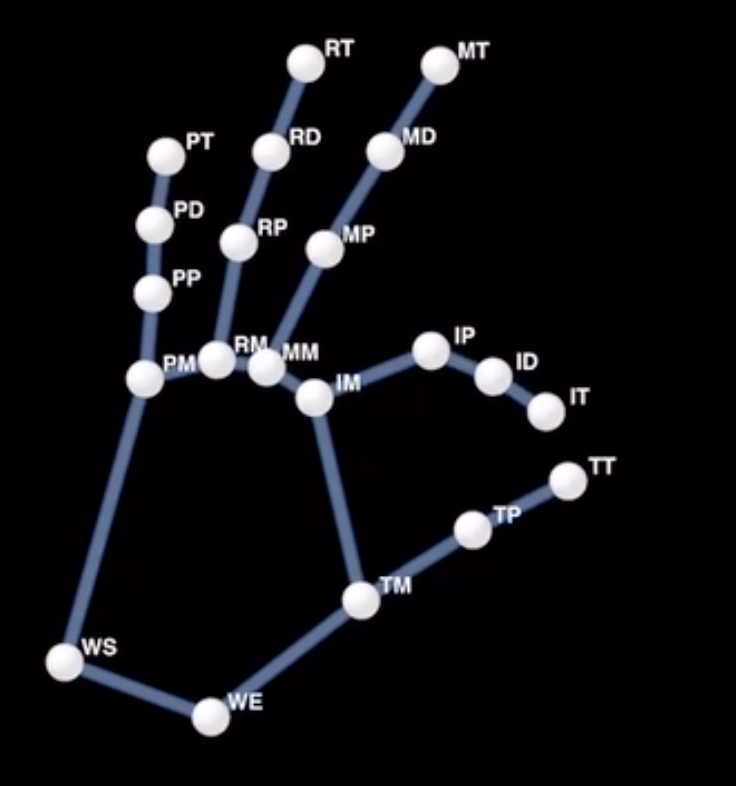
Google’s approach provides high-fidelity hand and finger tracking from an HD RGB camera by employing machine learning (ML) to infer 21 key points of the hand from a single frame.

The architecture of Clay AIR’s machine learning pipeline for gesture recognition and hand tracking is different in the methods and tools used to train our models, which results in higher performance, quicker implementation time, and higher accuracy.

Hand landmark model differences

Google hand landmark model performs precise key point localization of 21 3D hand-knuckle coordinates inside the detected hand regions via regression (direct coordinate prediction). Google feeds its real-time hand tracking model with cropped real-world photos and rendered synthetic images to predict the 21 key points

Clay AIR’s hand landmark models perform a prediction of 22 (now 23) 3D key point coordinates obtained from a 1,4M sample database, with cropped real-world and synthetic images.

However, the input (monochrome), the resolution (96x96p, 112x112p, 128x128p with a correlative maximum distance of 5,6 feet), the blending distribution (synthetic/manual), the bounding box (adaptive/rectangular), the model itself (direct 3D) and the training method differ from Google’s.

Input differences

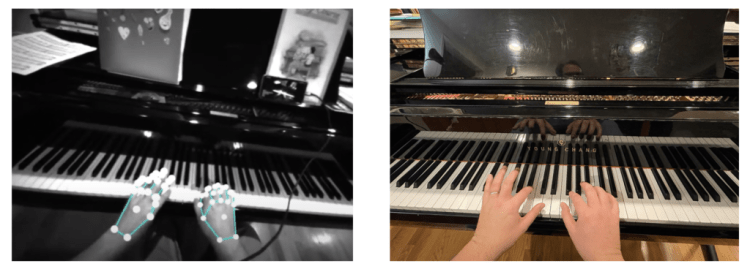
At Clay AIR we are able to use a 6DoF input out of a monochrome camera, versus Google’s 256x256p out of an RGB camera.

Monochrome sensors are typically already being used for room-scaling purposes, and running our software through the same camera allows us to avoid opening other cameras such as the RGB, which are well known for their heat and high CPU consumption.

Monochrome inputs are more challenging to process, as the images are lower resolution, in black and white, and more distorted. Even so, we are able to run machine-learning based tracking and gesture recognition through monochrome cameras, in addition to RGB, IR and ToF cameras.

Google uses models without SSD, which results in a slower and less accurate object detection.

Annotation, training and mixing method differences

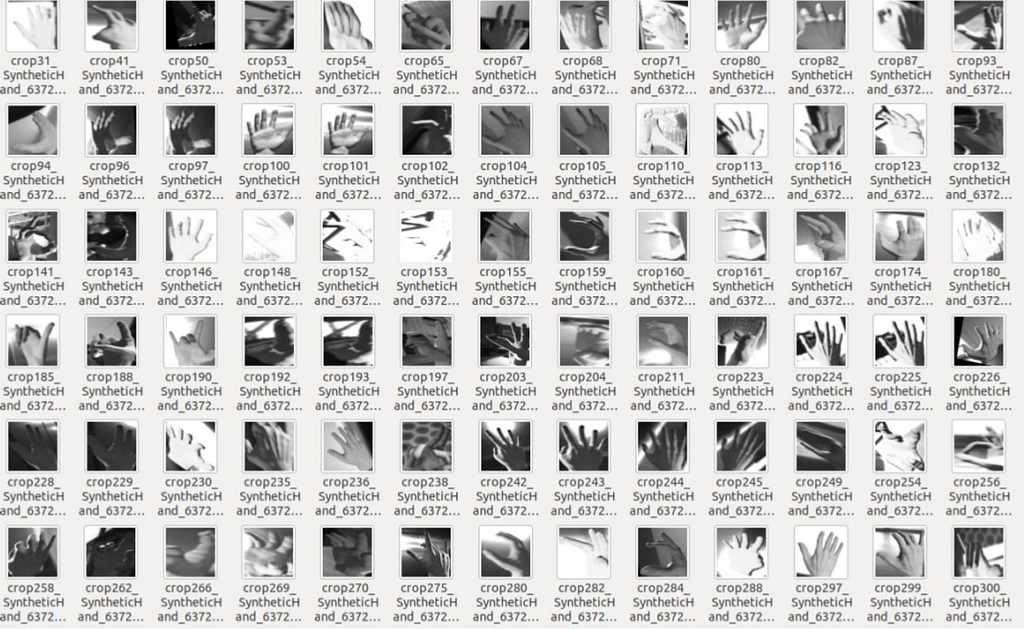
As Google stated, 30K samples were used, partly manually annotated and partly synthetic. Manual annotation usually costs 0.5 cents per sample and lasts 3 to 4 weeks.

As part of the process is manual, the positioning is uncertain and the confidence of the keypoints is consequently lessened, thus jitter is likely to occur. On the other hand, synthetic data can carry biases such as the image’s grain, that can result in less recognized hands.

Clay AIR developed two proprietary tools to accelerate the annotation and training process of in-house hand tracking models

KANT (Knowledge Automated Notation Tool)

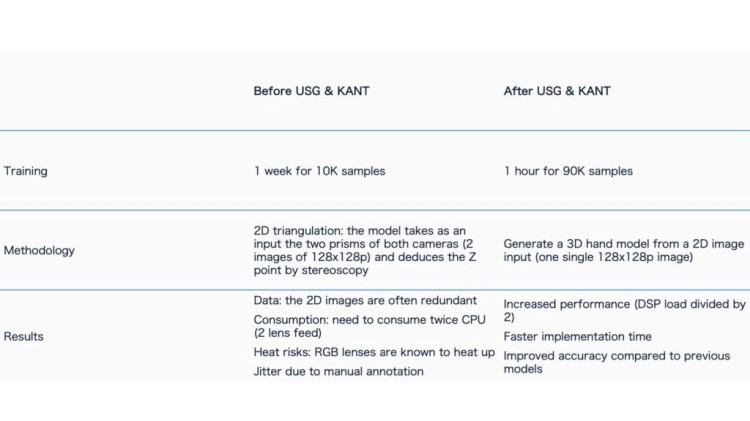
KANT is a generic annotation tool that enables us to generate 90k samples per hour. Any object could be generated, but we use it to generate balanced and representative hand poses and positions.

It includes luminance and background matching to adjust seamlessly to new devices, ISP, and FOV. The resulting generated samples feed our 2D or 3D hand models.

Trending AI Articles:

1. Top 5 Open-Source Machine Learning Recommender System Projects With Resources

2. Deep Learning in Self-Driving Cars

3. Generalization Technique for ML models

4. Why You Should Ditch Your In-House Training Data Tools (And Avoid Building Your Own)

USG (Unity Sample Generator)

USG is a semi-assisted tool conceived to help and accelerate the manual annotation process (real-world data). More particularly conjoining the simultaneous IR, TOF, Monochrome, and RGB cameras streams on the same calibrated device enables us to project 3D coordinates out of 2D monochrome images.

In addition, a grid that correlates ten monochrome, six RGB and eleven ToF cameras calibrated together makes it possible to multiply the annotated image by the number of all cameras, therefore substantially increasing the number of annotated images.

Our mixing method is different too: we nourish our three-model-based 2D or 3D architecture with samples of positive and negative proportion, and samples of accordingly rendered number and nature to modify the learning rate and perturbation data in real-time.

Ultimately, the two tools enable Clay AIR to use only one camera feed as no more triangulation is needed to predict the Z point, thus cutting the DSP load in half.

Google’s annotation process compared to Clay AIR proprietary tools

Google vs Clay AIR hand tracking: comparison of annotation, training method, lens, input data processing, hand landmark model, and computation.
Computing time comparison on different devices: Google vs Clay AIR

Implications for our partners and end-users using Clay AIR hand tracking models

A shorter implementation time

KANT and USG impact the training velocity drastically: from 10,000 images in 2D per month with the previous tools to 90,000 per hour in 3D, resulting in a shorter time to implementation for our partners.

Increased accuracy

With semi-automated annotation processes and an increased diversity of samples, Clay AIR is able to provide less jitter and reduce inaccuracy of manual-only annotated data. The hand tracking models are therefore more accurate, which increases the sense of immersion for users.

A power-efficient solution

The two tools enable Clay AIR to use only one camera feed as no more triangulation is needed to predict the Z point, thus cutting the DSP load in half.

It is particularly interesting for partners looking to implement intuitive hand interactions on lightweight devices with lower computing power, and in systems where the CPU load must be spared for essential features, such as in the driver monitoring systems in cars or trucks.

Using Clay AIR proprietary tools to annotate and train data sets: faster process and increased performance

About Clay AIR

Clay AIR is the only hardware-agnostic software solution for hand tracking and gesture recognition with leading-edge performance.

Clay AIR is a proprietary software solution that enables realistic interaction with the digital world for a variety of mobile, XR, and other devices using computer vision and artificial intelligence.

Recently, Clay AIR collaborated with Lenovo to bring native gesture recognition to the ThinkReality A6 augmented reality (AR) headset.

Clay AIR also partnered with Renault-Nissan-Mitsubishi to create their prototype in-car air gesture controls to increase safety and improve driving experiences.

The company is also working with Nreal to add hand tracking and gesture recognition to its mixed reality headsets, and with Qualcomm to implement Clay AIR’s technology at the chipset level to simplify integrations and bring hand tracking and gesture controls to more AR and VR devices.

If you would like more information about implementing our solutions, feel free to reach out to us here.

Don’t forget to give us your ? !


Machine Learning Tools for Gesture Recognition and Hand Tracking: A Comparison with Google… was originally published in Becoming Human: Artificial Intelligence Magazine on Medium, where people are continuing the conversation by highlighting and responding to this story.

Via https://becominghuman.ai/machine-learning-tools-for-gesture-recognition-and-hand-tracking-a-comparison-with-google-6c74fee31f3?source=rss—-5e5bef33608a—4

source https://365datascience.weebly.com/the-best-data-science-blog-2020/machine-learning-tools-for-gesture-recognition-and-hand-tracking-a-comparison-with-google

Design a site like this with WordPress.com
Get started