
How can you improve yourself in data science area to be a good Data Scientist?

Source

We aren’t trying to establish that those so-called data scientists lack any key skills, but companies are looking for something more to get some true help, especially in the context of today’s extremely competitive landscape.

The role of data scientist surely involves a lot of great things and those are the reasons professionals from across the globe are striving to step into the field of data science. Businesses, regardless of their field and volume, are looking to recruit ‘effective’ data scientists. We mentioned the term ‘effective’ because there is a huge supply of so-called data scientists that often fail to meet the expectations. The continuing media hype around data science has heavily exploded the volume of junior talents over the past few years.

We aren’t trying to establish that those so-called data scientists lack any key skills, but companies are looking for something more to get some true help, especially in the context of today’s extremely competitive landscape. This post is aimed at throwing some light on what an average data scientist should do to become a good data scientist.

1- Effective ways to become a good data scientist

Data science is a field where constant growth is required and possible. And to become a top-notch data scientist one needs to learn a lot of skills. But the question is, how many of those skills an average data scientist needs to improve to thrive in the field? And is that actually possible? And another key factor is anybody doesn’t have his/her entire life to keep on improving the skills.

So, the journey to become an effective data scientist has to be effective, based on the real-world requirements with justifiable duration.

Let’s have a closer look at the skills that you need to improve to become a good data scientist.

1.1- Sharpen your SQL skills

Expertise in SQL is a common requirement, whether your key focus is on machine learning or AI or data engineering. It’s also not a solution to all the problems a data scientist may ever face. But you have to become a master of it in order to comprehend how to access data.

If you find yourself stuck with the massive amount of data tooling, chances are you’ll find a SQL. And once you have a robust understanding of the SQL paradigm, most likely you’ll find it much easier to master other query languages that opens up a whole new world.

Data scientist and their future is seen bright for job analysts

1.2- Sharpen your programming language skills
In your journey to become a data scientist, you’ve certainly acquired a good amount of skills on procedural programming languages like Python, R, Java, Scala etc. For most of the established data scientists, Python usually serve them extremely well and for reasons. You can use it for a large number of different things — from cleaning data and creating deep learning models to accessing the AWS API and building a web application, and many more.

In case you don’t want to pick Python, you can always go with any of the other languages that are being preferred by the data science domain.

The thing is once you pick the language, you need to become a master of it. Get to know its best parts and build something fun with it. And when you feel really confident enough, you can start mastering another language.

1.3- Focus on applying theoretical concepts more

It’s always good to have solid grasp of the theoretical concepts running behind the techniques you use as a data scientist sometimes. But when you don’t apply them frequently, most of them remain as theoretical concepts only, which is one of the biggest obstacles to become a good data scientist. It’s imperative your practicing progress should maintain a healthy balance between practical and theoretical. As soon as you master a concept, simply head over to Google and look for a problem or dataset where you can use it and start working on it.
Machine Learning Jobs

You’ll be surprised to see that you’re retaining the concept way better than before. Also, it’s important to remember that it’s simply not possible to learn everything in one go. So, fill in the gaps with practice and your expertise will automatically increase.

1.4- Start with the answers

This is a common occurrence that when an average data scientist faces a problem statement, he/she, in most cases, spends the initial time on finalizing and looking at ways to attain their goal, instead of focusing on the goal itself.

Here comes the importance of developing a clear understanding of the business cases, without which the chance for the data scientist to come up with a solution that doesn’t meet the client expectation is more.

Hence, it’s extremely important to develop a robust understanding of the business use cases to be able to come up with an effective course of action. Also, a structure approach is crucial to become a good data scientist. Without it, your approach will likely be haphazard with chances of losing track of your own work when presented with a complex problem.

Data Scientist is better than Financial Analyst, Data Analyst and Research Analyst

1.5- Practice repeatedly and create a feedback loop
One of the most effective ways to become a good data scientist is to keep on practicing. This can be working on non mission-critical, mundane tasks and even can drag your productivity down initially, but it’ll force you to become a master of the fundamentals. It’s a fact that the more challenges you face, the chances for breaking down complex nuances and know the mechanism to attain your goals is more. Therefore, keep on frequent and regular practicing and try to determine the strategy, improve your problem-solving skills, and develop a clear understanding of client expectations to higher your overall chances of becoming a good data scientist. You should also try to review codes written by other people and fix small bugs if possible.

When writing your own code, try to make it more readable for others so you can get feedback from them. In this context, it’s imperative that you try to partner with senior data scientists in order to receive actionable and timely feedback. You should keep in mind that one of the biggest traits of the people, who’ve a solid growth mindset, is that they’re usually not ashamed of accepting what they don’t know and they constantly try to fill the gaps by seeking feedback.

1.6- Be prepared for continuous learning

The domain of data science evolves at a fast pace. It means, the tools and technologies are in demand now, may not remain so in the future. So, continuous learning and upgrading yourself is crucial to stay up-to-date with the industry trends and to become a good data scientist. Also, there are a significant number of tools and technologies appear in the tech domain as a whole.

Try to learn the relevant ones and put them to your use. For example, you can learn the Jupyter Notebook. You can consider it as a living online notebook and allows students and faculty to weave computational information such as statistics, code, data etc together with the help of narrative, graphs, and multimedia. You can use it to open up your data, share your stories behind your computations, and enable future innovation and collaboration. With a Jupyter Notebook, you can also play around and experiment with code.

Becoming a Data Scientist, Data Analyst, Financial Analyst and Research Analyst

1.7- Study consistently

One of the biggest things that differentiate a good data scientist from an average one is the former’s consistency in studying. Some data scientists tend to get distracted easily and take frequent breaks. In reality, trying to get back into the right track becomes extremely difficult at that time. To avoid this, you need to set goals for yourself and chalk out a solid plan on how to study consistently.

Top 4 Most Popular Ai Articles:

1. AI for CFD: Intro (part 1)

2. Using Artificial Intelligence to detect COVID-19

3. Real vs Fake Tweet Detection using a BERT Transformer Model in few lines of code

4. Machine Learning System Design

The thing to keep in your mind is that if you want to become a good data scientist, you’ve to be ready to put in the time and effort. If you keep finding excuses continually not to do this, data science may not be the ideal field for you.

1.8- Work on your communication skills

Though communication skills are one of the aspects usually overlooked by data scientists, it’s absolutely critical if you want to climb the ladder up. You can master multiple tools and learn all the techniques, but if you fail to explain your findings to your client in a digestible way, you’ll fail to become a good data scientist. In order to improve your communication skills, try to explain some of your findings to a non-technical person and see how you can articulate the problem. There’re lots resources available on the web that can help you greatly in this regard, but again practice is of key importance as well.

2- Parting Thoughts

You should understand that you’ll never become a good data scientist within just a couple of months or a year, regardless of how much you learn and how hard you work. It isn’t simply a feasible goal. But you’ve to keep on striving to continue improving your skills and growing. Finally, it doesn’t heavily matter from where you start your career as a data scientist. What actually matters is how you’re trying to progress in your career and what steps you’re following to become a good data scientist. Follow the above tips and you’ll surely be able to attain this goal if you’ve the motivation to do it the hard way.

How can you improve yourself in data science area to be a good Data Scientist? – Magnimind Academy

Join our new Slack community: https://bit.ly/AI-ML-DataScience-Lovers-Slack-Channel

Don’t forget to give us your ? !


How can you improve yourself in data science area to be a good Data Scientist? was originally published in Becoming Human: Artificial Intelligence Magazine on Medium, where people are continuing the conversation by highlighting and responding to this story.


Via https://becominghuman.ai/how-can-you-improve-yourself-in-data-science-area-to-be-a-good-data-scientist-42330be2c020?source=rss—-5e5bef33608a—4

source https://365datascience.weebly.com/the-best-data-science-blog-2020/how-can-you-improve-yourself-in-data-science-area-to-be-a-good-data-scientist

Artificial Intelligence: Renaissance of Technology

Source

Artificial Intelligence : Renaissance of Technology

Aiding ABC’s of the Industry

All About AI:

According to the Cambridge dictionary, the meaning of AI is, “the study of how to produce machines that have some of the qualities that the human mind has, such as the ability to understand language, recognize pictures, solve problems, and learn”. When a machine is able to make an intelligent decision, it can be referred to as being intelligent, but artificially. We mostly see people using the terms of machine learning, deep learning, and AI synonymously. However, Deep Learning is a subset of Machine Learning, and Machine Learning is a subset of AI.

The Evolution of AI:

The seeds of modern AI were planted by classical philosophers who attempted to describe the process of human thinking as the mechanical manipulation of symbols. In 1836, Cambridge University mathematician Charles Babbage and Augusta Ada Byron, Countess of Lovelace, invented the first design for the programmable machine. In the 1940s, Princeton mathematician John Von Neumann conceived the architecture for the stored-program computer — the idea that a computer’s program and the data it processes can be kept in the computer’s memory. And Warren McCulloch and Walter Pitts laid the foundation for Neural Networks.

The AI surge began with six major design goals as follows:

1. Teach machines to reason in accordance to perform sophisticated mental tasks like playing chess, proving mathematical theorems, and others.

2. Knowledge representation for machines to interact with the real world as humans do — machines needed to be able to identify objects, people, and languages. Programming language Lisp was developed for this very purpose.

3. Teach machines to plan and navigate around the world we live in. With this, machines could autonomously move around by navigating themselves.

4. Enable machines to process natural language so that they can understand language, conversations and the context of speech.

5. Train machines to perceive the way humans do– touch, feel, sight, hearing, and taste.

6. General Intelligence that included emotional intelligence, intuition, and creativity.

All these goals set the foundation to build a machine with human capabilities. Millions of dollars were invested in bringing their vision to life. However, soon, the US government realized the absence of powerful computing technologies needed to implement AI. The funds were withdrawn, and the journey took the first halt in the late 80s.

Machine Learning Jobs

The field of AI research was founded at a workshop held on the campus of Dartmouth College during the summer of 1956. The modern field of artificial intelligence is widely cited as starting in 1956 during a summer conference at Dartmouth College.

Top 4 Most Popular Ai Articles:

1. AI for CFD: Intro (part 1)

2. Using Artificial Intelligence to detect COVID-19

3. Real vs Fake Tweet Detection using a BERT Transformer Model in few lines of code

4. Machine Learning System Design

Sponsored by the Defence Advanced Research Projects Agency (DARPA), the conference was attended by 10 luminaries in the field, including AI pioneers Marvin Minsky, Oliver Selfridge and John McCarthy, who is credited with coining the term Artificial Intelligence.

In 1973, it became obvious that they had grossly underestimated the difficulty of the project. The US and British government stopped funding for the undirected research and the difficult years of AI started also termed as “AI Winters”.

Seven years later, a visionary initiative by the Japanese Government inspired governments and industry to provide AI with billions of dollars, but by the late 80s the investors became disillusioned and withdrew funding again.

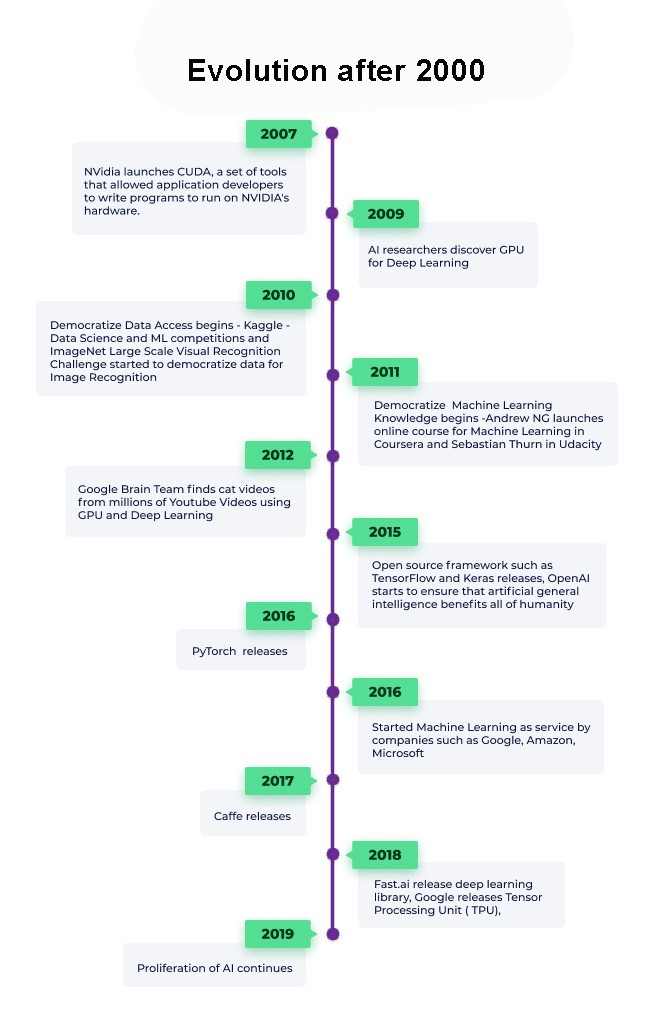
Increases in computational power and an explosion of data sparked an AI renaissance in the late 1990s that has continued to present times.

Source: Techtarget

The need for a massive amount of data and enormous computing power disrupted the progress in the 80s. The 21st century, however, brought the concept quickly back to life proving Moore’s law. The heavy processing power that tiny silicons hold today has made AI feasible in the current context, also enabling to build improved algorithms.

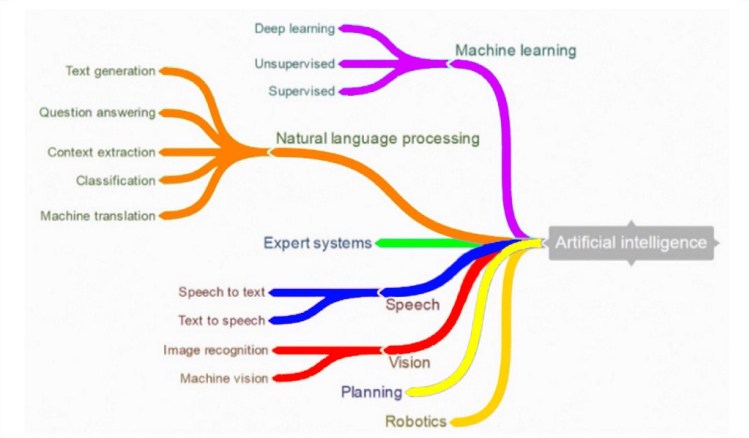
The latest focus on AI has given rise to breakthroughs in Natural Language Processing, Computer Vision, Robotics, Machine Learning, Deep Learning and more. Moreover, AI is becoming ever more tangible, powering cars, diagnosing disease and cementing its role in popular culture.

Branches of AI :

This era is of AI and here are the branches of AI so that we can understand the wide reach of AI.

Types of AI:-

Reactive Machines:
The most basic types of AI systems are purely reactive and have the ability neither to form memories nor to use past experiences to inform current decisions. Deep Blue, IBM’s chess-playing supercomputer, which beat international grandmaster Garry Kasparov in the late 1990s, is the perfect example of this type of machine.

This type of intelligence involves the computer perceiving the world directly and acting on what it sees. It doesn’t rely on an internal concept of the world.

Limited memory:
Limited Memory AI
, can make informed and improved decisions by studying the past data from its memory. Such an AI has a short-lived or a temporary memory that can be used to store past experiences and hence evaluate future actions. These observations are added to the Self-Driving Cars’ pre-programmed representations of the world, which also include lane markings, traffic lights and other important elements, like curves in the road. They’re included when the car decides when to change lanes, to avoid cutting off another driver or being hit by a nearby car.

Theory of Mind:
We might stop here, and call this point the important divide between the machines we have and the machines we will build in the future. In psychology, this is called “theory of mind” — the understanding that people, creatures and objects in the world can have thoughts and emotions that affect their own behavior. If AI systems are indeed ever to walk among us, they’ll have to be able to understand that each of us has thoughts and feelings and expectations for how we’ll be treated. And they’ll have to adjust their behavior accordingly.

Self-Awareness:
The final step of AI development is to build systems that can form representations about themselves. This is, in a sense, an extension of the “theory of mind”. The next stage of AI, where machines have their own consciousness and become self-aware. This type of AI is a little far-fetched given the present circumstances. However, in the future, achieving a stage of superintelligence might be possible. Geniuses like Elon Musk and Stephen Hawkings have consistently warned us about the evolution of AI specifically in this domain which is machines having self-awareness also termed as ‘Wide AI’.

AI aiding the ABC’s of the industry!!

A — Automotive
B — Bioscience
C — Creative Services
D — Data
E — Education
F — Finance
G — Gaming
H — Healthcare
I — Internet of Things

The above are the industries and domains where AI is widely used and accepted by many. Though many think that one day AI will take jobs of humans and they will overpower the humans but if this technology used widely can lead to a tangent growth of a nation and along with various nations together can do wonders.

Authors:

1. Mangesh Chincholkar
2. Rohan Sarkar
are part of CORE TEAM of HEXABERRY DATA SCIENCE COMMUNITY.

Authors can be reached at:
1. Hexaberry.datasciencecommunity@gmail.com
2. info@hexaberrytechnologies.com
3. https://www.instagram.com/hdsc.official
4. https://www.facebook.com/Hexaberry-Data-Science-Community-HDSC-105656644481089

Sources:

https://www.lftechnology.com/blog/ai/ai-evolution/
https://en.wikipedia.org/wiki/Artificial_intelligence
https://searchenterpriseai.techtarget.com/definition/AI-Artificial-Intelligence
https://theconversation.com/understanding-the-four-types-of-ai-from-reactive-robots-to-self-aware-beings-67616

Don’t forget to give us your ? !


Artificial Intelligence : Renaissance of Technology was originally published in Becoming Human: Artificial Intelligence Magazine on Medium, where people are continuing the conversation by highlighting and responding to this story.

Via https://becominghuman.ai/artificial-intelligence-renaissance-of-technology-66a98c1c6975?source=rss—-5e5bef33608a—4

source https://365datascience.weebly.com/the-best-data-science-blog-2020/artificial-intelligence-renaissance-of-technology

The 8 Basic Statistics Concepts for Data Science

Understanding the fundamentals of statistics is a core capability for becoming a Data Scientist. Review these essential ideas that will be pervasive in your work and raise your expertise in the field.

Originally from KDnuggets https://ift.tt/2AWdjyb

source https://365datascience.weebly.com/the-best-data-science-blog-2020/the-8-basic-statistics-concepts-for-data-science

Time Complexity: How to measure the efficiency of algorithms

When we consider the complexity of an algorithm, we shouldn’t really care about the exact number of operations that are performed; instead, we should care about how the number of operations relates to the problem size.

Originally from KDnuggets https://ift.tt/3droBYd

source https://365datascience.weebly.com/the-best-data-science-blog-2020/time-complexity-how-to-measure-the-efficiency-of-algorithms

KDnuggets News 20:n25 Jun 24: PyTorch Fundamentals You Should Know; Free Math Courses to Boost Your Data Science Skills

A Classification Project in Machine Learning: a gentle step-by-step guide; Crop Disease Detection Using Machine Learning and Computer Vision; Bias in AI: A Primer; Machine Learning in Dask; How to Deal with Missing Values in Your Dataset

Originally from KDnuggets https://ift.tt/2Vbldur

source https://365datascience.weebly.com/the-best-data-science-blog-2020/kdnuggets-news-20n25-jun-24-pytorch-fundamentals-you-should-know-free-math-courses-to-boost-your-data-science-skills

A TensorFlow Modeling Pipeline Using TensorFlow Datasets and TensorBoard

This article investigates TensorFlow components for building a toolset to make modeling evaluation more efficient. Specifically, TensorFlow Datasets (TFDS) and TensorBoard (TB) can be quite helpful in this task.

Originally from KDnuggets https://ift.tt/2VdmxwC

source https://365datascience.weebly.com/the-best-data-science-blog-2020/a-tensorflow-modeling-pipeline-using-tensorflow-datasets-and-tensorboard

Capsule Network

Capsule Networks provide a way of detecting parts of objects in an image and representing cognitive links between those parts. Which means…

Via https://becominghuman.ai/capsule-network-44db40f374c6?source=rss—-5e5bef33608a—4

source https://365datascience.weebly.com/the-best-data-science-blog-2020/capsule-network

ReboundAI: Measuring Economic Mood at Scale

Source

Machine Learning to Delve Deeper into Business Community

I am optimistic — like never before — that this moment is the rock-bottom on which we can lay a new foundation. Many things are happening that fill me with gratitude and show me nothing but opportunity. I see many signs that a “rebound” is on the way. It won’t feel like a return to normal, but it will be our hopeful “new normal” where we can shift from survival to growth. Anticipating when and how this might happen has occupied my recent efforts in the MyTri 2030 Prosperity Council.

Envisioning a decade of progress in the Columbia Valley

Prosperity in Tri-Cities

Since June 2019, I’ve been one of the local Tri-Cities community leaders lucky enough to be a part of MyTri 2030 — an effort to make a regional vision for Tri-Cities across key areas like Life, Energy, and Education. My opportunity area is “Prosperity”, where we focus on business, entrepreneurship, and economic vitality. We had our first kick-off in February, where I was lucky to be named one of three co-chairs of the council primarily to represent the community of Fuse.

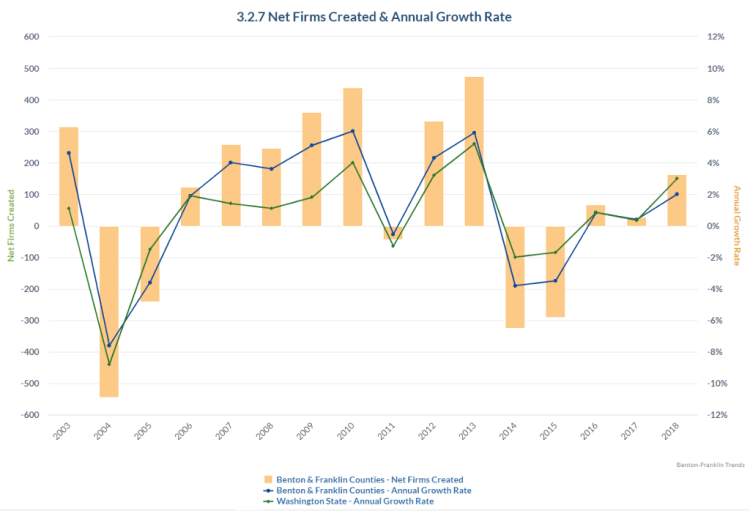
Benton & Franklin County currently lags Washington State in business creation

Despite the backdrop of a looming international crisis, when we started we were committed to the idea that our job would be continuing to grow the vibrant business community of Tri-Cities. Step one was to assess current state economics in the region. Not only through the qualitative lens of current mood, but looking for numbers — such as the Economic Vitality numbers on the Benton-Franklin trends website. While the site itself is great, the data on it is unfortunately 2 years old — it’s beyond challenging to find real-time economic data. Just as we were getting started, the COVID crisis hit home, the economy shuttered, and plans changed.

Top 4 Most Popular Ai Articles:

1. AI for CFD: Intro (part 1)

2. Using Artificial Intelligence to detect COVID-19

3. Real vs Fake Tweet Detection using a BERT Transformer Model in few lines of code

4. Machine Learning System Design

The Pivot

Across March and April, we had to pivot into rescue and recovery mode as we tried to assess how to help our community. MyTri 2030 partner organizations immediately sprang into action: Tri-Cities Regional Chamber of Commerce has a constantly updating, 37-page guide of resources for business. TRIDEC started connecting business owners with grants and loans.

Grassroots groups also started swarming the challenges of Tri-Cities: As health advocacy became a need, we saw the Flatten the Curve Tri-Cities Facebook group spring up to fill the gap. As Non-Profits struggled, the All In Tri-Cities Facebook group started raising money. Other individuals in the community are hoping to put together further action, including Adam Avenir lobbying for additional stimulus targeting small businesses and Dave Fritch forming a nascent coalition to assist small businesses — starting with renegotiating their commercial leases.

If you’ve seen more helpers in action here in Tri-Cities trying to preserve the culture or commerce in Tri-Cities, please tell me in the comments below!

While we tried our best to track and connect with each movement, the Prosperity council itself has been on the lookout to find gaps to fill with our limited resources. One area we identified was how organizations were checking in with their constituents. We not only wanted more of a pulse on the 8,000 businesses around Tri-Cities, but we also wanted a higher-resolution view and as much of an avenue toward actionable insights as we could achieve. This was an area where my background in technology could become a vital catalyst.

ReboundAI

I was able to obtain 679 survey responses from a local economic development group. Given a total of 8,000 businesses in the region, this sample would evaluate to about a 4% margin of error and a 95% confidence level. Using Microsoft’s Azure Cognitive Services, I was able to bring together cutting-edge cloud technology on my humble spreadsheet, yielding intriguing results.

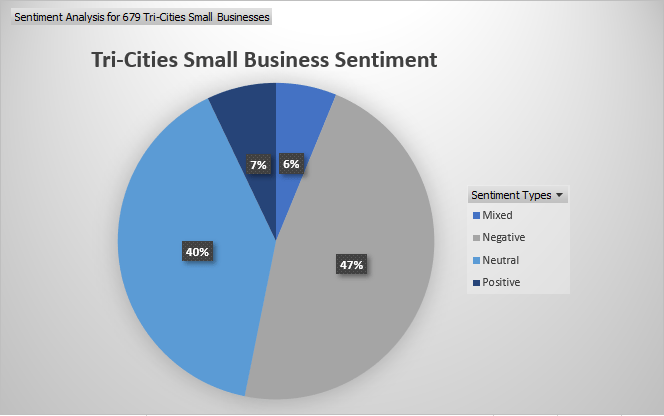
Pie Chart of Sentiment for 679 Tri-Cities Small Businesses

Step one was a basic sentiment analysis — categorizing responses as positive, negative, neutral, or mixed — based on the connotation of words in their response. This revealed an unsurprisingly overwhelmingly negative outlook amongst the business community. While not useful in isolation, we believe that repeating this analysis over time with many surveys, tracking the delta of sentiment, will give an indicator around when the “mood” of business in Tri-Cities rebounds. We speculate an uplift in sentiment will arrive much sooner than any report on revenue or sales, enabling us to predict recovery and create a sense of undeniable hope for the region.

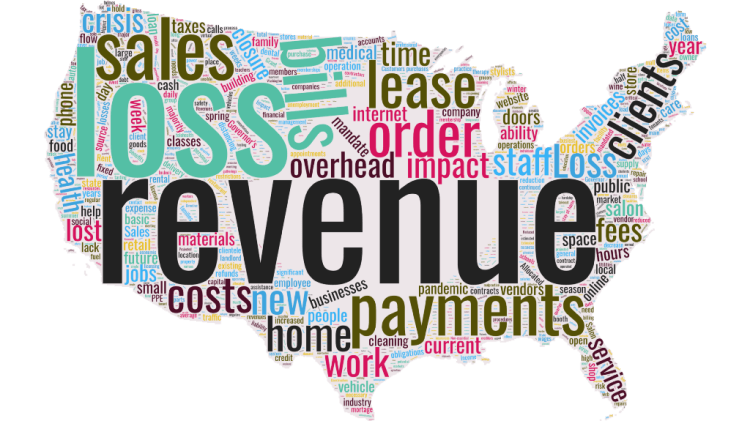
Word Cloud of Key Phrases for 679 Tri-Cities Small Businesses

To dive deeper, we started pulling apart the data with key phrase analysis. This extracts the semantically substantive phrases in a document, enabling one to understand the meaningful contents. Based on these phrases, actions like building workshops and resources to address a topic could be made (such as doing a class on payments with uncertain cashflow), plus quantitative arguments for actions in the community (like addressing commercial leases given it’s so much on the mind of business owners).

Jobs in AI

Given these core capabilities, we are working on making deeper correlations — such as splitting the phrases based on sentiment such that we could tell you what topics are relevant to the hardest-hit businesses. Through engagement with the community and further evolution of the technology, I believe we can discover key insights that allow for real-time economic evaluation in our region. If you have data you would consider sharing to help with gauging the mood of business in Eastern Washington, please post a comment or find me on LinkedIn.

To further share this work with the world, I have open-sourced the code on GitHub under the name “ReboundAI”. The tool is built on Microsoft technology’s AI technology and currently handles universal comma-separated value (CSV) file formats. Any services able to make a CSV (Google Forms, SurveyMonkey, etc) can have its data processed by ReboundAI. Thanks to Microsoft’s generosity, any community in the world can process sentiment for up to 5,000 businesses a month at zero cost.

Conclusion

This moment has many reasons to fear for our health, our income, and our country. Despite the prevailing gloom and the odds that things may still get worse before they get better, today I am optimistic. In my city, I see unstoppable forces helping lift the spirits of the people and sales of local businesses. If we can all find a way to keep holding on a little longer, we’ll see the day where our community rebounds into a “new normal” and under every mask will be a confident smile that the worst is behind and a bright future is ahead.

Erik Ralston is an innovator with 13 years of experience, 5 years in leadership at the fastest growing tech company in Australia, a BS in Computer Science from Washington State University, and too many ventures to mention in one biography. Erik is also co-founder of Fuse Accelerator in Tri-Cities, WA where he works on connecting people and sharing knowledge to turn new ideas into growing startups. You can find him on LinkedIn, Twitter, or the next Fuse event — once Benton county hits its milestones for Phase 2

Don’t forget to give us your ? !


ReboundAI: Measuring Economic Mood at Scale was originally published in Becoming Human: Artificial Intelligence Magazine on Medium, where people are continuing the conversation by highlighting and responding to this story.
Via https://becominghuman.ai/reboundai-measuring-economic-mood-at-scale-bdf6d8cac498?source=rss—-5e5bef33608a—4

source https://365datascience.weebly.com/the-best-data-science-blog-2020/reboundai-measuring-economic-mood-at-scale

Is AI Chatbots The Future?

credit GetApp Lab

The world is rapidly becoming digitized, and the services are attracting more customers than ever before. It results in better sales but also creates hurdles for the support team. The flow of customers who have questions and make some inquiries can grow regardless of the organization’s scale and other range of services. It needs much effort to address all the issues of the customers, developing the need for a conversation AI, or even a package of pre-built scripts that can reduce the burden of human workers.

Undoubtedly, Artificial Intelligence is all over us, and so are the AI chatbots. They aren’t a magical instrument used for giving mundane tasks and cutting the costs, but an abundant multiplier that creates some new values. The AI-based chatbots are helping us in different life situations and also responding quickly to our queries.

As per Forbes, a survey conducted by Oracle reveals that 80% of marketers plan to start using a chatbot in some way by the year 2020. A fundamental reason for this is the fact that various brands are investing in improving the user experience while the other purpose is that customers don’t have to wait in this fast-moving world. The chatbot market is predicted to reach $1.25 billion by the year 2025.

What to Expect From the Chatbot Technology?

In the modern AI computerized era, chatbots are becoming more polished, mature, and ready to anticipate the potential user needs. They do have a considerable capacity and potential to grow and deliver the results that haven’t been expected from a bot.

Chatbots have become a vital aspect of the digital customer service who can address customer queries consistently and promptly. According to Reports and Data, the chatbot market was approximately $1.17 billion in 2018 and predicted to arrive at $10.08 billion by 2026, with a 30.9 percent compound growth annual rate.

Top 4 Most Popular Ai Articles:

1. AI for CFD: Intro (part 1)

2. Using Artificial Intelligence to detect COVID-19

3. Real vs Fake Tweet Detection using a BERT Transformer Model in few lines of code

4. Machine Learning System Design

Secondly, the chatbot offers various advantages both for the chatbot owners and users. It opens new exciting opportunities for customer engagement and operational efficiency and creates a new form of doing business. Chatbots are an excellent example of how humans cast away to the machines all the tasks which we find annoying, dull, and tiresome. However, there are certain risks too associated with chatbots like network security but you can prevent it by using a reliable VPN, find out more about it.

Chatbots in Today’s Era

Chatbots have significantly altered the way organizations communicate with their customers. A study states that by 2024, the market size of bot will rise by $1.34 billion. Every chatbot solution provider is keeping themselves informed and updated with the new developments of AI and voice-enabled assistants to have the pace of technology and provide a consistent brand experience.

Now, chatbots are here to stay forever. As humans are restricted to the slow biological evolution process, artificial intelligence is not. With AI technology getting stronger and robust with each passing year, chatbots have few limits on what they can do. As a consequence, we humans can now communicate with chatbots as they usually talk with people.

Chatbots are proving themselves as a valuable technology in different situations in people’s lives. They are becoming famous not only for business but also for personal use. Unlike apps and sites, chatbots are much more convenient and simple to use. It is because the user-interface of the messenger apps are quite well-known.

Jobs in AI

Several businesses are now very close to AI chatbot integration in their everyday operations but haven’t yet leaped. According to the MITSloan Management Review, every three out of four of the executives believe that artificial intelligence will allow them to run their new business ventures and 85 percent believe that AI technology implementation offers a competitive advantage on the market. The same survey also finds that one out of 20 organizations has integrated chatbots in its processes or offerings.

Artificial Intelligence Chatbots

AI- chatbots are more sophisticated programs that involve machine learning capabilities. Such a program will not only answer questions and assist in problem-solving, but also collect and improve the received information, training itself to become more efficient and then sending the data to the analysts for further in-depth research. The business owners can alter the functionality of AI chatbots, can add new features, and improve the existing ones too. These bots identify the language and there is no need to be extremely specific and to get the desired result.

They function by using a set of scripts with pre-written responses. The organizations might reveal the list of all possible questions to ask the chat machine. It works to give the initial information to the clients, including availability hours, location, solutions to simple issues while using a product. It also helps the customers as well as pitch the services to new people. The direct commands activate these bots.

How Can Chatbot Benefit Your Business?

The AI and ML technology have made chatbots a more advanced and potent tool for business organizations. The following mentioned below are some of the benefits it can bring.

  • An Endless Source of Data

The AI bots remember what people ask them and improve on the bases of it. They also send the data about a user’s question to your employees. You will know what the customers are more about, which product is in more demand, and what flaws does your service have. You will have all the information at your disposal and ready to help in making decisions that will enhance the business development process.

  • Better Brand Exposure

The AI chatbots will successfully turn leads into sales without troubling the sales and marketing managers. It is because chatbots are the proven marketing tool that continuously explains to customers the basics of your product and services.

  • 24/7 Hours Availability

Some customers want to ask something late at night or send a message to you from a faraway location. A bot can efficiently take care of this thing and answer 100% of the questions despite any time of the day and availability of the staff workers.

  • Less Workload on Human Staff

When a business grows, or even one product or service becomes quite known, the customer support employees might not be able to cope with all the questions and new customers looking to buy. A chatbot will take care of most of that, leaving the complicated issues or direct sales to individual staff.

Technology Will Bring Better Functions

Without any doubt, both AI and ML will get developed in the future, ultimately improving the existing chatbots. Moreover, better customer experience, data management, analysis, and guidance will also become available.

There are two ways to get a chatbot and make it work for your organization. One way is to build a chatbot, and the other is to use the existing chatbot. Let’s discuss how each of them might benefit the organization.

1- Build a Chatbot

To develop such a program from the start, you need to know its purpose. What do you want your chatbot to do? Are you interested in spending more to get AI up and running or settle for a command bot? Are you planning to sell products by using bots? You first need to answer all these questions before choosing an optimal set of skills you want your chatbot to have.

The chatbot platforms allow building a bot without a massive team of skilled programmers. Various platforms are offering multiple functions, so choose according to your needs and desires.

2- Use the Existing One

The internet offers a diverse choice of pre-built bots for several different purposes. There are sites like Meokay and Chattypeople that provide bots that are ready to use right away, and you also don’t need to play with the code.

However, it is not the best decision to get a positive response from your business. It is unlikely that you might find a bot that will not match your all needs and won’t have anything unnecessary for your niche and vision of the desired chatbot. In the majority of cases, custom programs are the only way to get something that matches your business perfectly.

EndNote

To sum up all, it is valid to say that yes, AI chatbots are the future. We all know that things are going into the future. The only job left for the brands and businesses is to take the next step and move forward with AI chatbots. For both AI and chatbots, the upcoming time will be offering several benefits to the users and the business heads.

Don’t forget to give us your ? !


Is AI Chatbots The Future? was originally published in Becoming Human: Artificial Intelligence Magazine on Medium, where people are continuing the conversation by highlighting and responding to this story.
Via https://becominghuman.ai/is-ai-chatbots-the-future-215f53825d51?source=rss—-5e5bef33608a—4

source https://365datascience.weebly.com/the-best-data-science-blog-2020/is-ai-chatbots-the-future

Dont Click This (How to Spot Deepfakes and AI-Generated Text)

The technologies that generate deepfake content is at the forefront of manipulating humans. While the research developing these algorithms is fascinating and will lead to powerful tools that enhance the way people create and work, in the wrong hands, these same tools drive misinformation at a scale we can’t yet imagine. Stopping these bad actors using awesome tools is in your hands.

Originally from KDnuggets https://ift.tt/3hWIdXw

source https://365datascience.weebly.com/the-best-data-science-blog-2020/dont-click-this-how-to-spot-deepfakes-and-ai-generated-text

Design a site like this with WordPress.com
Get started