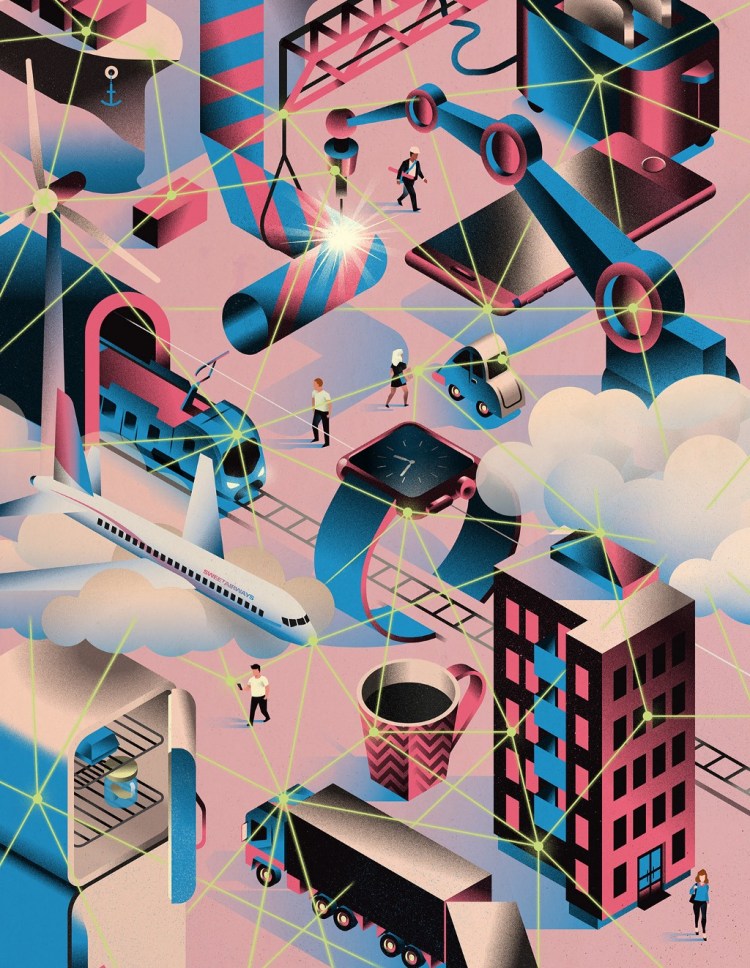
A business case for Over-the-Air updates (OTA) in Smart Devices

Source

“Soon there will be millions of smart devices across the globe, and it will be too costly and time-consuming to manually update these widely spread devices. Here is the solution to automatically update all your far-flung deployments”

The Growth:
IoT devices are growing rapidly around the world as they are constantly improving operational efficiency, enhancing productivity, and playing a major role in lowering operational costs. As a result, the number of businesses that use IoT technologies has increased from 13 percent in 2014 to about 25 percent in 2019. According to Ericsson, The number of cellular IoT connections is projected to reach 5 billion in 2025, where one quarter will represent LTE and 5G connection, while roughly 50% will be NB-IoT and LTE-M.
Jobs in ML

The Need:
Since LTE and 5G will represent one-third of the cellular IoT connections and soon there will be millions of smart devices enabling various sectors such smart cities, public transport, automatic fare collection system, Industrial automation, so on and so forth, we will soon have one essential requirement to take care of, and that will be keeping these widely spread deployments up to date.

The most commonly used connected devices will be edge devices that play a variety of roles including transmission, computing, routing, processing, monitoring, filtering, translation, storage of data, and also decision-making.

As we are aware that firmware and application updates are essential for consumer electronics such as laptops, tablets, and smartphones. Similarly, smart or edge devices are also required to be updated to keep the deployments healthy, improve performance, and upgrading to upcoming security protocols.

Why we need software updates:
Unfortunately, many organizations do not pay serious attention to the need for updating IoT devices so first let us discuss why we need software update in smart devices:

  • Improve the stability of software and applications
  • Enhances compatibility with hardware
  • Helps in faster time to market — release now, update later
  • Protect against rising cyberattacks with critical security patches
  • Facilitates innovative software-based business models
Over the Air (OTA) Updates

The Problem:
Since we now understand the need for software updates in smart devices, the question comes that how are we going to keep these widely spread devices up to date? As manual updation of such far-flung devices would be too costly and time-consuming.

Top 4 Most Popular Ai Articles:

1. AI for CFD: Intro (part 1)

2. Using Artificial Intelligence to detect COVID-19

3. Real vs Fake Tweet Detection using a BERT Transformer Model in few lines of code

4. Machine Learning System Design

Moreover, in epidemic situations such as the Covid-19 outbreak that resulted in a worldwide lockdown scenario, where arranging field service visits can be extremely hard and risky, how can we keep the system up and running without any physical intervention?

The Solution — Over the Air (OTA) Updates:
To avoid the cost burden of field service visits and increase operational efficiency for a widely spread device fleet, it is imperative for us to adopt such a system that will help us remotely access and update.

One of the most important features of wirelessly connected devices is the capability of over-the-air (OTA) updates. OTA is useful to update the firmware as well as applications. It works in a similar fashion as our computers, laptops, tablets, and phones get updated.

Off late, many organizations are showing interest in implementing OTA technologies, but currently, we are witnessing a significant increase in its adoption, partially because of the COVID-19 pandemic. As online conferencing tools such as zoom, skype, microsoft teams are booming nowadays because such tools connect people remotely to improve the workforce’s productivity. Organizations are also understanding the importance of connecting with their widely spread devices remotely to improve operational efficiency.

Now, let us cover how an Over-the-Air (OTA) update solution works. In our next blog, we will cover how OTA testing can be a game-changer when it comes to reducing maintenance costs.

How it works: learn more here https://trunexa.com/blog-detail/what-is-ota-updates-for-iot-and-why-its-important-in-todays-world

Don’t forget to give us your ? !


A business case for Over-the-Air updates (OTA) in Smart Devices was originally published in Becoming Human: Artificial Intelligence Magazine on Medium, where people are continuing the conversation by highlighting and responding to this story.


Via https://becominghuman.ai/a-business-case-for-over-the-air-updates-ota-in-smart-devices-9d2ac479eeb2?source=rss—-5e5bef33608a—4

source https://365datascience.weebly.com/the-best-data-science-blog-2020/a-business-case-for-over-the-air-updates-ota-in-smart-devices

3 Key Data Science Questions to Ask Your Big Data

The process of understanding your data begins by asking 3 questions at the highest level, and then iteratively asking hundreds of cascading questions to get deeper insights.

Originally from KDnuggets https://ift.tt/3duVlR3

source https://365datascience.weebly.com/the-best-data-science-blog-2020/3-key-data-science-questions-to-ask-your-big-data

From Languages to Information: Another Great NLP Course from Stanford

Check out another example of a Stanford NLP course and its freely available courseware.

Originally from KDnuggets https://ift.tt/2Mrz9vy

source https://365datascience.weebly.com/the-best-data-science-blog-2020/from-languages-to-information-another-great-nlp-course-from-stanford

KDnuggets News 20:n22 Jun 3: How to Think Like a Data Scientist; Six Ways For Data Scientists to Succeed at a Startup

Learn how to think like a Data Scientist; Read about 6 ways for a data scientist to succeed at a startup; Get a great and free new book on Deep Learning for Coders with fast.ai and PyTorch; check best GIS Courses in 2020; and more.

Originally from KDnuggets https://ift.tt/36T4TmG

source https://365datascience.weebly.com/the-best-data-science-blog-2020/kdnuggets-news-20n22-jun-3-how-to-think-like-a-data-scientist-six-ways-for-data-scientists-to-succeed-at-a-startup

STIPS Statistical Thinking for Industrial Problem Solving A free online statistics course

This online course is available – for free – to anyone interested in building practical skills in using data to solve problems better.

Originally from KDnuggets https://ift.tt/2XpwvMY

source https://365datascience.weebly.com/the-best-data-science-blog-2020/stips-statistical-thinking-for-industrial-problem-solving-a-free-online-statistics-course

Four Ways to Apply NLP in Financial Services

Natural language processing (NLP) is increasingly used to review unstructured content or spot trends in markets. How is Refinitiv Labs applying NLP in financial services to meet challenges around investment decision-making and risk management?

Originally from KDnuggets https://ift.tt/2Mkv3oX

source https://365datascience.weebly.com/the-best-data-science-blog-2020/four-ways-to-apply-nlp-in-financial-services

A visual and intuitive understanding of image classification

We are going to start a new deep learning series — Image classification step by step! This is the first part of this tutorial series.

Via https://becominghuman.ai/a-intuitive-introduction-to-k-nearest-neighbors-27198171fb56?source=rss—-5e5bef33608a—4

source https://365datascience.weebly.com/the-best-data-science-blog-2020/a-visual-and-intuitive-understanding-of-image-classification

Hurricane Prediction

Building a machine learning model that can predict and analyze future hurricanes.

In the country, I live we really experience any hurricanes. After finishing high school I found a university in Houston Texas and decided to continue my education there. My first impression of Texas was not what I was expecting. Meaning no cowboys with hats. Unfortunately, there was one more thing I wasn’t expecting at all…..hurricanes. It was late summer of 2017 when hurricane Harvey hit Houston and it hit it hard. I was living in a dorm at that time. Dying from boredom I decided to find something to do. I started working on building a machine learning model that can predict and analyze future hurricanes.

In this project, we will use the Jupiter notebook and for the dataset, it will be atlantic.csv, which can be found on the official government website.

First, let’s import libraries

import pandas as pd
import numpy as np
import matplotlib.pyplot as plt
import random
import seaborn as sns
from fbprophet import Prophet
from datetime import datetime

After, we need to load a dataset.

dataset_df = pd.read_csv(‘atlantic.csv’,error_bad_lines=False)

#This dataset consists not only of the hurricanes but tsunamis and other catastrophes.

Jobs in AI

After closely analyzing the dataset we need to drop unnecessary columns


dataset_df.drop([‘ID’,’Name’, ‘Time’ , ‘Event’ , ‘Latitude’, ‘Maximum Wind’, ‘Minimum Pressure’,’Low Wind SW’, ‘Low Wind NW’, ‘Moderate Wind NE’, ‘Moderate Wind SE’, ‘Moderate Wind SW’, ‘Moderate Wind NW’ , ‘High Wind NE’, ‘High Wind SE’, ‘High Wind SW’, ‘High Wind NW’ ,’Longitude’ , ‘Low Wind NE’ ,’Low Wind SE’], inplace=True ,axis = 1)

We will be using Facebook Prophet to make predictions. Since it is a time-series database we need to adjust it’s format a little bit.

dataset_df[‘Date’]=pd.to_datetime(dataset_df[‘Date’].astype(str), format=’%Y/%m/%d’)
dataset_df[‘Date’] = dataset_df[“Date”].apply(str)
type(dataset_df[“Date”][0])

You should be able to see something like this.

dataset_df[‘Status’].value_counts()

Let’s plot some graphs.

plt.figure(figsize=(15,10))
sns.countplot(y = ‘Status’ , data = dataset_df, order = dataset_df[‘Status’].value_counts().iloc[:15].index)

Top 4 Most Popular Ai Articles:

1. AI for CFD: Intro (part 1)

2. Using Artificial Intelligence to detect COVID-19

3. Real vs Fake Tweet Detection using a BERT Transformer Model in few lines of code

4. Machine Learning System Design

As you notice, tsunamis happen more frequently than hurricanes.

dataset_df.index = pd.DatetimeIndex(dataset_df.Date)

Let’s resample it by month and plot a different graph.

dataset_df.resample(‘M’).size()
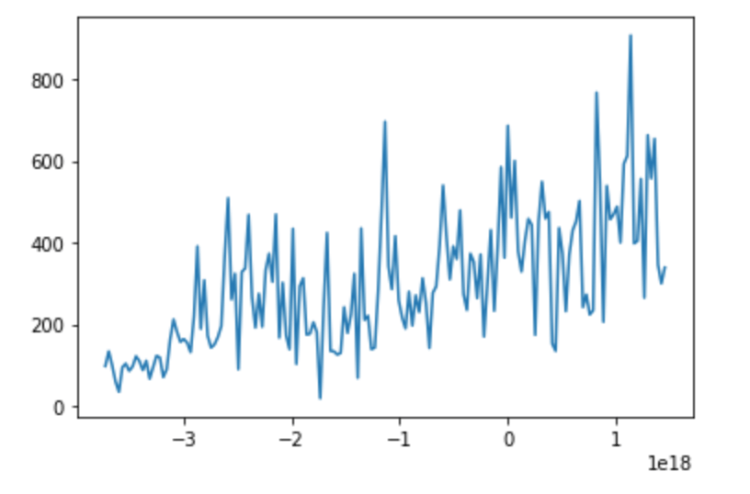
plt.plot(dataset_df.resample(‘Y’).size())

Let’s resample it, but now reset the index


dataset_prophet = dataset_df.resample(‘M’).size().reset_index()

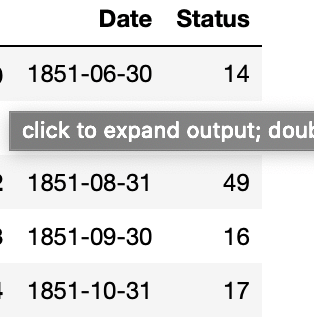
Right now the columns show Date and 0. I will change it to something that makes more sense.

dataset_prophet.columns = [‘Date’,’Status’]

Perfect! Now it has much better names.

Now we need to convert it to the format that facebook prophet accepts.

dataset_prophet = pd.DataFrame(dataset_prophet)
dataset_prophet_final = dataset_prophet.rename(columns = {‘Date’: ‘ds’, ‘Status’:’y’})

Next comes training! With 2 lines of code, we can fit our dataset.

m = Prophet()
m.fit(dataset_prophet_final)

Let’s forecast the future!

future = m.make_future_dataframe(periods=365)
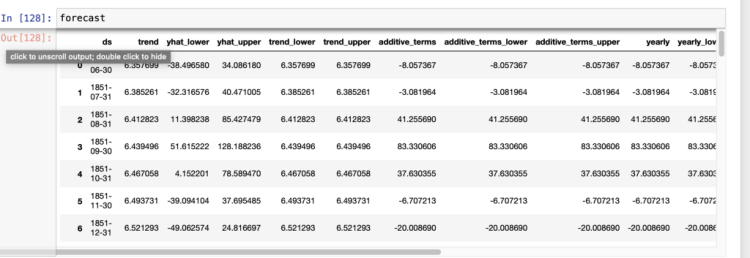
forecast = m.predict(future)

Detailed representation of the output. Some graphs would make it easier to understand.

pd.plotting.register_matplotlib_converters()
m.plot(forecast, xlabel=’Date’, ylabel=’Events’)

I hope you enjoyed it!

Don’t forget to give us your ? !


Hurricane Prediction was originally published in Becoming Human: Artificial Intelligence Magazine on Medium, where people are continuing the conversation by highlighting and responding to this story.

Via https://becominghuman.ai/hurricane-prediction-7077c26405ca?source=rss—-5e5bef33608a—4

source https://365datascience.weebly.com/the-best-data-science-blog-2020/hurricane-prediction

The Working Components Of AI

Source

Artificial Intelligence (AI) is the science of creating intelligent machines and algorithms capable of learning and solving tasks that usually require human intelligence. AI is a major driving force towards digital transformation. The applications of AI keeps expanding; for example, AI is being used to predict the risk of chronic disease, inventory optimisation, fraud detection, to name a few.

Machine learning is a subset of AI, a class of algorithm that learns from examples and experiences rather than relying on predefined rules that characterise traditional algorithms. An algorithm is simply a sequence of instructions that a computer carries out to transform input data to output data. A recipe is an excellent example of an algorithm because it states what must be done, step by step. It takes ingredients as input and produces an output, the completed meal.

An algorithm is simply a sequence of instructions that a computer carries out to transform input data to output data.

Machine learning algorithms have been used to analyse a wide variety of both structured and unstructured data (images, text, sounds), found patterns and relationships in these datasets and generated meaningful insight. A famous example is an algorithm in self-driving cars that analyses images and classifies it as “pedestrian” or “no pedestrian.” The algorithm is trained by giving it millions of images labelled as “pedestrian” or “no pedestrian”. When properly trained, the algorithm can analyse an unlabeled image and infer with a high degree of precision, whether it is a pedestrian.

Jobs in AI

Traditionally machine learning has also required extensive feature engineering, an approach that merges subject matter experts with data science tools to identify the relevant data representations or features that influence an outcome. We’ll learn shortly of modern machine learning algorithms that can determine the right features from the data.

Machine learning is grouped into “supervised” and “unsupervised” methods. In supervised learning, the algorithm is trained using labelled training data like in the example of the self-driving car described above, whereas, in unsupervised learning, the algorithm is trained on data without labels, the algorithm finds meaningful patterns or clusters within the dataset. In retail, for example, an unsupervised machine learning can be used to segment customers for marketing purposes.

Photo by Alex Knight on Unsplash

Deep Learning is a subset of machine learning and has contributed a significant growth to the advancement of AI in recent times. For example, we mentioned feature engineering as a traditional approach employed by a data scientist to build solid models, in deep learning, however, the relevant features are not predefined by data scientist but instead learned by the algorithm.

Top 4 Most Popular Ai Articles:

1. AI for CFD: Intro (part 1)

2. Using Artificial Intelligence to detect COVID-19

3. Real vs Fake Tweet Detection using a BERT Transformer Model in few lines of code

4. Machine Learning System Design

This saves the data scientist a significant amount of time as a huge chunk of their task is devoted to this procedure. Also, for many tasks, it is tough for data scientists to determine features on their own, take image recognition as an example, it’s nearly impossible for a data scientist to extract all the features to train an algorithm in this domain. For such problems, deep learning employs a neural network technology — described below:

Neural network, inspired by the human brain’s network of neurons is a series of algorithms that endeavours to recognise underlying relationships in a set of data through a process that mimics the way the human brain works. Neural networks can adapt to new data; so the network generates the best possible result without having to redesign the output criteria. Think of neural network as a series of chained algorithms with organised hierarchy

In the case of the car recognition task, for instance, the neural network is trained by feeding it a large number of images(with and without cars in them). Each layer of the neural network analyses the various components of the data progressively, identifying edges, corners, contours, rectangles that represent a car’s body and eventually develops the concept of a car. Once appropriately trained, the neural network can be given an image it has not seen before and determines with high precision whether it is a car

Todays CEOs and senior executives should be actively thinking about how AI would affect the landscape in which they function and initiate strategies to innovate and reinvent their businesses processes before a competitor does.

Don’t forget to give us your ? !


The Working Components Of AI was originally published in Becoming Human: Artificial Intelligence Magazine on Medium, where people are continuing the conversation by highlighting and responding to this story.

Via https://becominghuman.ai/the-working-components-of-ai-26f7b0ca61de?source=rss—-5e5bef33608a—4

source https://365datascience.weebly.com/the-best-data-science-blog-2020/the-working-components-of-ai

Design a site like this with WordPress.com
Get started