365 Data Science is an online educational career website that offers the incredible opportunity to find your way into the data science world no matter your previous knowledge and experience.
Also: Automated Machine Learning: The Free eBook; Sparse Matrix Representation in Python; Build and deploy your first machine learning web app; Complex logic at breakneck speed: Try Julia for data science
In recent years, machine learning has become an extremely popular topic in the technology domain. A significant number of businesses — from small to medium to large ones — are striving to adopt this technology. Machine learning has started to transform the way companies do business and the future seems to be even brighter.
However, still lots of companies that feel hesitant when it comes to implementing this technology, mainly because of uncertainty about what is machine learning, what are its key characteristics that make it one of the most useful advancements in the tech landscape.
In this post, we’re going to take a closer look at machine learning and discuss its seven key characteristics that have made it extremely popular.
1- What is machine learning?
Put simply, machine learning is a subset of AI (artificial intelligence) and enables machines to step into a mode of self-learning without being programmed explicitly. Machine learning-enabled programs are able to learn, grow, and change by themselves when exposed to new data. With the help of this technology, computers can find valuable information without being programmed about where to look for specific piece information. Instead, they achieve it by utilizing algorithms which iteratively learn from data.
Machine learning is unique within the field of artificial intelligence because it has triggered the largest real-life impacts for business.
Due to this, machine learning is often considered separate from AI, which focuses more on developing systems to perform intelligent things.
While the core concept of machine learning isn’t a new one, the ability to apply complicated mathematical calculations to big data automatically — quickly and iteratively — is a recent development.
2- Key characteristics of machine learning
In order to understand the actual power of machine learning, you have to consider the characteristics of this technology. There are lots of examples that echo the characteristics of machine learning in today’s data-rich world. Here are seven key characteristics of machine learning for which companies should prefer it over other technologies.
2.1- The ability to perform automated data visualization
A massive amount of data is being generated by businesses and common people on a regular basis. By visualizing notable relationships in data, businesses can not only make better decisions but build confidence as well. Machine learning offers a number of tools that provide rich snippets of data which can be applied to both unstructured and structured data. With the help of user-friendly automated data visualization platforms in machine learning, businesses can obtain a wealth of new insights in an effort to increase productivity in their processes.
2.2- Automation at its best
One of the biggest characteristics of machine learning is its ability to automate repetitive tasks and thus, increasing productivity. A huge number of organizations are already using machine learning-powered paperwork and email automation.
AI Jobs
In the financial sector, for example, a huge number of repetitive, data-heavy and predictable tasks are needed to be performed. Because of this, this sector uses different types of machine learning solutions to a great extent. The make accounting tasks faster, more insightful, and more accurate. Some aspects that have been already addressed by machine learning include addressing financial queries with the help of chatbots, making predictions, managing expenses, simplifying invoicing, and automating bank reconciliations.
2.3- Customer engagement like never before
For any business, one of the most crucial ways to drive engagement, promote brand loyalty and establish long-lasting customer relationships is by triggering meaningful conversations with its target customer base. Machine learning plays a critical role in enabling businesses and brands to spark more valuable conversations in terms of customer engagement. The technology analyzes particular phrases, words, sentences, idioms, and content formats which resonate with certain audience members. You can think of Pinterest which is successfully using machine learning to personalize suggestions to its users. It uses the technology to source content in which users will be interested, based on objects which they have pinned already.
2.4- The ability to take efficiency to the next level when merged with IoT
Thanks to the huge hype surrounding the IoT, machine learning has experienced a great rise in popularity. IoT is being designated as a strategically significant area by many companies. And many others have launched pilot projects to gauge the potential of IoT in the context of business operations. But attaining financial benefits through IoT isn’t easy. In order to achieve success, companies, which are offering IoT consulting services and platforms, need to clearly determine the areas that will change with the implementation of IoT strategies. Many of these businesses have failed to address it. In this scenario, machine learning is probably the best technology that can be used to attain higher levels of efficiency. By merging machine learning with IoT, businesses can boost the efficiency of their entire production processes.
2.5- The ability to change the mortgage market
It’s a fact that fostering a positive credit score usually takes discipline, time, and lots of financial planning for a lot of consumers. When it comes to the lenders, the consumer credit score is one of the biggest measures of creditworthiness that involve a number of factors including payment history, total debt, length of credit history etc. But wouldn’t it be great if there is a simplified and better measure? With the help of machine learning, lenders can now obtain a more comprehensive consumer picture. They can now predict whether the customer is a low spender or a high spender and understand his/her tipping point of spending. Apart from mortgage lending, financial institutions are using the same techniques for other types of consumer loans.
2.6- Accurate data analysis
Traditionally, data analysis has always been encompassing trial and error method, an approach which becomes impossible when we are working with large and heterogeneous datasets. Machine learning comes as the best solution to all these issues by offering effective alternatives to analyzing massive volumes of data. By developing efficient and fast algorithms, as well as, data-driven models for processing of data in real-time, machine learning is able to generate accurate analysis and results.
2.7- Business intelligence at its best
Machine learning characteristics, when merged with big data analytical work, can generate extreme levels of business intelligence with the help of which several different industries are making strategic initiatives. From retail to financial services to healthcare, and many more — machine learning has already become one of the most effective technologies to boost business operations.
Whether you are convinced or not, the above characteristics of machine learning have contributed heavily toward making it one of the most crucial technology trends — it underlies a huge number of things we use these days without even thinking about them.
3- Why the adoption of machine learning is getting thwarted?
It isn’t possible to predict whether machine learning-enabled systems will replace human workers or not. But it can be said that the biggest factor which is slowing down the advancements of cutting-edge technologies like machine learning is the lack of human skills. A new survey conducted by Cloudera reveals that for 51% of business leaders across Europe, it’s the skills shortage that was holding them back from implementation.
Machine learning, in a similar way like data science, is progressing in a clearly different way. As this technology trend involves capturing, collating, and interpreting data, an effective machine learning professional needs to a master of a huge number of disciplines — from mathematics and statistics to programming — all are required. As you may already imagine, machine learning is pretty complicated stuff and thus, it has become actually difficult for business leaders to find the right candidates who can help them to meet their digital transformation goals.
Those who are interested to become a machine learning professional should choose their learning avenue wisely. Though there are different types of avenues available including self-learning, traditional approach, bootcamps etc, most of them come with their own disadvantages. Given the broad spectrum of machine learning domain and its rapid advancements, aspirants need to understand that no course is actually comprehensive enough. If you too are interested in stepping into this field with real-life knowledge and possess the core skills to some extent, joining a bootcamp like the ones offered by Magnimind Academy would be a good idea.
Final Takeaway
These days, machine learning is gaining serious momentum throughout the world and it has become one of the key responsibilities of senior executives to steer their business in the right direction by leveraging its true characteristics.
We are at the verge of entering a world where machines and humans will work in harmony to collaborate, campaign, and market their products/services in an innovative way which is more personal, effective, and informed than ever before.
In order to attain this, it is the time for business owners to think about how they can leverage machine learning characteristics, how they want the technology to operate and behave to take the business forward. It’s also important to roll out an effective and transparent strategy encompassing machine learning. It’ll help the teams to understand how they can perform their tasks more effectively by embracing the power of machine learning.
As you are reading this, you’re probably locked down under quarantine for several weeks already and you don’t have much to do. It’s likely that you were thinking about doing something creative with your time, like drawing or making music, but you were never really into that and you feel too lazy to learn. If my guess is correct, I have some good news for you. Newest Artificial Intelligence technology is here to help. In this post, I will describe three awesome tools that enable you to channel you imagination and create something beautiful in collaboration with an AI. I will get a bit technical in the descriptions, but don’t worry, you don’t need to understand that to use the tools. They don’t require any programming knowledge or special skills. The only thing you need is an open mind and a dose of courage.
Artbreeder
The website artbreeder.com is a cool new project that lets you create beautiful, dream-like art by making mixtures of pictures and ideas. It gives you the possibility to explore and interact in a simple way with a brilliant technology of Generative Adversarial Networks, or GANs.
Jobs in Big Data
If you’re not familiar with it, here is a quick explanation. GAN is a technology created for synthesizing images, based on an interaction between two neural networks. The program is given a set of images, for example depicting dogs. One of the networks tries to create a picture that looks as if it comes from that set. The other one, given that image has to judge whether that image is real or generated. They have opposite tasks, and when they try to outsmart each other, they learn really well how to generate and recognize images of various objects. If you train your network on, for example, dogs and pandas, you can use the learned representations to create something that tries to look as a dog and a panda simultaneously, which results in a beautiful pandog, like this one:
Artbreeder is built on top of BigGAN, a huge generative network trained on 150 GB dataset of pictures, with dozens of different classes including animals, plants, buildings and everyday objects. Later they expanded by adding new models based on landscapes, faces, album covers, anime girls and recently, video game characters. Each picture you create has an internal representation in a continuous space of possible pictures. You can freely move around that space, which means that you can create a mix of a cat, a cauliflower and a jellyfish and adjust with sliders how much of each you want. These sliders also take negative values, which means you can see how the opposite of a cat looks like according to the network. The community aspect of the website is very important — you can take existing pictures and change them by adding new components or mixing them together. Every image has its history available, letting us trace back what it was bred from.
The images created by the network look very bizarre and surreal, in a way that makes them fascinating. It creates objects that often resemble something, but nothing you could name and identify, residing in the fuzzy space in-between, open for interpretations. I have a feeling they somehow touch the deep, unconscious parts of my mind, the same way weird, incomprehensible dreams do.
The website deepdreamgenerator.com offers another great and easy to use tool for visual art — style transfer. This technology also relies on deep neural networks and enables us to take two images — one for content and one for style, and create a blend between them. It brilliantly utilizes the structure of convolutional neural networks that are used for image recognition. In the early layers of processing, the network looks for small, simple patterns a few pixels in size — straight lines, curves, circles. Then, in next layers, it gradually builds more complex representation using these low-level ones, up to a level of complex shapes like faces, cars and animals. The style transfer algorithm modifies an image in such a way that the small, low-level representation become more similar to the ones in the style image while keeping the high-level features as intact as possible. This way, the general shapes and structures of the content image are preserved, but the style changes. Here is an example I made:
Content + style = A R T
I hope you get the basic idea. This tool is as simple to use as it gets —you just choose two pictures, optionally tune a few parameters, and let the algorithmic magic do the rest. At the same time, it’s incredibly powerful. With a smart combination you can create high quality, powerful art that is novel and unlike either of the images you start with. I like to use it to create abstract patterns like the ones you can see below. They are made from pictures of simple things around me, like curtains or plants.
The website is completely free to use and has a great community that can serve as a source of inspiration and cool style images.
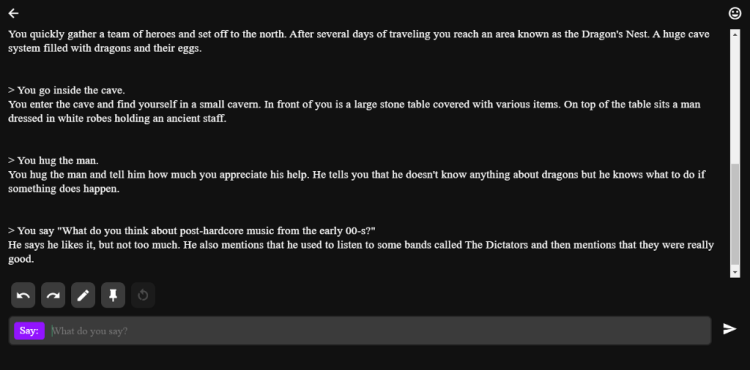
If you have ever played an RPG video game, you probably experienced at some point that although the world seems big and filled with opportunities at the beginning, you later discover that the set of actions you can take is actually very limited. That is not the case with the project called AI Dungeon. It is a text-based AI-powered RPG game, where the possibilities are literally infinite. You don’t have to choose your actions out of any set, but you can type anything you want, and let the artificial Dungeon Master decide what happens next. This way, it is not only a game, but a creative endeavor, a story you create in collaboration with an AI.
The program running the game is built on top of GPT-2, a neural network model that was trained on a huge database of text in English to learn the structure and dependencies of human language. When the famous OpenAI lab first created GPT-2, at first they didn’t want to release it to the public because it was supposedly too powerful and could be easily abused for misinformation. You can type in any scenario, even really absurd, and the model will make some sense of it. Even though it does not have any explicit knowledge about the world and the events, it has enough understanding to make a coherent, convincing story including several characters and a chain of events. Sometimes you can see that it doesn’t really understand how the real world works, but it gives an interesting, surreal vibe to the adventure.
The website has a lot of cool features and is being constantly developed. The initial setting of your story can include: fantasy, mystery, apocalyptic, zombies, cyberpunk or a custom one. There is also a community, where you can share and read the generated stories. Another great thing is a dedicated phone app.
I hope you found these interesting, and maybe will use them to fight boredom and look for inspiration. All these websites appeared in the last 2 years and are still fresh, exploratory and underdeveloped. I’m sure that this field will mature and provide us with more and more AI tools that will open new dimensions for both amateur and professional artists.
Stanford’s Natural Language Processing with Deep Learning is one of the most respected courses on the topic that you will find anywhere, and the course materials are freely available online.
Designing a Covid-19 drug from the perspective of a Data Scientist/Aerospace engineer
Source
Like any other design problem we’ll start by framing the Covid-19 drug design as an optimization problem.
To that end, our objectives are:
Maximize drug potency, how efficiently a drug disrupts the virus activity
Minimize the synthesis cost, how “easy/cheap” it is to manufacture the drug
and our design space is:
the entire chemical space (all possible molecules)
Jobs in Big Data
To be able to solve the aforementioned optimization problem we need two things:
a) a set of predictive models able to, given as input the representation of a molecule, predict our 2 objective functions. For the data scientists among us, this refers to the predictive analytics part of our solution.
b) an effective and efficient Optimization algorithms able to operate on discontinues (non-differentiable) design spaces (as is the chemical space) and able to solve multi-objective optimization problems. This is the prescriptive analytics part of our solution.
Predictive Analytics
As far as predicting the drug potency against Covid-19 is concerned, we’ll be using a Gated Graph Sequence Neural Network (originally introduced here https://arxiv.org/abs/1511.05493) trained on the data published here, predicting MM-GBSA based binding free energy from chemical structure.
For our optimizer, we selected Evolutionary Algorithms (EAs) due to their well known ability to solve multi-objective optimization problems and the fact that they can do so without requiring gradient information (hence they can handle non-differentiable design spaces).
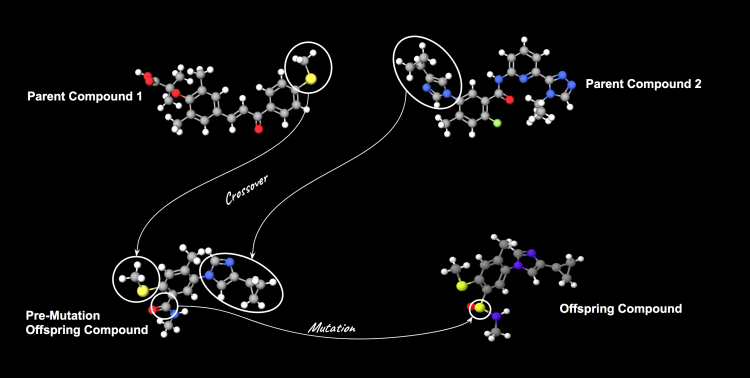
EAs utilize the main principles of Darwinian evolution, evolving better and better molecules as generations proceed. They do so by selecting parents based on their environmental fitness (demonstrated good behavior regarding the selected objectives) and breeding new individuals via crossover and mutation (see figure 2).
Figure 2; Crossover and Mutation as applied on Chemical space
Results
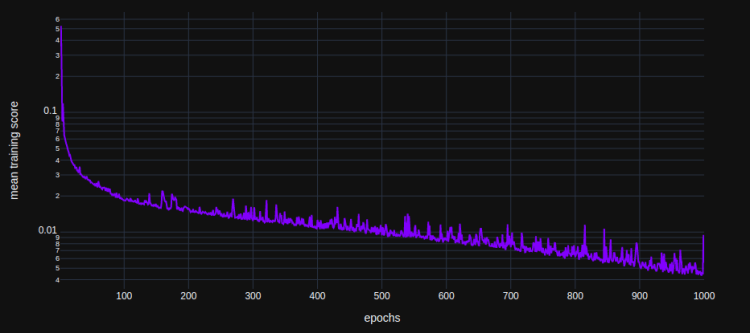
The result of every multi-objective optimization is in the form of a Pareto front denoting all the best (non dominated) compromises between the objectives. Below is the computed Pareto Front approximation of the Covid-19 drug design problem (after 40 generations of evolution). For comparison the potency of lopinavir (a drug currently undergoing clinical trial for Covid-19) is noted with the dotted line.
Figure 3; Pareto Front after 40 Generations
Epilogue
We’ve seen that reframing drug design from a simple (but expensive) screening exercise to a multi-objective optimization problem could be beneficial.
We’ve also seen that methods borrowed from Machine Learning and numerical optimization could be used when undergoing such a task.
Caveats
The purpose of this post was to present a different way of thinking about the drug design problem and NOT to design a new compound.
The results of the optimization (Pareto front) heavily relay on the quality of the predictive models utilized. Models who’s accuracy I have no way of validating! In fact I would suspect that accurate predictive modeling would involve chemical/physics/quantum simulations which would be vastly more computationally demanding than the simple GGNN used here.
To handle that extra computational cost, a very interesting next step would be to borrow a method typically used in aerospace engineering, the notion of Distributed Hierarchical Optimization. More about that on a following post.
Many statisticians in industry agree that blindly imputing the missing values in your dataset is a dangerous move and should be avoided without first understanding why the data is missing in the first place.
Agile project management for Data Science development continues to be an effective framework that enables flexibility and productivity in a field that can experience continuous changes in data and evolving stakeholder expectations. Learn more about the leading approaches for developing Data Science models, and apply them to your next project.
Now, I can almost hear you asking why you need to reduce the number of requests when scraping in the first place.
Let me explain.
Why Limit Your Rate of Requests?
First, let’s consider the matter from an ethical point of view. Your program should be respectful to the site owner.
Remember that every time you load a web page, you’re making a request to a server. When you’re just a human with a browser, there’s not much damage you can do.
With a Python script, however, you can execute thousands of requests a second, intentionally or unintentionally. The server then needs to process every request individually. This, combined with the normal user traffic, can result in overloading the server. And this overload can manifest in slowing down the website or even bringing it down altogether.
Such a situation usually degrades the experience of real users and can cost the website owner valuable customers.
Obviously, we don’t want that. In fact, if done intentionally, this is considered a crime – the so-called DDOS attack (Deliberate Denial of Service), so we better avoid it.
Given the potential damage this easy technique can do, servers have started employing automatic defense mechanisms against it.
One form of such protection against spammers may be to temporarily block a user from the service if they detect a big amount of activity in a short period of time.
So, even if you are not sending huge numbers of requests, you may get blocked as a preventive measure. And that’s precisely why it is important to know how to limit your rate of requests.
How to Limit Your Rate of Requests When Scraping?
Let’s see how to do this in Python. It is actually very easy.
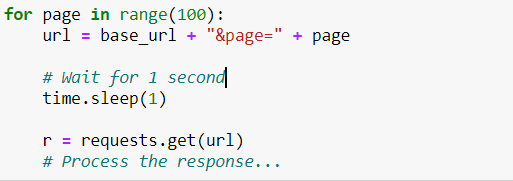
Suppose you have a setup with a “for loop” in which you make a request every iteration, like this:
Depending on the other actions you take in the loop, this can iterate extremely fast. So, in order to make it slower, we will simply tell Python to wait a certain amount of time. To achieve this, we are going to use the time library.
It has a function, called sleep that “sleeps” the program for the specified number of seconds. So, if we want to have at least 1 second between each request, we can have the sleep function in the for loop, like this:
This way, before making a request, Python would always wait 1 second. That’s how we will avoid getting blocked and proceed with scraping the webpage.
So, this is one more web scraping roadblock you now know how to deal with.
I hope this tutorial will help you with your tasks and web scraping projects.
The course is part of the 365 Data Science Program. You can explore the curriculum or sign up for 12 hours of beginner to advanced video content for free by clicking on the button below.





























 365 Data Science