365 Data Science is an online educational career website that offers the incredible opportunity to find your way into the data science world no matter your previous knowledge and experience.
This book teaches linear algebra and optimization as the primary topics of interest, and solutions to machine learning problems as applications of these methods. Therefore, the book also provides significant exposure to machine learning.
Python comes with a lot of handy and easily accessible libraries and we’re going to look at how we can deliver text-to-speech with Python in this article.
Also: Satellite Image Analysis with fast.ai for Disaster Recovery; Machine Learning in Power BI using PyCaret; Deep Learning: The Free eBook; 24 Best (and Free) Books To Understand Machine Learning
Demografyis a privacy focused customer segmentation SaaS that usesAIto predict demographic data from masked names.
Unlike traditional solutions, businesses don’t need to know and disclose their customers’ sensitive information. This makes Demografy privacy by design and enables businesses to get 100% coverage of any list.
KEY TAKEAWAYS
AI and machine learning is a frontline in fighting COVID-19
However tech community critically lacks individual case data
Demografy’s potential application in appending incomplete data
ML Jobs
SOME BACKGROUND
Private companies’ fighting against COVID-19 is not limited to mass production of medical equipment, test kits development and vaccine research. Another frontline in fighting COVID-19 is data. And advances in Artificial Intelligence is our weapon in this fight.
Today the tech community is being increasingly employed in fighting COVID-19. You can find many data projects that apply AI to COVID-19 data. For example, one of the biggest initiatives is CORD-19 dataset where thousands of scientific papers about COVID-19 are fed to AI and NLP to provide medics and scientists with fast access to mission critical information. There are also plenty of others Kaggle challenges involving aggregated COVID-19 data.
But one of the biggest gaps in available COVID-19 data is a lack of individual case data. Case data would enable the tech community to build principally new solutions to COVID-19. It would make possible to build machine learning predictive models that find correlation between a person’s medical condition, symptoms, treatment and other data. For example, it could allow AI to find optimal treatment for specific demographics, predict spread of disease in areas populated with specific demographic groups and many more.
Although there are plenty of aggregated data (e.g. cases by country / state) published online, we miss case by case data. Case data can be in the form of:
However, unlike CORD-19, case data is not publicly available to tech community. Even though citizen science and public involvement of tech companies, independent researchers and other parties has proven its efficiency, case data remains unavailable and useless. Perhaps only large tech companies have access to patient data via their cooperation with hospitals and authorities.
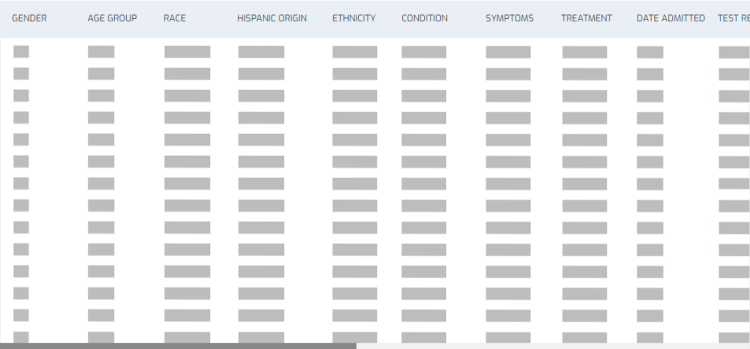
But the larger share of the tech community doesn’t have a privilege of access to such data. And sometimes this larger share of smaller entities contributes most to the solution. One of the possible excuses to not publish case data is privacy concerns about disclosing data containing at least partially individual medical records. Though we can solve this problem by stripping all personally identifiable information from this data.
Data like the one below actually doesn’t pose risks of identity theft and privacy violation:
And this data is especially vital in order to build real world AI tools to combat COVID-19. That would enable researchers and tech companies to build predictive models that predict best treatments for specific demographic groups. That would allow to provide vital demographic data for scientists developing vaccines. That would allow to provide decision makers with actionable analytics and insights. That would allow to develop fast decision making tools for medics to make an early, definitive diagnosis and prepare relevant treatment for each particular case. There are plenty of other possible applications that the AI community can come up with having vital case data at hand.
Even if we have case data published, there is another problem. Its incompleteness. Demographic data is the most important information in patient case data after medical information like condition, treatment, medication, test results, etc. It’s impossible to build demographic-centric models without having demographic data for cases at hand.
However demographics is not always present in medical records. In most cases it is limited to sex and age or racial data is not always available. For example, according to John Hopkins University of Medicine:
9 states don’t provide race data for confirmed COVID-19 cases
12 states don’t provide race data for COVID-19 related deaths
48 states don’t provide race data for COVID-19 testing
How can we append missing demographic data to case data? Traditional solutions include data append services or data brokers. They usually require personally identifiable information since they use consumer databases and try to match records in these databases in order to provide additional information. For obvious reasons, it’s not the case for medical case data since it jeopardizes privacy. Besides this, data append services provide low coverage and unexpected accuracy.
Possible alternative is to use privacy by design solutions like Demografy. Demografy’s key difference from traditional data append is that it relies on machine learning instead of consumer databases. It uses machine learning to predict demographics using non personally identifiable information as input. It can use only first and masked last names to hide identities. E.g. John J*son. Thus identities in list remain safe. Privacy focused solutions are must in order to make it even possible to use case data with third-parties.
In case of COVID-19 case data, we have the following proposal how Demografy can be used as privacy safe proxy between data owners and general public:
1. Healthcare organizations, authorities and other parties possessing COVID-19 case data share only first and masked last names with Demografy (without full names and without medical information like symptoms and treatment)
2.Demografypredicts missing demographic data for provided masked names
3. Tech community then has access to richer data containing both demographics (gender, age, race, ethnicity, etc) and medical information (symptoms, treatment, condition, etc) but without full names and other personally identifiable information.
However we have little to do without an action from authorities and/or healthcare organizations. They have case data but they are still reluctant to share it with the tech community.
Meanwhile Demografy offers its services for free to any non-profit COVID-19 initiative — https://demografy.com/covid19 . Contact us if you want to find out more.
Artificial intelligence(AI) has become the name that is used to describe all the technologies that can simulate human intelligence. AI is a technique that teaches computers to parse data contextually. This helps in providing requested information, supply analysis, or trigger an event based on the findings. AI app development companies create apps that can perform all these tasks efficiently.
As a big hit among top CMOs today, AI is highly admired as a way to save time and money. Indeed, a global study by Salesforce this year indicated that more than half of marketers are already using AI, and over a quarter will follow suit over the next two years.
ML Jobs
But the question that draws our attention here is:
What is AI marketing?
AI marketing uses technologies related to artificial intelligence to make automated decisions based on data collection, data analysis, and additional observation of audiences or economic trends that may impact marketing efforts.
AI is often used in marketing efforts, where speed is essential. AI tools use data and customer profiles to learn how to best communicate with customers, then serve them with tailored messages at the right time without intervention from marketing teams, ensuring maximum frequency.
There are a few use cases in AI marketing as follows:
Data analysis
Natural language processing
Media buying
Automated decision making
Content generation
Real-time personalization
Now, that we know about AI, let us discuss the benefits of implementing artificial intelligence in marketing.
9 Benefits Of AI in Marketing:
Artificial intelligence, predictive insights, machine learning you can call it what you want. Artificial intelligence is here to make the life of marketers easier.
1- Automatic Interactions with Customers:
Today, most customer interactions require human interaction. This includes emails, social media conversations, online chats, and telephone calls. However, with Artificial Intelligence, companies can automate this process of communication.
This is possible by analyzing data from previous conversations and then programming the computers for accurately responding to customers and then dealing with their inquiries. Further, when AI is combined with Machine Learning, the platform interactions become even better.
2- Improving Personalised Shopping experiences:
Companies are taking advantage of Artificial Intelligence because it enables them to provide their patrons with personalized marketing. This helps in increasing customer engagements, enhances customer loyalty, and improves sales.
Another advantage of Artificial Intelligence is that it can identify the patterns in customers’ habits of browsing and buying behavior. This helps the companies to craft highly accurate offers to individual customers.
3- Data Mining becomes easy-peasy:
Cloud-based Artificial Intelligence apps are so advanced that they can quickly discover all the essential information and relevant findings while processing big data.
Data mining using AI gives businesses insights that were previously undiscovered, providing a significant advantage in the marketplace.
4- Realtime Assistance:
Artificial Intelligence is fantastic for businesses that need to communicate continuously with high volumes of customers each day.
For instance, in the transport industry, train, bus, and airlines, companies can use AI-powered apps to interact with customers in real-time by sending personalized travel information.
5- Predicting Outcomes:
Artificial intelligence is excellent in the sense that it can predict outcomes based on data analysis.
For instance, it detects patterns in customer data that show if the products currently on sale are likely to sell and the volume in which it will do so.
It can also predict when the demand for products will increase or decrease. This is essential information in helping a company purchase the right stock, in the right amount.
6- Smart Advertising on Social Media:
By incorporating Artificial intelligence software, you can create smart advertisements for your business.
For instance, if you are a restaurant owner, then advertising is essential for you. Backing your social media advertisement campaign with Artificial Intelligence is a game-changing step.
AI software allows an insightful analysis of your restaurant and your customers online. You can hire AI developers and implement AI in your marketing strategy. This will help you to utilize your available data to become smarter and reach potential customers with compelling ads.
7- Reduced Marketing costs for the best ROI:
If you own a business, then there is a high probability that you are spending a lot of money on advertisements without seeing any results. Targetable is a lot less expensive and is powered by Artificial Intelligence to give you the best ROI.
Another good thing with automated AI is that it saves time and marketing costs while making the customer experience more personalized and efficient.
8- AI can decide what content to design and when to distribute it:
Did you know that 47% of the marketers say scaling up their content marketing efforts is their biggest challenge?
AI software development companies can make this job easy for you by streamlining content creation and handling distribution for you.
Artificial Intelligence can understand open forms of communication. This means that it can understand and learn your personality by tracking emotion in your social media posts. From there, it embodies your brand’s voice to create content that resonates with your audience and sounds like you.
9- Machine Learning and Continued Learning:
One of the benefits of Artificial Intelligence is its power of machine learning. Now the question is, What is Machine Learning? It is the AI that can learn and improve from its own experiences without being programmed again and again.
Machine learning focuses on computer programs that access data and uses it to learn from themselves. Using AI software is a great way to learn about trends related to your business. Data collected from various sources are used by it. This way machine learning and continued learning go hand in hand.
From these benefits, we can draw one more thing, and that is the
Impact of Artificial Intelligence on business.
By deploying the right AI technology, your business may gain the following abilities:
Save time and money by automating routine processes and tasks.
Increase productivity and operational efficiencies.
Brand improvement.
Enhanced targeting of the audience based on trends.
AI makes faster business decisions based on outputs from cognitive technologies.
Choosing a good AI software development company reduces the risk of mistakes and human errors.
Uses insights to give a better and personalized experience to your user.
Increases revenue by identifying and maximizing sales opportunities.
Grow expertise by enabling analysis and offering intelligent advice and support
Is your business capitalizing on AI?
As you can see, there are countless benefits and impacts of Artificial Intelligence on your business, including customer service, personalized marketing, operational automation, inventory management, and the list can certainly go on.
If your business has yet not decided about whether to switch to Artificial intelligence software or not, then you must get in touch with the best in class software development company. This will help you get a personalized experience for your business.
Feel free to give any suggestions or ask any queries in the comment section below. Cheers!
When it comes to implementing AI projects in companies, we have noticed a trend: those people in charge want their project to be A REAL BIG DEAL— after all, this is about AI. And that is totally understandable and definitely should be the case. Have big wishes, have great expectations! But also plan the project thoroughly to know what’s your goal and where to start.
For most AI related projects we believe it’s better to start small although you’re thinking big. Don’t plan a monster project to cover everything you can think of at the beginning. Instead break your project into the smallest possible piece which still provides value. To do so, you often need to adjust the use case.
ML Jobs
Your Idea Is Your Compass
To make your AI project a big deal, keep your original idea. It’s your overall vision. Take this idea as your compass, pointing you in the right direction towards your long-term goal. But to have quick results, you should start with a tiny project.
Advantages of Starting Small
The advantages of a tiny initial project are both practical and commercial. Therefore, do not hesitate to use them as a basis for argumentation when trying to start an AI project in your company.
#1 Small Risk of Failure
The larger a project is, the greater the risk that it will fail. This is because there are many things to consider in a large project. Many problems and pitfalls only become apparent on the way. And the bigger the project, the more uncertainties you have. Therefore, it’s a good advice to reduce the project scope into the smallest possible project which still creates added value and start with that.
Boiling down the initial project idea to the smallest possible goal results in a project with clear scope which can be easily communicated and avoids investments that do not create added value.
#2 Low Costs
Of course, a small project costs less than a large project. This means two things: First, it’s often easier to get the budget approval if the needed investment isn’t that big. Second, the financial risk is minimized as well.
The commitment needed to start an AI project is therefore not big.
#3 Faster Time to Market
You can implement and release a small project more quickly than a large project. This also enables user feedback and insights from real world usage more quickly. These insights can then be incorporated into next development steps which ensures that your project remains valuable and relevant for real users.
#4 Start With Few Data
As we explained in a previous article, the quality of training data is everything. But often you have very little training data at the beginning of an AI project. Sometimes you can avoid a massive investment for better training data if at least one of the following can be done:
You can reduce the scope and thus the needed data the AI is applied to (for instance recognize the most important products instead of all products).
You can still get value from an AI with low quality predictions (for instance use AI as an assistence system instead of an automated process without the possibility to intervene).
If you can start with few training data, you can collect more data over time and your project is already adding value to your business.
We very much hope you can use some of the above mentioned for your own project planning. If you need an experienced helping hand with your AI project drop us a line. We’d love to hear from you!
Big Data generated by people — such as, social media posts, mobile phone GPS locations, and browsing history — provide enormous prediction value for AI systems. However, explaining how these models predict with the data remains challenging. This interesting explanation approach considers how a model would behave if it didn’t have the original set of data to work with.
More and more programmers are learning the R programming language to become a Data Scientist, one of the hottest and high paying technical jobs on the planet.
Even though I am from the Python camp, when it comes to choosing between Python and R for Data Science, Machine Learning, and Artificial Intelligence, mainly because of the excellent libraries like TensorFlow Python offers, I had tried R for a short time.
Jobs in AI
If you are also on the same boat and want to try or learn R programming for Data Science and Machine learning purpose and looking for some excellent free courses to start your journey, then you can take some ideas from this article.
In the past, I have shared some machine learning courses on Python, and today, I am going to share some of the free courses to learn R programming language as well as Data Science and Deep Learning using R.
Btw, for those, who are not familiar with R, it’s a programming language and a free software environment popular among statisticians and data miners for developing statistical software.
R burst into the scene with its robust support for stats (linear and nonlinear modeling, classical statistical tests, time-series analysis, classification, clustering, …) and graphical techniques. Still, in recent years, it has gained a lot of popularity among Data Scientist and Data minors.
Along with Python, R is the second most popular language to learn the new world of Data Science, Machine Learning, Deep Learning, and Artificial intelligence.
5 Free R Programming Courses for Data Scientists and Programmers
When you look for free R tutorials and courses, you will find a lot of classes, but most of them are neither complete nor up-to-date. There are very few excellent quality courses and tutorials that are freely available.
This article is a collection of such free R programming courses. I compiled this list for learning Data Science and Machine learning with R,. Still, this list is equally useful for people learning R programming for statistics and graphics purposes, which is another strength of this excellent programming language.
Anyway, without any further ado, here is my list of some of the best, free online courses to learn R programming language.
This is one of the best and excellent course to get a general overview of the R programming language in Coursera , and I strongly suggest you go through this course before starting with any other class.
Like many Coursera courses, this is also free if you want to learn and explore, but you need to pay if you wish to a certificate as well. It won’t take much time to finish, and you will learn both the historical background of R as well as where does it stand now.
This course will make you familiar with the R programming language; it’s terminology, features, syntax, and other stuff.
This is another free R programming course from Udemy and perfect for learning R programming from scratch.
The course contains more than 4 hours of content and 2twoarticles. Its step by step approach is great for beginners and Martin has done a wonderful job to keep this course hands-on and simple.
You will start by setting up your own development environment by installing the R and RStudio interface, add-on packages, and learn how to use the R exercise database and the R help tools.
After that, you will learn various ways to import data, first coding steps including basic R functions, loops, and other graphical tools, which is the strength of R
The whole course should take approx. 3 to 5 hours to finish, and there are exercises available for you to try out whatever you have to learn in R. You will also get access to the Martin Code (The instructor) is using for the demos.
In short, one of the best free courses to learn R programming in 2020.
This is the R programming course which will introduce Data Science with R. It has over 8.5 hours of material and touches most of the R concepts which are useful for Data scientists.
You will learn basics of Data Science like what is Data Science, data types, Vectors, Factors, List, Matrices, Data Frames, and Reading Data from files, Oracle Data using RJDBC, RODBC, and ROracle.
The Instructor Ram Reddy is a Data scientist himself and founder of RRITEC, a company dedicated to helping scientists better understand and visualize their data.
Though the course is good in terms of understanding fundamentals of both R and Data Science, it lacks some real-world examples and business scenarios, which you can find on @Kiril Eremenkoon’s R Programming A-Z™: R For Data Science With Real Exercises! course.
If you can spend a couple of dollars then that is the best resource to learn Data Science with R. You can grab this course on just $9.9 which is fully worthy of your money.
Apart from Statistics, Graphics, Data Science and Machine Learning, R is also growing on the Business Analytics platform. It’s possible that R may become one of the most used Business Analytics tools in nature future.
It is giving strong competition to giants like SAS, SPSS, and other erstwhile business analytics packages.
If you are someone who wants to learn Business Analytics and want to leverage R’s capability then this is the perfect course for you.
As the instructor says this course is designed specifically for someone who knows the basics of Business Analytics and wants to learn the implementation of those skills on the R platform.
In this course, you will learn how to download and install R programming packages, IDE like RStudio. You will also learn how R can be leveraged in Business Analytics.
The course is also hands-on and you will learn how to import Data in R and perform exploration and transformation activities, perform bivariate analysis and plot charts in R to understand data distribution and run correlation and regression in R to analyze model results.
This is rather old but one of the most popular free R programming courses on Udemy which will teach you Data Science with R.
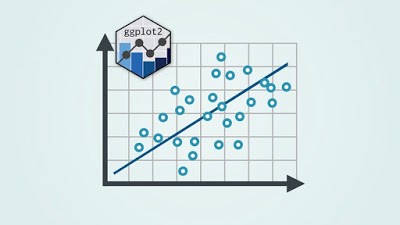
In this course, you will learn how to start with R programming and use the excellent graphics package for R, ggplot2. Along the way, you will also learn Data Science concepts like the basics of simple linear regression.
There are no prerequisites, so anyone interested in R, ggplot or data science and join this course.
The course starts with the installation of R and RStudio and then explains R and ggplot skills as they are needed when you progress toward an understanding of linear regression.
That’s all about some of the best free courses to learn R Programming language, particularly for Data Science and Machine learning. It’s true that many programmers are learning R for just those two reasons, R has other advantages as well, particularly on statistics. If your job involves a lot of statistics and graph work, R could be a good tool in your arsenal.
Thanks, You made it to the end of the article … Good luck with your R Programming journey! It’s certainly not going to be easy, but by following this roadmap and guide, you are one step closer to becoming the Data Scientist you always wanted to be.
If you like this article, then please share it with your friends and colleagues, and don’t forget to follow javinpaul on Twitter and of course (javinpaul) on Medium!












 365 Data Science