
Building a digital workforce is a critical endeavour for any organisation in the twenty first century. The events of last couple of months…
Continue reading on Becoming Human: Artificial Intelligence Magazine »
365 Data Science is an online educational career website that offers the incredible opportunity to find your way into the data science world no matter your previous knowledge and experience.
Building a digital workforce is a critical endeavour for any organisation in the twenty first century. The events of last couple of months…
Continue reading on Becoming Human: Artificial Intelligence Magazine »

Both data science and artificial intelligence are extremely talked about topics in today’s technology domain. Both of these technologies are being steadily adopted by businesses across the globe, regardless of industry or domain. However, there is a question often asked by people, particularly those looking to enter any of these fields, regarding how data science and artificial intelligence are connected and how they’re different from each other. In this post, we’re going to take a closer look at both aspects of both the fields to help you obtain a clear idea and take an informed decision.
Before delving deeper, let’s have a quick look at the fundamental concepts of data science and artificial intelligence.
With the emergence of big data coupled with fast computing power, many decision-makers of businesses are trying to identify different ways to attain their business goals. These days, whenever they want to launch something new, they’re looking to data science professionals in order to get demand, market, target demographic, among others.
You can think of data science as an umbrella term for all methods and techniques that professionals use to analyze huge amounts of data in order to derive insights from them.
It’s the general practice of utilizing scientific tools and techniques to draw insights from or find patterns in data. Almost everything is covered by this field — from preparing raw data for analyzing to presenting insights gained from analytics.
What advice do you give someone beginning to learn data science?
Artificial intelligence or AI is a broad term. At its core, it attempts to make machines think like human beings. Any algorithm, code or technique that enables computers to develop, demonstrate, and mimic human cognitive behaviors or abilities falls under the category of artificial intelligence.
An artificial intelligence-powered system can be as complex as driverless cars or as simple as software which plays chess. Within artificial intelligence, there is machine learning which is considered the most exciting part of the field today and for reasons. With the help of machine learning, artificial intelligence has made a significant number of breakthroughs which once seemed nearly impossible. It’s the key reason that computers can steer a car or spot one of your friend’s face in a photo.

Here are some of the major differences between data science and artificial intelligence. It’s important to understand that both of these are extremely popular choices in the tech landscape and the differences mentioned below are completely based on their operational nature.
4 free maths courses to do in quarantine and level up your Data Science skills

Data science is an interdisciplinary domain which requires concepts and skills used in disciplines like statistics, visualization, machine learning etc. Data science is a general term for methods and process which analyze and manipulate data. It empowers artificial intelligence to identify appropriate information and meaning massive volumes of data with higher efficiency and speed. As for the term data science and artificial intelligence, it’s quite easy to become confused. Unfortunately, both of these terms get discussed frequently and casually by some people more interested in hype instead of solving problems, making the scenario even more confusing.
If you want to step into any of these fields, here is the think you need to keep in mind — forget the term artificial intelligence for the time being because machine learning is the biggest and most practical application for this field today. So, machine learning is the technology businesses expect candidates to understand. You can consider data science as the way you wish to implement that machine learning. It’s the real-world application of artificial intelligence with the objective of developing products/services for people.
1. Top 5 Open-Source Machine Learning Recommender System Projects With Resources
4. Why You Should Ditch Your In-House Training Data Tools (And Avoid Building Your Own)
One may argue that data science professionals were working long before the appearance of artificial intelligence as a functional option and there’re applications that don’t exclusively benefit from contemporary artificial intelligence.
In the context of data science, the problem with the conventional approach is that there are massive amounts of data to be analyzed and a limited number of data science professionals to do it.
Non-intelligent methods are very time- and talent-intensive. They can take a huge to come up with results when answers are really time-sensitive. As a matter of fact, artificial intelligence does need data science professionals to set up and monitor, but real-time analytics can be powered by its algorithms. And this shortens the gap between the time data is produced and the time it’s interpreted into valuable insights.
If you want to learn about an example that uses both data science and artificial intelligence, you can think of IBM Watson. It’s an AI technology which helps physicians identify key information in the medical records of a patient quickly to offer relevant evidence, as well as, explore treatment options. It takes in the medical records of a patient first and then comes up with personalized and evident-based recommendations fueled by information from a collection of 15+ pages of texts, 200 textbooks, and 300+ journals that provide the doctors with instant access to a huge amount of information personalized to the treatment plan of the patient.

If you consider any subset of artificial intelligence — from basic machine learning to deep learning, you can see that all these recent advancements have created a huge need for talent, creating a substantial demand and supply gap of data science professionals. Even if you consider data scientists, who belong to the highly trained segment of the data science field, most likely it’s the youngest of generations who have actually been trained in the advanced artificial intelligence approaches, narrowing the present pool of talent even further.
As the artificial intelligence is steadily becoming transformational across different end-markets — from consumer platforms to enterprise, from robotics to cybersecurity, and more — the demand for data science professionals is growing at an extremely fast pace. The role of data science professionals in the context of artificial intelligence now assumes a new level of importance.
These days, data science professionals are automating different types of lower level tasks and handling more complex and higher level tasks. In that process, they’re both automating tasks done manually be developers or users previously and enabling them to create or use increasingly powerful products.
In the short-term, artificial intelligence is creating an actual need for data science professionals with real talent. In the long-run, data science professionals will likely to evolve from their present roles with the advancements taking place in the artificial intelligence landscape.
So, if you want to start your career in any of these fields, you’ve to be prepared to show your prospective employers that you’ve the right skills together with a deep understanding of the concepts that would go along with your abilities. But you should always remember that skills, as well as, understanding don’t come from following a specific set of steps. You can only attain them, at an exceptional level, by solving real-life business challenges. You’ve to work on projects which convert raw data into features that automate learning. So, start with the basics of finding an appropriate project that would enable you to work on both data science and artificial intelligence technologies.
There’re lots of people who may think that following a set plan will help them greatly to get them their skills faster but in reality, there’s no quicker way to learn what’s needed than struggling through the problem first and then trying to find the solution. So, focus on the problems related with both data science and artificial intelligence, and try to solve them. Try to build real-world applications in order to solve them, if possible, to maximize your learning.
Utilize this time by learning new Data Science skills

Both the fields of data science and artificial intelligence are heavily impacting almost every industry. If you want to step into any of these fields, probably this is the best time to start your journey in order to become a part of the transition. Businesses are shifting their resources from highly expensive tools to open-source platforms. Existing tools are being scaled or replaced by open-source platforms to manage and analyze huge amounts of data.
You can see from the present trends in the tech domain that both of these fields offer massive opportunities. However, it’s important to remember that becoming a data science professional or an artificial intelligence professional isn’t easy at all and doesn’t involve working on fancy forecasts and models always. A career in any of these fields comes with a steep learning curve. But if you think you can put in your best effort to maximize your learning and stay motivated throughout the journey, keep the above steps in mind and jump in.
2 Immersive Topics: Data Science and Artificial Intelligence – Magnimind Academy
Subscribe to receive our top stories here.



2 Immersive Topics: Data Science and Artificial Intelligence was originally published in Becoming Human: Artificial Intelligence Magazine on Medium, where people are continuing the conversation by highlighting and responding to this story.
What does it literally mean, and why should business commence care? Let’s consider some of the most popular buzzwords and realize the…
Continue reading on Becoming Human: Artificial Intelligence Magazine »
So you find yourself saying “Well, it’s time we step on to digital transformation for our organization. Let’s look at the technologies we can implement.”
When you complete saying that sentence, the first thing that comes to your mind is Artificial Intelligence(AI) systems. You think of intelligence machines that can execute tasks on their human and make insightful decisions — like Sophie or Watson.
“So artificial intelligence(AI) is what we need.”, you say to yourself
Yes and No. Yes, in the sense that AI machines are useful for digital transformation.
No in the sense that you will integrate Artificial Intelligence with the help of algorithms which build the foundation for these systems. So you are not integrating AI but the algorithms that make AI machines work.
Here’s a simple explanation — The process that you want to improve through digital transformation will be optimized through AI machines.
These machines will be developed using a subset of AI — Machine Learning Algorithms. To go further deep — your organization can also implement Deep Learning — a subset of Machine Learning.
You might be confused about whether you should implement Artificial Intelligence Systems, Machine Learning Programs, or Deep Learning Algorithms.
Let us clear this confusion for you.
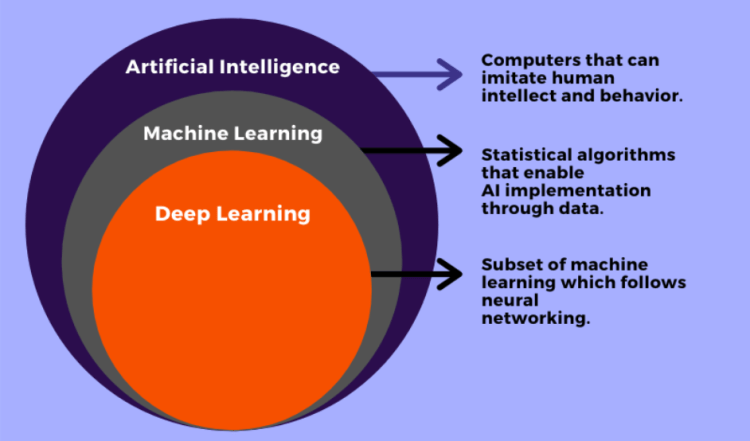
Artificial Intelligence is the technique of developing machines that imitate human behaviour. It provides objects, machines, and systems the ability to simulate real-world actions.
Think of this way — Artificial Intelligence(AI) systems are machines that think and act as humans do. They have an intelligent brain, just like humans do.
It is useful to your organization in ways you can’t even imagine — an accurate visual perception of data, speech recognition, extracting insights from data, translation of documents and languages, and much more.
Artificial Intelligence doesn’t require human intervention. It is one of the primary reasons scientists are concerned about its future. But if used properly, Artificial Intelligence(AI) machines can be the biggest advantage for your business.
The best example of Artificial Intelligence(AI) in today’s world is Siri. Apple Inc. developed Siri, which imitates human behaviour and learns from the user’s choices. It acts as a personal virtual assistant for people all over the world.
1. Top 5 Open-Source Machine Learning Recommender System Projects With Resources
4. Why You Should Ditch Your In-House Training Data Tools (And Avoid Building Your Own)
Do you know why your business needs to implement Artificial Intelligence? 54% of business executives say that they already see a productivity increase with AI implementation.
Artificial Intelligence is the broader term that is used to talk about intelligent machines. Any system which has intelligence capabilities and imitates human behaviour comes under the horizon of AI.
Let’s move on to the real hard worker behind AI systems and their development. And before that,
If you want to know more about the future of Artificial Intelligence(AI) for businesses, read this article.
Machine Learning is the building blocks behind Artificial Intelligence systems. You might have read somewhere about AI and ML and probably gotten confused.
You may also think that AI is a subset of Machine Learning (ML), but it’s the other way around. Machine Learning is a subset of Artificial Intelligence.
Machine Learning is a technique, approach, or process for implementing Artificial Intelligence which involves parsing massive amounts of data, learning from that data, and making predictions based on that.
What you should know about Machine Learning programs is that the more data you feed them, the better they get at making predictions. These Machine Learning algorithms modify on their own using the datasets.
Tom Mitchell, former chair of the Machine Learning Department at Carnegie Mellon University, and E.Fredkin University Professor at the same said the following about Machine Learning –
A computer program is said to learn from experience E with respect to some class of tasks T and performance measure P if its performance at tasks in T, as measured by P, improves with experience E.
Machine Learning algorithms modify themselves based on data without any human experts. Once your business has enough data, you can feed it to the Machine Learning programs. Your future predictions will be in your hand within no time.
Here’s what machine learning has already achieved — Netflix saved nearly $1 billion in 2017 through Machine Learning by making a personalized recommendation engine. Now imagine how much it would have saved in 2020? You can also save massive costs through Machine Learning as well.
But what type of Machine Learning does your business need? Let’s dive into that.
There are three types of Machine Learning widely used by AI & ML experts for building intelligence machines and systems. These include:-

Probably one of the most commonly used types of Machine Learning is supervised learning. These algorithms work with labelled datasets with fixed input and output parameters.
When the Machine Learning algorithm comes across new data, it delivers the correct output based on these predefined parameters. As it receives more data, it corrects itself and makes accurate predictions.
For example, look at the following table:-

The question mark is the value that the supervised learning algorithm will generate. Sure, it is a simple example, but you get the gist of it. Using supervised learning, you can build Machine Learning programs that can provide you with accurate predictions for cost and reduce them twofold.
In real-life, supervised learning is playing a vital role in medical diagnosis. AI & ML experts are working on systems that can detect cancer patients based on a few parameters. It will classify the patients according to the symptoms and check whether they have cancer not.
Supervised learning is best for classification and regressions Machine Learning models. You can read more about them in this article.
To the beginner, unsupervised machine learning would look like something can have complete freedom of doing what it wants. The thought is scary. However, that is not the case.
Unsupervised learning is not commonly used by small businesses but is an integral part of the digital transformation strategy for big businesses. Remember Netflix’s recommendation engine — it utilizes unsupervised learning.
But it does not mean that experts don’t monitor the Machine Learning algorithms. Unsupervised learning just doesn’t have any labelled datasets. It has to work with unstructured data.
Unsupervised learning makes sense of massive amounts of data through clustering. In a simple model, if there are cars, motorcycles, and airplanes, unsupervised learning won’t be able to tell what is what.
However, Machine Learning programs and Artificial Intelligence(AI) Systems that used unsupervised learning works with a concept called clustering.
The Machine Learning model would cluster all these objects based on their nature. It would make a cluster of cars, a separate one for motorcycles, and another for airplanes.
When any input is given, it will go to the appropriate cluster of data and use it to deliver the output. Netflix saves the user’s watch history and delivers content that is based on history. A classic case of data clustering!
Probably one of the least common types of Machine Learning is reinforcement learning. It involves Machine Learning algorithms that try to find the optimal solution for a problem with minimum errors.
Reinforcement learning is sort of taking the right action for achieving the maximum reward.
A simple example would be that if a salesperson is using a technique and closes only a few deals per month, it will improve or change the method to close more leads.
It may look like supervised learning, but reinforcement learning doesn’t have labelled datasets. It involves deciding which is the best way to perform a task such that the right output is achieved. It is more about the optimal process.
Reinforcement learning involves making sequential decisions through Machine Learning algorithms for your business. The output depends on the current input, and the next input depends on the previous output.
With the help of reinforcement learning, Google reduced its energy consumption by 50%.
If you need more information about Machine Learning(ML) for your business, here’s an article that tells everything you need to know on Machine Learning.
Now comes the deepest(excuse the pun) part of Artificial Intelligence(AI) systems. Deep Learning is a subset of machine learning that involves the artificial neural network — the kind of neural network we have in our brains for making connections.
You and many others might confuse Deep Learning with Machine Learning. But Deep Learning vs Machine Learning is a much broader topic.
Deep Learning algorithms are much more complex than simple Machine Learning algorithms. They make use of natural language processing combined with neural network development.
Neural networks are based on the biological neural networks that we have in our brains. It involves interconnecting different neurons(inputs in the case of Deep Learning) to form an output.
Deep Learning algorithms are highly advanced, and they involve much more computation complexity than Machine Learning programs. Here’s a good example by geeksforgeeks.
Through a Machine Learning algorithm implemented in a flashlight(for the sake of understanding), the model will learn and train itself to switch on the flashlight whenever you say “dark”.
However, a Deep Learning algorithm goes further beyond and develops connections based on neural networks. So when you say “I can’t see anything without a light”, the Deep Learning AI machines will make the connection and switch on the flashlight.
Read the complete example on their website.
To summarize, Artificial Intelligence(AI) is the broader technology that covers both Machine Learning and Deep Learning.
Machine Learning algorithms are an approach to implementing Artificial Intelligence systems and AI machines.
Deep Learning is a more comprehensive approach to implement Machine Learning that works with the interconnection of neural networks rather than plain data.
Now that you know what each of them is, you can clearly make the decision about which one to implement in your organization.
If you need more help in understanding and choosing the right digital transformation technology, you can Talk for FREE with our ML experts, AI experts or DL experts. The choice is yours!
How are deep learning, artificial intelligence and machine learning related was originally published in Becoming Human: Artificial Intelligence Magazine on Medium, where people are continuing the conversation by highlighting and responding to this story.
Originally from KDnuggets https://ift.tt/316XNZG
Originally from KDnuggets https://ift.tt/3f05KIl
source https://365datascience.weebly.com/the-best-data-science-blog-2020/teaching-ai-to-see-like-a-human
Originally from KDnuggets https://ift.tt/3cZehIT

Hi, hope you are healthy and well.
We wanted to thank you for being a long time subscriber and for helping make Chatbots Life one of the most popular blogs on Chatbots and Conversational AI online.
The event features speakers from Google, Salesforce, IBM Watson, GoDaddy, ADP, Rasa, etc. It’s the perfect opportunity to discover how enterprises are using Conversational AI and to network with top industry experts.
Also, we wanted to inspire you to create more great Conversational AI systems!
So we created a special promo just for you and are offering you a Discounted Pass to the Chatbot Conference for only $49! This is $170 off our current price and this offer is limited to the first 25 people who register.
You can now attend the Chatbot Conference on May 25th for only $49.
Hope to see you there!
Stefan
Cheers!
Exclusive VIP Promo for Conversational AI Conference was originally published in Becoming Human: Artificial Intelligence Magazine on Medium, where people are continuing the conversation by highlighting and responding to this story.
Originally from KDnuggets https://ift.tt/3eXH6Iq
With digital transformation, we are stepping through a worm-hole that takes us to a different time-line while re-defining the way we are doing business and consuming services. Now, most of us prefer to embrace digital transactions and try out door-delivery of goods.
As we are increasingly moving towards distributed work environments — perhaps our homes — Firms will look at embracing distributed agile delivery practices for solutions, in Information Technology.
One such aspect is Continuous integration and continuous delivery where delivery of quality software at frequent intervals, is enabled through automated ways of detecting, pulling, building, and unit testing code.
Integrating Data Quality into the change life-cycle of the organization is important for better operational outcomes from the solutions builds.
In continuous integration, most often code review is optional, but having code review enabled as a best practice, enables one to include certain pre-checks of data quality that can be performed one-time while doing the test builds. Validation routines like precision, format conformance can be easily spotted in this review. Frameworks like Gerrit allow these features.
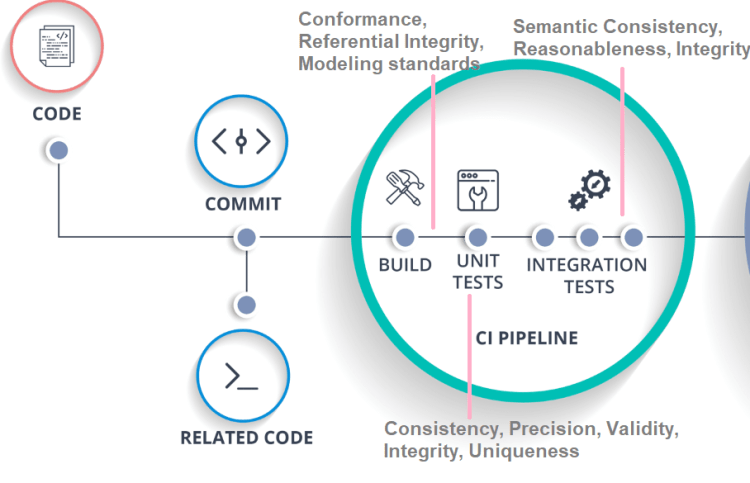
Another aspect of continuous integration is continuous unit testing where smaller builds, in isolation, are tested for basic functions. In a typical data lifecycle like “POSMAD”, planning for data includes modeling for data for better outcomes from data acquired by the organization.
Data Quality checks during data modeling catch costly errors during the planning stages of product or solution development. Even in modern databases like Graph, one needs to decide which entities can be nodes while others can be edges. Various unit-testing solutions like Junit can be leveraged for unit tests while coding in Java.
In continuous unit testing, there can test cases specific to the below dimensions of data quality
1. Top 5 Open-Source Machine Learning Recommender System Projects With Resources
4. Why You Should Ditch Your In-House Training Data Tools (And Avoid Building Your Own)
Continuous delivery encompasses Continuous integration and continuous testing as concepts. These concepts are translated into features that are made available through an integrated framework and toolsets. One data quality solution can be leveraged to perform a complete test coverage including unit tests, integration tests, functional tests.
However, the available test environment often has contextual data that can be profiled and the profiling results from the quality assessment provide a platform to explore and analyze data quality using the Data Quality Validation Routines or Checks. The selection of data Quality validation routines varies across the data lifecycle and the Software development lifecycle.
Summarizing the key aspects —
? What if your organization is actively embracing agile practices & toolsets — Should the data quality practices mature as well?
? In a Distributed & Disciplined Agile environment, Data Quality Management can be integrated with the DevOps integration tools to support Continuous Integration & Delivery.
? In such fast-paced deployments, the data quality test automation in unit & integration test automation stages is required.
? Often, Data Quality tools have their own code repository and versioning, & Integration, as well as Deployment capabilities and having to integrate them with CI/CD toolsets, can be a challenge.
? Automating data quality management by running pre-built or templated rules in an automated manner assists in integrating the feedback faster by the developers.
? Integration with Test management tools would also be beneficial to raise data quality issues and assigning them to the developers and data owners.
Integrating Data Quality Management into Continuous integration and continuous delivery (CI/CD) was originally published in Becoming Human: Artificial Intelligence Magazine on Medium, where people are continuing the conversation by highlighting and responding to this story.

 365 Data Science