Use the time at home productively and learn something new! We bring you a selection of upcoming interesting webinars and online events on AI, Data Science, Machine Learning, and related topics.
Originally from KDnuggets https://ift.tt/3b2WsWY
365 Data Science is an online educational career website that offers the incredible opportunity to find your way into the data science world no matter your previous knowledge and experience.
Originally from KDnuggets https://ift.tt/3b2WsWY
Originally from KDnuggets https://ift.tt/3edvv59
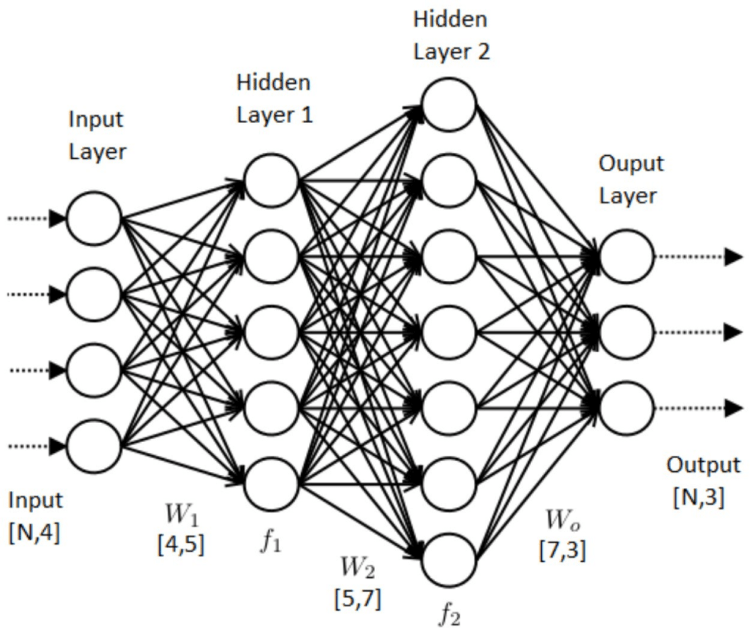
Artificial Neural Networks( ANN ) has gained immense traction in the recent years owing to its ability to emulate human brain and perform activities otherwise thought impossible. It is arguably the most intelligent piece of the whole game of Machine Learning as we know it today.
There are a number of frameworks and libraries like PyTorch and Tensorflow that have made building, training, and deploying Neural Networks really easy, fast and straight-forward. It is however beneficial to understand the underlying concepts to feel confident using these libraries and contribute in advancing the subject.
At the heart of it, neural networks are a collection of nodes working together in an inter-connected multi-layered structure. Each node loosely resembles a neuron in an animal brain which takes an input which can be image pixels, words, sentences, numbers, etc., processes it and forwards the processed state to another node for further processing and finally creating an output or an inference.
The whole life-cycle is broadly divided into training and testing phases. The ANN is trained using historical data and testing is done using a test set of data to validate the efficiency of the trained network. In training data, a set of characteristics, also called features, say Xi, are chosen on which you want the predictions to be based. The features are passed through a set of hidden layers which try its part to best understand and get closer to predicting the input correctly. The predicted result, also called a Label, say Y , is the guess that the neural networks have made to best identify your data.
Believe it or not, it is still unknown how these hidden layers actually work and the whole process is a trial-and-error till the best possible situation is achieved. Also, it is important to bear in mind that these hidden layers consume a lot of processing power and it is crucial to maintain a balance to how many layers you would want to add in the middle or how many times you want to iterate before you reach that sweet spot.
Activation Function
If Xi is the input for a hidden layer then Xi+1 can be the output from the layer. To every input or feature( Xi ), a specific weight( Wi ) and a bias (bi) are applied which outputs a value. Both the weight and the bias are chosen at random such that an input is better positioned to predict the output. An Activation function ( f ) then is applied which is essentially based on a threshold value.
One of the popular activation functions is Sigmoid function. This function takes its input and if the input is greater than a threshold it is forwarded to the next layer and if it’s less it is turned to zero.

Forward Propagation
Every output of an activation function either triggers another neuron or gives out the final prediction depending on its position in the multi-layer. Every layer takes the input from the previous layer, processes it and the output is either discarded or passed on to the next layer. The output of the final layer ( Y ) is the considered the predicted value or Label for the features supplied.

Back Propagation
After every iteration, the predicted value ( Y) is compared to the actual value, say Ya. The idea is to minimize the difference the predicted value and the actual value ( Ya ~ Y ). The weights and the bias values are tuned accordingly in every iteration to make the prediction closer to reality. This process is called Back Propagation. However, it is important to exercise caution to not get too close to real values using techniques of Generalization. For the sake of simplicity, we will keep it out of scope for this blog.
Cost Function
The predictions, after every iteration, are passed through a cost function to understand how different the prediction is from the actual. One of the popular cost functions is Mean Squared Error function. In MSE, the square of the difference between the Actual value and the Predicted Value is divided by the number of features provided to get the average.

The intention is to minimize cost to an optimum level such that predictions can, more or less, fall in line with actual data.
Gradient Descent
The cost function output, also called cost, is mapped with the corresponding weights as below –

The weight that gives the least cost is the chosen weight to produce the most optimum prediction. Also, we would want to reach the lowest cost with minimum number of steps using most optimum learning rates (blue arrows).
The resultant network, after this whole process of training, takes in new data inputs to make predictions on them. The prediction efficiency is monitored using techniques like Accuracy, Precision and Recall ( will discuss these on later blogs). The input data are stored and used for training the ANN during the next training cycle for better efficiency and accuracy.
This is all there is to understand the basics of Artificial Neural Networks. I believe the above content has been useful to help you get interested in the field of Neural Networks and Machine Learning.




Neural Networks — the Rudiments and the Mathematics was originally published in Becoming Human: Artificial Intelligence Magazine on Medium, where people are continuing the conversation by highlighting and responding to this story.

In traditional software systems, outcomes are discrete and the creators are aware of the behaviour of these systems (rigid set of instructions). AI/ML based systems bring a fundamental shift to this way of thinking where instead of programming a system to do a certain action, it’s creators provide data and nurture them to curate outcomes based on the input. These systems learn over time.
What role do designers, managers and HCI practitioners play in defining guidelines and design of these systems when much of the workings of these systems are largely inaccessible to it’s creators?
Before getting into the details of whether your problem needs AI, let’s understand some basic terminologies.
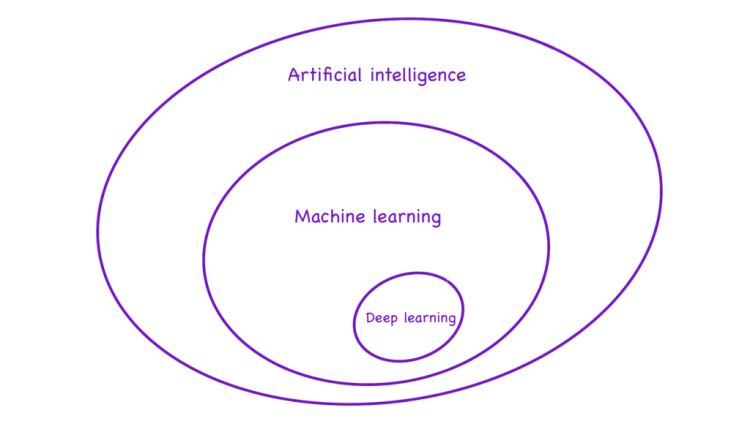
Machine learning comprises techniques and methods that make computer programs do something without programming super-specific rules. It’s creators help computers discover patterns and relationships from a dataset. Popular examples where ML is used include object detection, voice recognition, OCR or recognizing cats from youtube videos.
In machine learning, instead of the creator specifying rules to the program, the program learns by discovering patterns and relationships from a dataset. The job of the creator then is to nurture, guide and provide feedback to this ML algorithm to behave predictably.
An important thing to remember is that techniques like machine learning don’t actually bring intelligence, but rather they bring a critical component of intelligence — Prediction
A model is a specialized mathematical function that represents steps for a computer to arrive at a decision. When programming traditional software, we are used to strict rules; if this then that. For eg. If you click the button, send an email, press the shutter and a picture is taken . On the other hand, machine learning models are ‘soft’: they don’t follow a strict logic. ‘Write’ and ‘right’ sound the same but have different meanings depending on the context. Maybe a bald person’s head looks really similar to a duck egg from a certain angle, a bunch of skin colored pixels. We can grasp the workings of ML models better if we embrace this ‘softness’ and understand how these algorithms make the mistakes that they do.
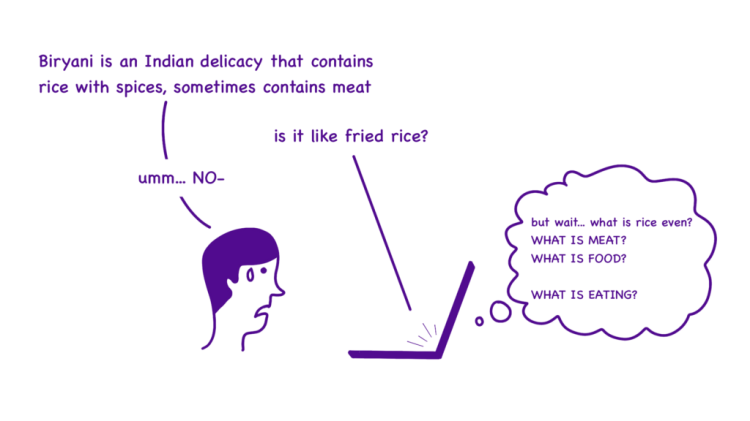
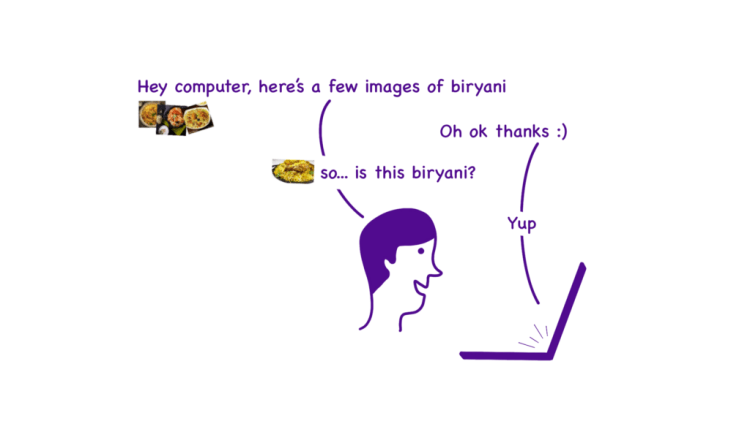
How do you tell a computer what Biryani looks like?
Explaining a computer what Biryani looks like is a really difficult problem to program traditionally. Here’s how you would go about it:
Here’s how you’d go about the same problem with a Machine learning approach:
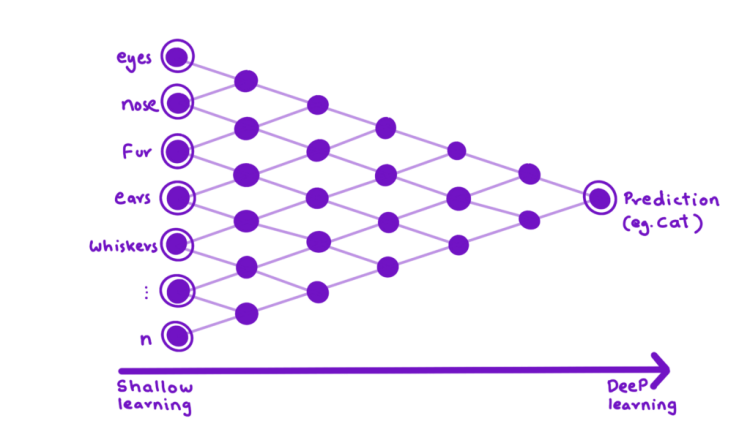
This is a subfield of Machine learning where multiple ML models are layered into artificial neural networks. The system learns from large volumes of datasets and has the ability to learn deeply. Deep learning enables the system produce results which are often more creative than the predicted outcome.
One useful mental model for deep learning is that systems which use deep learning models often appear to be creative. Eg. FaceApp, AlphaGo
The science of making machines intelligent, so they can recognize patterns and get really good at helping people solve specific challenges or sets of challenges.
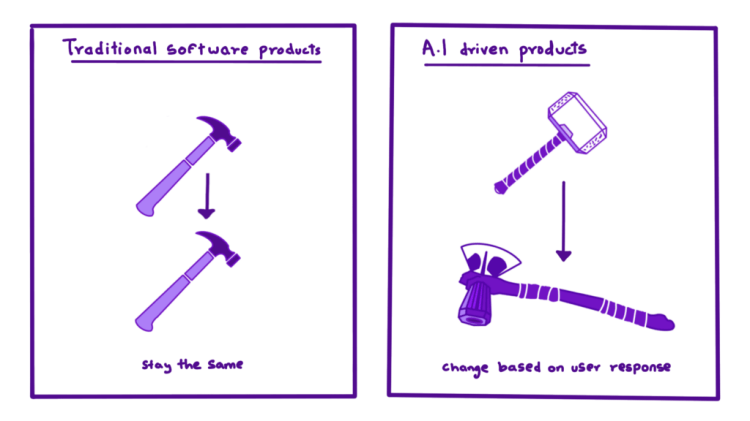
How are AI products different?
Most traditional products stay the same, while AI driven products tend to change overtime in response to their users and the environment (digital or physical).
When designing products, the most important thing to consider is the problem being solved and then look at whether AI is uniquely positioned to solve it. Shift your thinking from technology-first to people-first. Often a simple non-AI solution is the best way solve a problem with an added benefit of being easier to build, explain, debug and maintain. Take time to evaluate whether AI will improve or degrade your product.
Instead of asking “Can we use AI to solve {problem x} ?”, a better approach would be to ask “How might we solve {problem x} ?” and “Can AI solve this problem in a unique way?”
Once you’ve decided that your problem can be better solved through an AI based approach, an important consideration is to evaluate whether your solution should automate a task or augment the user’s ability to do the task themselves. It can be tempting to believe that the most valuable product is one that automates everything that people do manually. For eg. A movie app that tells you what to watch with no option to choose an alternative.
Mapping existing workflows of the user’s current tasks is a great way for finding opportunities where AI can improve the experience. As you walk through the user’s experience, you can better understand the necessary steps that can be automated or augmented.
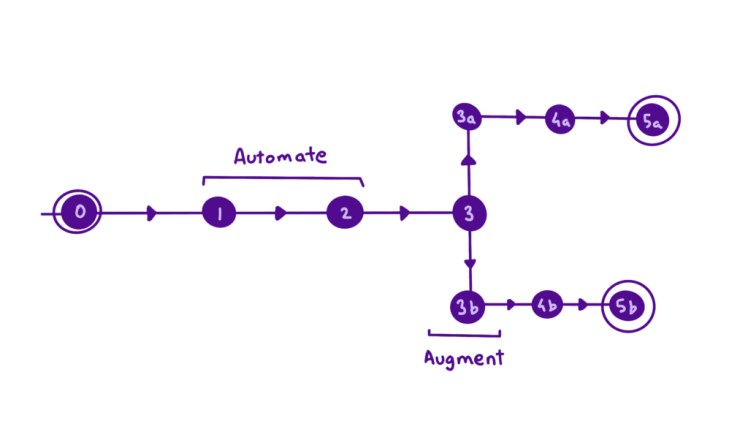
In automation, the AI system performs the task without user involvement. It is good to automate tasks that are undesirable and the user’s investment of time, money or effort is not worth it. Many of the tasks that can be automated do not require oversight and users are often happy to delegate. E.g. Sifting through a large number of photos.
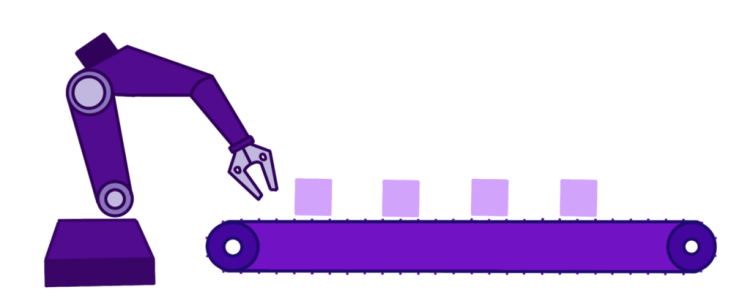
Like any AI system, automation will not always be foolproof. Even when automating, there should be an option for human oversight and intervention if necessary. This can be achieved by allowing users to preview, test, edit or undo any actions that the AI automates. When your system isn’t certain, or can’t complete a request, make sure there’s a default user experience that doesn’t rely on AI.

In augmentation, the AI system extends the abilities of the user to perform a task. It is good to augment tasks that are inherently human, personally valuable or high stakes in nature. Think of giving your users superpowers instead of doing the work for them. E.g. An illustration design software that suggests colors to pick based on what’s on the artboard.

Use this flowchart to decide whether you need to invest in AI/ML capabilities for your product.
How to decide if your problem needs AI? was originally published in Becoming Human: Artificial Intelligence Magazine on Medium, where people are continuing the conversation by highlighting and responding to this story.

World of business has undergone a significant facelift over the last few years. And, all thanks to Artificial Intelligence and its trends. AI has changed the way we do business. Now, it is possible for us to become more productive by replacing time-consuming processes and complicated choices with quick and informed decisions.
Robotic Process Automation is one such artificial intelligence trend that has helped many businesses to grow in their domain.
The benefits of implementing RPA in business are spectacular. This is the reason why it is one of the most emerging AI trends of 2020. We have even covered a blog about which you can read here.
RPA has made abrupt changes from when it first came into existence. From automating mundane tasks and need limited or no human involvement, businesses can;
According to a recent report, the Robotic Process Automation Market is all set to reach USD 20.7 Billion By 2026.
So, here in this blog, we are going to discuss the benefits of deploying RPA in business.
So, read carefully as we mention:
Eliminating the risk of errors is crucial if we want to achieve the maximum efficiency in a business. However, ensuring that it becomes impossible when we dispose of human resources to perform tedious jobs. They often get bored and make silly mistakes while carrying out repetitive and complex tasks. This leads to a great wastage of time and money.
But with the help of RPA, we can prevent all this from happening. We can use RPA to automate complex tasks and assign human resources the jobs that are worthy of their time and effort. This can take business productivity to a whole new level.
Since RPA lets you efficiently perform complex tasks with the minimum chances of error, the AI trend can help you reduce operational risks to a major extent. Not only this, but we also need a lesser amount of human resources to get the jobs done. This also brings the costs down and proves to be a gamechanger for your business. We can really aim for cost-effectiveness with the help of RPA.
Effective communication is the key if we want to grow as a business. There are times when people really fail to understand what a business really does. Even the blogs, websites, and documentation are not of any help — and this often leads to disaster.
RPA can help you by effectively carrying out communication with the audience. With the help of RPA, we can figure out our audience and make changes in all the documentation accordingly.
We can even save the efforts of employees to manually make changes every time we make new updates in the processes. This way, consumers can remain up-to-date all the time without much effort from the end of businesses.
Employee engagement and customer experience are the two most important aspects of your business. Your business certainly can’t thrive without them. It’s after when employees are engaged, they can give their hundred percent and ensure a high-quality customer experience.
Through necessary activities like data retrieval, planning, and implementation of necessary steps, RPA solutions ensure that employees are engaged right from the beginning and they pay special attention to the customer experience.
Not only this, but RPA solutions can also improve the customer experience of artificial intelligence. This ultimately helps in offering the best services to customers and helping businesses grow.
Robotic Process Automation uses bots to handle the queries of users and artificial intelligence algorithms to handle their concerns.
Also, the automation part ensures that the tasks which human resources were going to perform in days can be performed in just a few hours, that too without any error. This also eliminates the need for supervising a task or making changes later. Hence, the RPA trend can help our businesses to provide faster services to clients and result in increased customer satisfaction.
Analytics and insights play a crucial role in improving the processes of a business. Robotic Process Automation (RPA) has certain tools that let you store data that you can analyze later to see where you stand in the market and how you can improve.
This way, RPA helps businesses see right through data and get actionable insights that can help them grow and become more productive, that too with minimal error rate. Collecting this data would’ve been difficult, if not impossible for humans. So, with the help of the RPA solution, we get access to insights that lead to better decision-making.
RPA solution not just helps in the optimized use of resources as we mentioned earlier in this blog, it also increases employee satisfaction. Studies have shown that employees are more satisfied when they are assigned meaningful and worthy jobs instead of tedious and boring tasks.
This also drives them to perform better and put the best efforts in their tasks. Another benefit of increased employee satisfaction is that employees don’t need to switch jobs if they are satisfied with their job. This ultimately makes businesses more productive and helps them grow.
Another big business benefit of the RPA solution is that it lets you make changes in your business operations according to the user demand.
For example, We can increase or decrease resources or the size of business processes according to user demand. This ensures the optimized resource use and more productivity as we are able to concentrate on processes that are going to get us the maximum results. In case, you want to check some successful RPA use cases, you can click here.
Also, there is less amount of risk involved because we are not investing resources in processes where we think we are not getting a fair amount of traffic.
Yet another big benefit of Robotic Process Automation is that we can integrate it into multiple applications to enhance business security. These integrations will ensure that the apps of your clients are not modified, enhanced, or compromised in any way.
Even the risk of unauthorized access will be reduced to a minimum due to smart AI algorithms and the improved security infrastructure. It will change the way businesses work — making them more secure and more capable to counter cybersecurity threats.
The benefits of RPA in business are incredible. It can revolutionize the way we do business and make it a hundred times more productive.
However, implementing RPA in business is not as easy as it seems. Without proper planning, it can be difficult for businesses to achieve the results they desire. Most of the time businesses only focus on the internal policies, processes, and business operation. They think that they can achieve more productivity just by automating these processes, and while doing so, they completely miss the bigger picture.
We just have to avoid making the same mistake and plan the RPA solutions carefully so that we can make the best possible use of the trend. And for this, you will need expert guidance.
Top 10 Benefits of Implementing RPA in Business was originally published in Becoming Human: Artificial Intelligence Magazine on Medium, where people are continuing the conversation by highlighting and responding to this story.
Originally from KDnuggets https://ift.tt/3c5PO2q
Originally from KDnuggets https://ift.tt/3cdK6vD
Originally from KDnuggets https://ift.tt/2wwab9Y
Originally from KDnuggets https://ift.tt/3aWv6C1

How I used a neural network to diagnose ADHD with functional connectome data
Continue reading on Becoming Human: Artificial Intelligence Magazine »

 365 Data Science