Read on to find out how to use a decorator to time your functions.
Originally from KDnuggets https://ift.tt/30SKJaj
365 Data Science is an online educational career website that offers the incredible opportunity to find your way into the data science world no matter your previous knowledge and experience.
Originally from KDnuggets https://ift.tt/30SKJaj
Originally from KDnuggets https://ift.tt/38LDuVV
Originally from KDnuggets https://ift.tt/38PxprE
Without training data, there is no machine learning model.

Data annotation technique is used to make the objects recognizable and understandable for machine learning models. It is critical for the development of machine learning (ML) industries such as face recognition, autonomous driving, aerial drones, and many other AI and robotics applications.
Data annotation is the procedure of processing unprocessed raw data, including voice, picture, text, video, etc., and converting it into a structured one that can be recognized by an AI algorithm. Data annotation is a process in which a data annotator uses annotation tools to structure data so as to empower the AI model.
At present, a data labeling tooling platform is one of the important trends in the data labeling industry. A high-quality data annotation service platform should have the following characteristics:
1. Workflow system
In a narrow sense, data annotation refers to the operation of pulling frames, tracing points, and transferring the raw data, but in a complete annotation loop, the annotation process is only a part.
Under normal circumstances, a complete annotation project, from the beginning to the end, requires multiple processes such as build custom annotation tool, scripts for pre-processing data, project creation, labeler training, worker performance tracking, data security and compliance, quality inspection, data delivery, and so on. Each individual process can be subdivided into more detailed workflows.

Taking project creation as an example, the following steps need to be completed from new creation:
New Project — Upload Data — Requirements Management — Annotations Scheme — Processing — Annotations Result in Export Settings — Release Project.
For project managers, a perfect and smooth workflow system is of great significance to project management.
The whole-process workflow system can effectively help the project team control the project, avoid unnecessary costs, and increase operational efficiency.
2. Different Role Players
From the perspective of role configuration, data annotation platform participants can be roughly divided into annotator, auditor, quality inspector, administrator (project manager, representative of Party A), etc.
Different roles have different authorities, corresponding to different work and levels. Take the annotator as an example, the work is to follow the guideline and accomplish basic annotation tasks. The annotator cares more about the amount of data completed, rejected, and qualified, as these are related to their own income.
Project managers, on the other hand, are more concerned about big pictures such as project completion, data quality, role authorization assignment, project schedule, and so on.
1. Top 5 Open-Source Machine Learning Recommender System Projects With Resources
4. Why You Should Ditch Your In-House Training Data Tools (And Avoid Building Your Own)
Machine learning success depends on the human workforce, however, a person’s energy is always limited. The more data he or she is exposed to, the greater the probability of missing data and error will be. Therefore, platform data visualization becomes particularly important.
Automation management connects different roles, generates customized data service, and helps different roles quickly grasp the project operation, not only shorten the time required to understand the project but also can decrease the error problems.

ByteBridge, a human-powered data labeling tooling platform with real-time workflow management, providing flexible data training service for the machine learning industry.
Automation management: task splitting algorithm
ByteBridge divides the complex work automatically into simple small components to further reduce human error.
On the dashboard, clients can set labeling rules, iterate data features, attributes and workflow, scale up or down, make changes based on what they are learning about the model’s performance in each step of test and validation.

For further information, please visit our website site:ByteBridge.io



How data service providers acquire core competence throutechnology? was originally published in Becoming Human: Artificial Intelligence Magazine on Medium, where people are continuing the conversation by highlighting and responding to this story.
Conversational marketing has been in the mainstream for quite some time now; the reason is the need for real-time interactions with your customers. Chatbots are the pivot of conversational marketing, having been built on the principles of Natural Language Processing (NLP), Natural Language Understanding (NLU), and Natural Language Generation (NLG).
However, the era of big data means that you may need more than just Chatbots to ensure that your customers don’t churn. It’s not just all about conversation; how much do you know about your customers?
You need to understand the pain points of your customers, their sentiments about your product or service, and how they rate your product as good, bad, or neutral. While conversational marketing has a lot of merits, fusing it with sentiment analysis can be very productive.
Your customers live and revolve around data; studies have shown that your customers will create 463 exabytes of data each day globally by 2025. Part of this data will be what and how they feel about your product, which you must do everything to know about if you want to stay relevant in the business world.
You can use any of the following channels to discover what your customers say about your product or service.
1. Review sites
You may want to use sites that collect public reviews of different products to source what customers feel or make use of eCommerce sites like Amazon and eBay where people leave reviews about their experience with products. You must, however, understand that reviews from these sites are unstructured and not easy to understand.
You may end up putting a lot of manual labor to bring the data into a structured format and analyze the data.
2. Social Media
Social media platforms allow consumers to freely comment on products and services. Apart from these, you can also get reviews from forums and Q&A sites that allow consumers and the public to share their feelings on specific topics.
While these are channels you can use to collect data and views from consumers about your product, you must understand that these sources may not be authentic, and it may not be easy to categorize the sentiments into positive, negative, or neutral.
1. Top 5 Open-Source Machine Learning Recommender System Projects With Resources
4. Why You Should Ditch Your In-House Training Data Tools (And Avoid Building Your Own)
Since the data you collect from review sites and social channels are in an unstructured format and difficult to analyze, Natural Language Processing and machine learning become indispensable here.
With machine learning tools, you can spot the difference between context, sarcasm, and misapplied words. This is possible because of the integration of technological advancements,
several techniques and complex algorithms such as Linear Regression, Naive Bayes, and Support Vector Machines (SVM), you can use to detect user sentiments.
An interesting case study is how the Consumer Insights and Product Development Teams at TTI made use of insights gathered by Revuze’s AI to identify customer pain points for mid-range household carpet washers.
The product development team made use of these insights to design, develop, and release a special add-on to one of their best-selling products in this category. The changes which the TTI’s marketing team carried out on its product description page (PDP) bring to focus the power and impact of sentiment analysis of customer product reviews using AI.
The result was an improvement in customer satisfaction and the average star rating of a product that sells more than 300,000 units per year in the North American market alone.
Ryan Caycova, Senior Product Manager of TTI has this to say, “Revuze Explorer allows us to make decisions based on consumer analytics insights data and understand what customers want, how to improve existing products, and gain a competitive edge by creating better products with added value to consumers.”
If you have insights that outline consumer pain points, they enable you to:
By deploying machine learning into sentiment analysis, you enable the use of computational linguistics that has far-reaching effects than the mere detection of words in a sentence. You can also use it to match sentiments to entities as well as identify sarcasm to accurately recognize the emotional tone behind a sentence.
High-level programming languages such as Java, Ruby, and Python are what you use in sentiment analysis to enhance advanced programs for data acquisition, processing, feature extraction, supervised learning, and result in classification.
Apart from using review text data to conduct sentiment analysis, you can use it to increase your business’s local search engine results. Consumers don’t readily depend on only word-of-mouth again, they go online to check out reviews before purchasing.
Google recognizes how important this is and uses the same data to provide its users with the most relevant result. Google can filter out the local businesses with bad reviews or lower ratings and displays only the best brand, products, or services in the user’s locality.
Sentiment analysis makes use of machine learning tools that have been designed to read beyond mere definitions. It can detect the exact feeling in the text and tag them accordingly.
The competition is getting fiercer daily, therefore, you must turn to sentiment analysis to stay relevant. Even the big brands in the market are making use of this technique to improve the customer experience.
The better you understand each customer, the more you will give a personalized experience. Even if your product is relatively new in the market or popular, you can’t help without using sentiment analysis.
If you improve customer experience, you are certain of being ahead of the competitors.
How You Can Deploy AI and Machine Learning for a Better Customer Experience was originally published in Becoming Human: Artificial Intelligence Magazine on Medium, where people are continuing the conversation by highlighting and responding to this story.
In this story, we will investigate a dataset from Airbnb, which can be found in this link.
The goal of the present analysis is to clarify some issues concerning the prices of Airbnb.
Here, we’ll make a simple, yet relevant, data analysis, clarifying three business questions, discussing them, followed by a brief conclusion.
The whole Data analysis process was performed in Python 3.6 and can be found in the following repository hosted in Github, here.
Outline of the Data Analysis:
1. Top 5 Open-Source Machine Learning Recommender System Projects With Resources
4. Why You Should Ditch Your In-House Training Data Tools (And Avoid Building Your Own)
Below, it will be shown the answers to these questions along with insighful graphs.
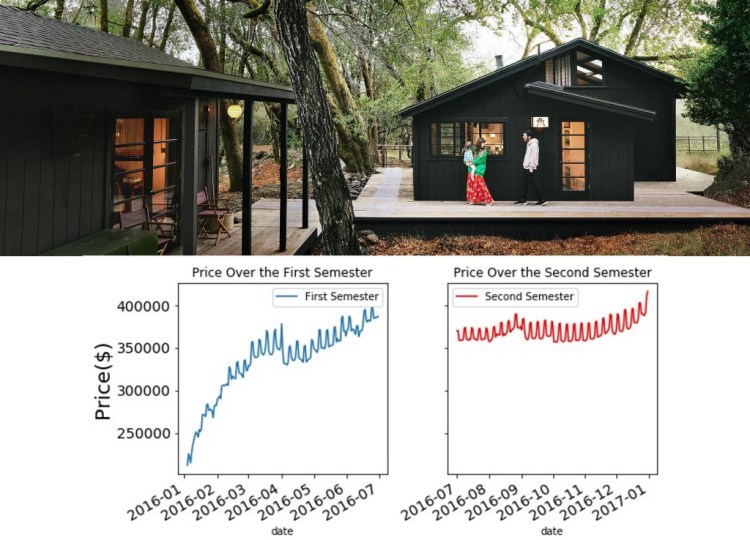
In the plot below it can be seen the total amount spent by all clients for the first (left) and second semesters (right).
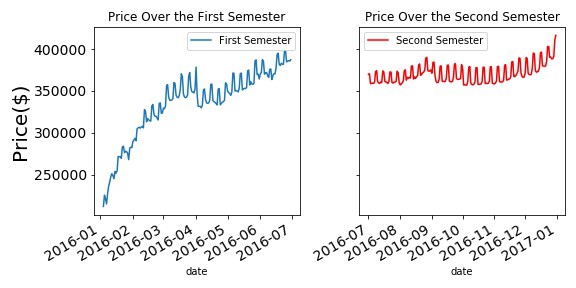
In the first semester, it can be clearly be seen a trend of quadratic increase of the price with time, while for the second semester it is rather constant, in spite of a slight increase in December.
Below is shown the plot of the total Price for each day of the week for the first and second semesters.
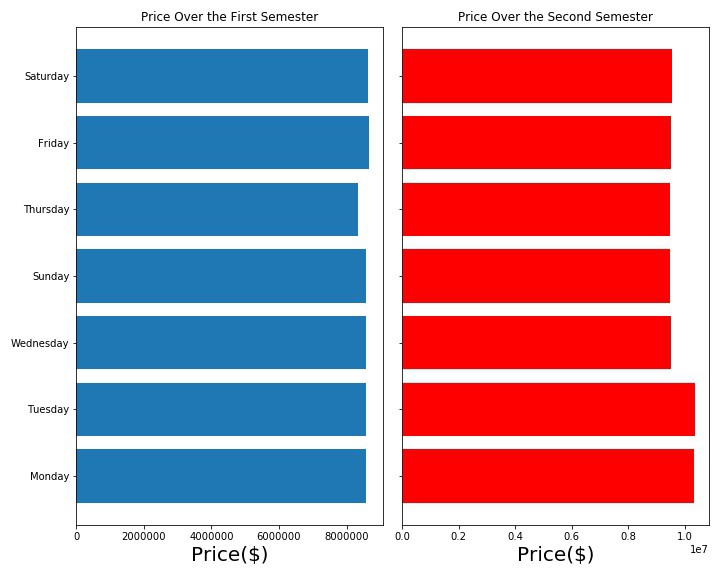
It can be clearly seen that in the first semester the prices are evenly distributed over the days of the week, whereas for the second semester there is a significant increase for Monday and Tuesday.
In the plots below, we can see histograms of the mean amount spent by a client. The distributions are clearly right-skewed, being rather similar in their shapes.
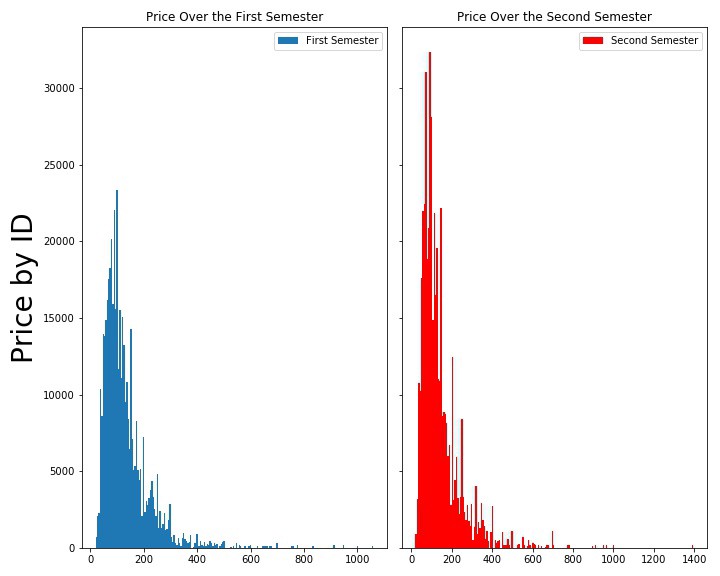
The mean, minimum and maximum values, as well as the standard deviation are given for each semester shown in the notebook. Essentially, during the second semester, there are larger mean and maximum values, but also accompanied but also by a broader standard deviation.
For the first semester of 2016, the total sales of Airbnb was increasing fastly, but in the second semester, it reached a plateau. The analysis of the total price by day of the week showed that in the first semester the sales are evenly distributed, while in the second semester they are biased toward Monday and Tuesday. Analysis of the amount spent by a client showed that in the second amount the mean and maximum values were larger than in the first semester, however, also more spread (larger standard deviation).
ANALYSIS OF AIRBNB DATA: THE INFLUENCE OF TIME, DAY OF WEEK, AND CLIENT DISTRIBUTION was originally published in Becoming Human: Artificial Intelligence Magazine on Medium, where people are continuing the conversation by highlighting and responding to this story.
Originally from KDnuggets https://ift.tt/3vBZuw4
Originally from KDnuggets https://ift.tt/2Q3imnp
source https://365datascience.weebly.com/the-best-data-science-blog-2020/how-to-begin-your-nlp-journey
Originally from KDnuggets https://ift.tt/2Qd9Rq6
Originally from KDnuggets https://ift.tt/30M6xEb

 365 Data Science