This article is a practical guide to exploring any data science project and gain valuable insights.
Originally from KDnuggets https://ift.tt/3rjKlNq

365 Data Science is an online educational career website that offers the incredible opportunity to find your way into the data science world no matter your previous knowledge and experience.
Originally from KDnuggets https://ift.tt/3rjKlNq

Digital technologies have become an integral part of the house-hunting process, shaping the home buying industry and affecting everyone involved. The research shows that every second buyer heads online first to look for a new home.
Responding to this, real estate agents, brokers, and investors are leaning toward custom software and purpose-built mobile applications in their day-to-day practices to engage customers in the digital space.
Here are five leading technologies that are driving the revolution in the home buying experience right now:
The adoption of business intelligence tools in the real estate industry is growing, especially when it comes to self-service data analytics platforms. These BI solutions provide agents with relevant insights and strategies to home buying in real time, without the need to engage IT resources.
Big data enhances decision-making based on the prevailing market and micro-economy trends. BI software can reveal essential information about customer purchase intent and behavior based on historical data.
Another use case in home buying where big data capabilities find application is marketing. Integrated with the enterprise CRM system, data-driven BI solutions help agents capitalize on customer data integrated from a variety of sources and target the prospects with a high conversion propensity without delay.
The use of predictive analytics and machine intelligence automation drives smarter decisions in the real estate sector. The AI use cases holding the most value for the industry include:
● Enhanced home search experience. By leveraging predictive algorithms combined with big data analytics engines, realtors can pinpoint individual tastes and requirements of every single buyer. Based on these findings, they can tailor house recommendations to suggest the exact kind of properties their customers are looking for.
● Real property valuation. AI valuation models aid real estate agents and property owners in maximizing their sales. Artificial intelligence algorithms take into consideration the full spectrum of factors involved in real estate appraisal and provide accurate estimations of a property’s worth. This way, these systems enable sellers to determine the fair market value of their assets quickly.
● Faster transactions. The real estate industry generates vast amounts of paper documentation. Processing all reports, permits, certificates, and contracts is a mind-numbing and tedious task. AI-based intelligent process automation can free up agents’ time on paperwork. Solutions exist that can automate the collection, review, and generation of required documents to cut down manual processes and speed up transactions.
Blockchain is another technology with a strong potential to disrupt the dynamic real estate market. Secure, traceable and immutable distributed ledgers allow plenty of benefits, from cost saving through increased transparency to time efficiency. Agents, sellers, and buyers use blockchain-based smart contracts to reduce friction and transaction costs, streamline payments, and mitigate fraud.
In recent years, we have seen an emergence of real estate blockchain services that facilitate fast and secure property sales. Meridio, for example, provides a blockchain platform to create, manage, and trade fractional ownership shares in real estate assets. Propy uses blockchain to automate and speed up international property transactions. ShelterZoom delivers a customizable widget, a mobile application, and dashboards that allow brokers and agents to transact with buyers and sellers through blockchain.
1. Top 5 Open-Source Machine Learning Recommender System Projects With Resources
4. Why You Should Ditch Your In-House Training Data Tools (And Avoid Building Your Own)
Augmented reality is perceived as the next big home buying disruption. The technology allows prospective buyers to walk through a property on the screens of their laptops and mobile phones. High-quality digital walkthrough solutions offer a 360-degree view of a property enhanced with 3D visualization, interactive hotspots, pop-ups, and embedded media. Thanks to this elaborate mix of technologies, virtual tours make it possible to visit a place 24/7 and inspect it inside out in close detail, without the need to waste time on travel to the actual physical site.
Online location and property walkthroughs have been experiencing explosive growth during the COVID-19 outbreak. The VR technology creates a unique opportunity for homebuyers to continue their search for a new home despite the lockdown.
Chatbots and virtual assistants are gaining traction in all sectors, including real estate where they are deployed to enrich customer experience and help close deals faster. By integrating 24/7 virtual assistants into websites and mobile apps, agents gain a powerful tool to interact with buyers, nurture their interest, and address their questions about a property.
Bots may also be used to collect information necessary for the sales and marketing teams to proceed to the next stage of customer engagement.
More advanced bots can assess prospects’ requirements, suggest matching properties, and even act as a guide during a 360-degree virtual tour of a site. Virtual assistants also create new business efficiencies, freeing up agents’ time and reducing the burden of basic tasks, such as scheduling or addressing common buyer questions.
From AI recommendations to VR tours, home buying is not the same anymore. In the current information age, it takes much more than a simple listing to distinguish a real estate property from thousands of available offers. The modern consumer expects real estate services to be delivered with speed and convenience. As homebuyers are increasingly turning to the web and mobile channels, real estate companies need to be prepared to embrace the technology in order to maintain their competitive advantages.



5 Tech Trends Redefining the Home Buying Experience in 2021 was originally published in Becoming Human: Artificial Intelligence Magazine on Medium, where people are continuing the conversation by highlighting and responding to this story.
Driven by the continuous innovation of “Ai + IoT” technology and application, a construction boom of “smart city” has been rising all over the world. As a key part of the construction, the intelligent transportation industry has been into the stage of rapid expansion.
Netvision Telecom is a technology company, located in South Korea, specializing in communication and network development. At present, the company undertakes the project of intelligent license plate recognition system of Incheon government in South Korea.
Vehicle license plate recognition (VLPR) is an application of computer video image recognition technology in vehicle license plate recognition. License plate recognition technology requires that the moving license plate can be extracted and recognized from the complex background. Through license plate extraction, image preprocessing, feature extraction, license plate character recognition and other technologies, information such as vehicle number and color can be recognized.
To build such a system, firstly, it is necessary to have a large number of car license plate training data, clearly identifying and marking the plate type, background color, text, and number. Then, the recognition algorithm should be continuously trained with labeled pictures to improve the performance.
1. Top 5 Open-Source Machine Learning Recommender System Projects With Resources
4. Why You Should Ditch Your In-House Training Data Tools (And Avoid Building Your Own)
Netvision Telecom chose to cooperate with ByteBridge to complete license plate number labeling projects.
ByteBridge firstly disassembles the complex tasks and divides them into several simple components, such as license plate counting, license plate labeling, unlabeled license plate counting, etc. Each part is aligned to a certain consensus mechanism to ensure accuracy.
Mathew Kim, head of the recognition program said, “it’s difficult to complete video annotation cases. The license plate is very small, and there is a lot to do. I didn’t expect that ByteBridge delivered the project in a very short time, with high accuracy and consistency. The overall rate reached 99%, which helped us solve a big problem.”
ByteBridge, a human-powered data labeling tooling platform with real-time workflow management, providing flexible data training service for the machine learning industry.
On the dashboard, clients can set labeling rules, iterate data features, attributes and workflow, scale up or down, make changes based on what they are learning about the model’s performance in each step of test and validation.

These labeling tools are available: Image Classification, 2D Boxing, Polygon, Cuboid.
Our expertise can create new recommendations based on the client’s use case. For further information, please visit our website site: ByteBridge
Labeling Case Study — Video Annotation — License Plate Recognition was originally published in Becoming Human: Artificial Intelligence Magazine on Medium, where people are continuing the conversation by highlighting and responding to this story.
We have seen in the earlier part of the AI model deployment how to set up the directory as well as the git. In this part we will build the foundation of how we can deploy model locally and in the next article we deploy the model in Heroku and Streamlit, In this section we will focus how to deploy model using Json .
1.Iris Model deployment using JSON.
1.1. Packages
The following packages were used to create the application.
1.1.1. Numpy
1.1 .2. Flask, Request, Jsonfy, render_template from flask
1.2. Dataset
Dataset is used to train the model is of iris dataset composed of 4 predictors and 3 target variable i.e. Classes
Predictors: Sepal Length, Sepal Width, Petal Length, Petal Width
Target : Setosa [0], Versicolor[1], Verginica[0]
Dataset Shape: 150 * 5

1.3. Model
For training the model we followed the following procedure:
Data Split up: 8:2 ie. 80% training set and 20 for the test set
Model: Ensemble- RandomForestClassifier(n_estimators=500)
Saving Model: Saved in the pickle file
Below is the code for the training the model.
import sklearnimport
sklearn.datasetsimport sklearn.ensemble
import sklearn.model_selection
import pickle
import os
#load data
data = sklearn.datasets.load_iris() #Split the data into test and
traintrain_data, test_data, train_labels, test_labels = sklearn.model_selection.train_test_split(data.data, data.target, train_size=0.80)
print(train_data,train_labels)
#Train a model using random forestmodel = sklearn.ensemble.RandomForestClassifier(n_estimators=500)model.fit(train_data, train_labels)
#test the model
result = model.score(test_data, test_labels)
print(result)
#save the model
filename = ‘iris_model.pkl’
pickle.dump(model, open(filename, ‘wb’))
1. Top 5 Open-Source Machine Learning Recommender System Projects With Resources
4. Why You Should Ditch Your In-House Training Data Tools (And Avoid Building Your Own)
Now, after training the model, we need to create the script which sends the data to the script which is locally hosted in our system. The locally hosted script will classify the data. Below is the code for the script which will send the data.
Script for sending JSON data client script:
#import libraries
import numpy as np
from flask import Flask, request, jsonify, render_template
import requests
import json
import os

url="Url of the locally hosted application"
data = {‘A’: 5, ‘b’: 1, ‘c’: 3, ‘d’: 4}
data=json.dumps(data)
send_requests=requests.post(url,data)
print(send_requests)
result=send_requests.json()
#result=json.loads(result)
labels=[‘setosa’,‘versicolor’,‘virginica’]
print(labels[result[‘results’][‘results’]])
The above code will convert the data into the JSON format and will send to the classifier/server script.
1.4 Deployment
For deployment the model we will use Server-Client procedure where client script will send the data to the server and the server will classify and send the data back to client scriptThe following code will send the data true and forth for the client script.
Script for Server script:
#!/usr/bin/env python2
# -*- coding: utf-8 -*-
”””Created on Wed Jan 20 21:40:45 2021
@author: ravishekhartiwari@website: https://www.rstiwari.com"""
#%%
import pandas as pd
from flask import Flask, jsonify, request
import pickle5 as pickle
import json
import numpy as np
#%% # load model
pickle_in = open(‘iris_model.pkl’,”rb”)model = pickle.load(pickle_in)
app = Flask(__name__)
# routes
@app.route(‘/’, methods=[‘POST’])
def predict():
 # get data
 data = request.get_json(force=True)
 # convert data into dataframe
 data.update((x, [y]) for x, y in data.items())
 data_df = pd.DataFrame.from_dict(data)
 # predictions
 result = model.predict(data_df)
 # send back to browser
 output = {‘results’: int(result[0])}
 # return data
 return jsonify(results=output)
if __name__ == ‘__main__’:
   app.run(port = 5000, debug=True)
1.5 Final Ouput
Congratulation, we have created JSON APIfor Iris Server- Client process.
Step 1: Run the server script
Command: python3 server.py
Since it is using JSON format it will show method not found. But you need not to get carried away it is totally fine because we did not create any front end we are just using the API to access the result.
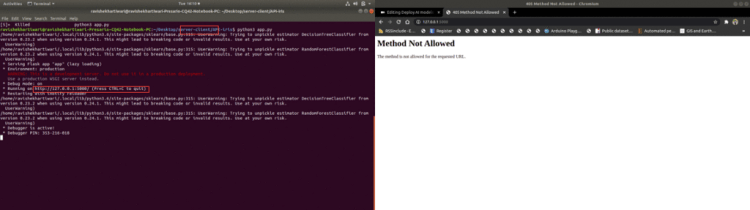
The above application is deployed and it displays the port number which is highlighted i.e. http://127.0.0.1:5000/. Now we need to replace the url in the client script to to run the code. The output is shown below.
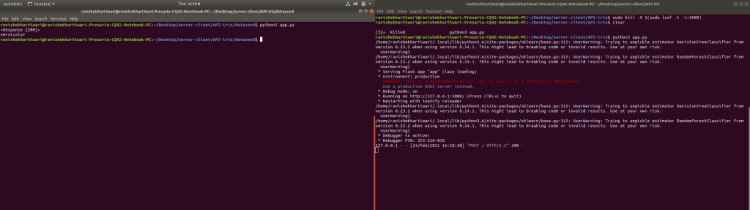
The left side is client script where it shows the predicted class i.e. Versicolor with response 200 which means the APIis working fine.
As we say “Car is useless if it doesn’t have a good engine” similarly student is useless without proper guidance and motivation. I will like to thank my Guru as well as my Idol “Dr. P. Supraja”- guided me throughout the journey, from the bottom of my heart. As a Guru, she has lighted the best available path for me, motivated me whenever I encountered failure or roadblock- without her support and motivation this was an impossible task for me.
Extract installed packages and version : Article Link.
Notebook Link Extract installed packages and version : Notebook Link
YouTube : Link
Deployed Application: Link
If you have any query feel free to contact me with any of the -below mentioned options:
Website: www.rstiwari.com
Medium: https://tiwari11-rst.medium.com
Google Form: https://forms.gle/mhDYQKQJKtAKP78V7
Deploy AI models Deployment Part 3. Deploy model locally using Flask and Json was originally published in Becoming Human: Artificial Intelligence Magazine on Medium, where people are continuing the conversation by highlighting and responding to this story.
Originally from KDnuggets https://ift.tt/3ebL1Rj
Originally from KDnuggets https://ift.tt/3uWALCr
Originally from KDnuggets https://ift.tt/3sK8DAo
Originally from KDnuggets https://ift.tt/2MKc8HM

2020 was extremely challenging for healthcare. A year after, the challenges carry through. Caregivers continue to fight against the COVID-19 pandemic — the mission hard enough as it is, to say nothing of its aggravation by a workforce shortage, the national mental health crisis, and treatment of postponed chronic conditions. Building on automation, artificial intelligence is about to revolutionize healthcare and help caregivers address the challenges they face. So, what does the future of AI in healthcare look like? Will artificial intelligence replace doctors? What are the specific examples of artificial intelligence in healthcare organizations? And how do you implement AI solutions without adding up to the uncertainty of the pandemic? Let’s dig in.
The COVID-19 crisis has pushed the healthcare industry, traditionally rather skeptical of IT innovations, to actively adopt modern tech. Accenture predicts that through 2021, the market of healthcare AI will reach $6.6 billion with an explosive CAGR of 40%. The same study highlights the positive economic impact of AI in healthcare. The adoption of artificial intelligence will drive $150 billion in annual savings for the US healthcare economy in just five years. Let’s have a closer look at AI use cases that bring about such an impressive value.
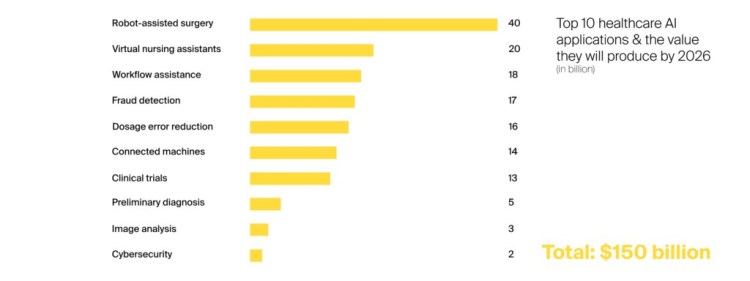
Source: Accenture analysis
Many fear that a robot-assisted surgery involves AI replacing doctors and autonomously making decisions about surgical motions. In reality, it’s a human who stays in control, while AI-powered robotic instruments help surgeons make more precise and delicate motions. For instance, Maastricht University Medical Center uses an AI-powered robot to suture small blood vessels, some no thicker than 0.03 millimeters. Another hospital to rely on AI-powered robots is Mayo Clinic in Jacksonville, Florida. They use AI to perform abdominal surgeries and now develop robotic technology to operate on the brain. For that, they make AI “watch” surgeons perform, recognize their movements and patterns, and convert these patterns into commands for the robot. When it comes to how robots and artificial intelligence can benefit hospitals, the value is clear. The key advantages of applying AI in operating theatres are:
When considering an opportunity to set up a robotic surgical program, hospitals should be ready to face organizational and technological challenges. For example, healthcare providers must ensure the precision of AI algorithms by training them on large amounts of reliable data and to plan training programs for the hospital personnel to confidently work alongside intelligent machines.
89% of patients in the US google their symptoms before turning to doctors, and the results of self-diagnosing turn out rather scary. Virtual nursing assistants prevent such delusive endeavors. Utilizing AI healthcare analytics, they monitor patients’ health parameters, medication intake, and habits to prevent worsening of chronic conditions and schedule medical appointments when needed. A good example of a multi-functional virtual nurse is Molly. Visualized as an avatar, it provides remote support for common medical conditions and tracks a patient’s weight, blood pressure, and other parameters generated by monitoring devices. The app features a chatbot, too, for patients to discuss their health requests privately and conveniently book an appointment with their physician. Virtual assistants like Molly have already won remarkable popularity — 64% of patients feel more comfortable receiving instructions from them. Virtual nurses also outrun humans in the following aspects:
But if you decide to adopt a virtual nursing assistant, focus on thinking out data compliance and security aspects. Make sure to set up data protection controls and risk mitigation procedures to prevent common problems with AI in healthcare, such as PHI leakage and malware attacks.

Doctors spend about 16 minutes per patient just to fill out EHR forms. But with AI-powered workflow optimization, caregivers can stop worrying about administrative tasks and dedicate their time to patients. Machine learning and natural language processing — the subsets of AI — help to navigate medical records with voice commands, transcribe clinical data recorded during patient visits, and return personalized responses to EHR searches. AI-powered workflow assistants simplify appointment booking and help prioritize and discharge patients quicker as well. Many healthcare organizations, among them Cleveland Clinic, already see their workflows improve. The clinic collaborates with IBM to process medical papers with AI and reduce operational costs, while driving patient care forward. We at ITRex, too, have helped caregivers optimize daily operations by developing a robotic process automation solution that synchronizes appointment scheduling between an appointment booking service and an EMR. The solution frees doctors from manually entering appointment data into two systems and adds consistency to patient scheduling. The benefits of AI in healthcare workflow optimization are numerous:
Still, AI by itself is not a cure to all workflow-related issues — it requires thorough expertise, process, and technology planning, workflow transformation, and weighing the outcomes. So, to maximize the impact of artificial intelligence on healthcare, go slowly and consider all the factors that influence AI adoption success, from the quality of data inputs to human factors.
1. Top 5 Open-Source Machine Learning Recommender System Projects With Resources
4. Why You Should Ditch Your In-House Training Data Tools (And Avoid Building Your Own)
About 3% of all healthcare claims in the US are fraudulent. Not that big a number, but it translates into a hundred billion dollars lost annually. Artificial intelligence automates claims assessment. Machine learning models detect invalid claims before they are paid for and help to speed up processing, approval, and payment of valid ones. But it’s not only insurance fraud AI is capable of detecting. When it comes to billing for procedures a patient never received, upcoding — billing for a simple procedure as for something more complex — or preventing patient data from being stolen, AI helps there, too. Leading healthcare services organizations, among them Harvard Pilgrim Health, are embracing AI to root out healthcare fraud. Harvard Pilgrim Health has chosen AI-based fraud detection software over legacy rule-based systems to identify claims and provider behaviors that don’t look normal. Such early adopters already enjoy the benefits of artificial intelligence in healthcare fraud prevention:
But if you decide to tap into AI-powered fraud prevention, remember that however reliable, technology is not a replacement for the human eye. While AI can accurately detect obvious signs of fraud, one of the common disadvantages of AI in healthcare is its tendency to flag anything that seems out of place as a fraud mark, including typos. So, do have human analysts to sort out real fraud marks from human error until your AI engine is trained well enough to handle the task.

In the US alone, 5,000 to 7,000 people die annually because of prescription errors. These errors often stem from flawed EHR interfaces — doctors choose wrong drugs from a drop-down menu or get confused in dosing units. AI fights this issue. ML models analyze historic EHR data and compare new prescriptions against it. Those prescriptions that deviate from typical patterns get flagged, so doctors can review and adjust them. Brigham and Women’s Hospital uses an AI-powered system to pinpoint prescription errors. Over a year, the system identified 10,668 potential errors, and 79% of them were clinically valuable, so the hospital managed to save $1.3 million in healthcare-related costs. Along with cost savings, AI-powered prescription error recognition apps help:
However, along with organizational challenges halting the adoption of AI in general, wider usage of technology for prescription error recognition relies much on the quality and heterogeneity of input data. Today, hospitals and practices manage data in many different ways that are not always consistent. This may lead to hidden errors that may be hard to recognize. So, healthcare organizations will need to strengthen healthcare databases to enjoy the full benefit of AI.
Computer vision capabilities of AI benefit healthcare a lot. Hospitals and clinics use AI to recognize abnormalities in different kinds of medical images — from CT to MRI to radiology scans. Image recognition assists doctors in improving cancer prognosis, diagnosing tumors, kidney and liver infections, bone fractures, and other illnesses and conditions. One of the examples of AI-powered visual perception in healthcare is the tool applied at the UVA University Hospital. Utilizing ML algorithms, the tool analyzes children’s biopsy images to distinguish between environmental enteropathy and celiac disease, doing it as reliably as doctors do. Image recognition is also being used to fight the pandemic. Huiying Medical developed an AI-powered imaging solution that analyzes patients’ chest scans and detects the COVID-19 virus with 96% accuracy. The benefits of AI-powered image recognition comprise:
If you are to develop an image recognition solution, pay attention to implementing DICOM-compliant data structures, media formats, and storage, and set up the needed security controls.

The healthcare sector isn’t new to cyberattacks. Back in 2017, the infamous WannaCry ransomware paralyzed parts of the UK’s National Health Service for days. In 2019, a malicious agent leaked personal data of thousands of Singapore’s HIV-positive patients. In the midst of the pandemic, cybersecurity has taken on extra importance. To avoid system downtimes and data breaches, healthcare organizations are tapping in AI-powered cybersecurity. AI-based security solutions analyze data flows within a technology system to get the grasp of what behavior is normal and abnormal for each user. Building on this knowledge, AI detects and neutralizes cyberattacks, so attackers are caught before they do any damage to the system. For instance, AI has become a powerful tool for Boston Children’s Hospital. Using AI, they stay one step ahead of the potential attackers and identify anomalous behavior, for example, hundreds of doctors trying to access a patient’s record at the same time, as it’s happening. Along with preventing cyberattacks, AI protects healthcare data. For example, we used AI to mask huge volumes of personally identifiable information across our client’s databases, cloud apps, and unstructured resources, so that they could achieve compliance with healthcare standards. A high degree of medical systems’ protection brings about numerous benefits:
Still, skills shortages prevent healthcare organizations from massively adopting AI for cybersecurity. Almost 40% of healthcare companies say they lack qualified employees to manage security strategies. In such cases, bringing in third-party vendors may be necessary to realize the advantages of AI in healthcare and keep medical systems and data protected.
AI serves as “the brain” for a whole range of connected medical devices — from simple glucose monitors to advanced insulin delivery systems and wearables for monitoring blood pressure and other vital signs. The AI engine processes the data fetched from connected devices to alert doctors if anything goes wrong and provide real-time reports about patients’ health. A well-known example of a connected medical system is IntelliVue Guardian Solution by Philips Healthcare. It uses AI to analyze data from sensor-equipped wearables, identify abnormal changes in the patient’s vital characteristics, and notify doctors to prevent any events threatening the patient’s life. Seventy percent of doctors say that the solution has made it easier for them to identify patients who need immediate help. We also have implemented AI to help our client track the frequency and quality of hand hygiene in hospitals via connected wristbands and a remote patient monitoring platform. With an advanced dashboard, hospital administrators could monitor hand hygiene compliance on a daily, weekly, monthly, or even hourly basis. As a result, the hospitals saw an increase in hand hygiene compliance by more than 70% within a single week. Using AI to power connected medical devices opens up opportunities for:
Yet, we don’t see many hospitals adopt AI-powered connected, medical devices. Common concerns range from the need to ensure interoperability between medical devices and legacy hospital systems, data security, and patients’ reluctance to use such devices to ethical aspects of patient monitoring.

Recruitment is the most time-consuming and expensive part of clinical research. Searching for the right group of people may last for years. With AI, however, researchers could find potential clinical trial participants in hours, if not in minutes. Harnessing vast amounts of data, including those from EHRs and smart wearables, AI algorithms may drastically speed up medical research, save healthcare and pharmaceutical companies billions of dollars, and pave the way to more efficient experimental treatments. Natural language processing algorithms can search through patients’ health records and pathology reports to single out patients eligible for clinical trials. AI helps design better processes for clinical trials as well. As each trial follows a formal protocol, any deviation from it requires amendments, which may delay the research for months. AI analyzes previous studies and scientific literature to let researchers integrate agility and reliability in protocol design. Although AI is still a rare component of clinical trials, some institutions already witness its value. Using AI-powered software, the researchers at Cedars-Sinai Smidt Heart Institute in Los Angeles found 16 eligible participants for their trial in just one hour, while manually searching for candidates provided only two in six months. The advantages of AI for healthcare research are:
However, there’s no AI engine that can take any clinical notes and interpret them. For AI to drive value, clinical data should be prepared beforehand. The eligibility criteria that AI would use as the base for analysis should be translated into standardized, coded queries for the software to understand them.
AI algorithms can diagnose patients the way doctors do. For that, AI feeds on the data about previous diagnoses and learns to make its own diagnostic decisions. Then, the algorithms take in symptoms data and, if any, the data from wearables or medical images and analyze it against previous research mistakes, available treatment options, side effects, and diseases with similar symptoms to give a preliminary diagnosis. Because AI can simultaneously process so much data, it has the potential to outperform humans in diagnosing diseases, from cancers to eye conditions. Moorfields Eye Hospital in London, for instance, uses AI-powered software to diagnose ocular conditions. AI diagnoses and offers treatment for over 50 diseases with 94% accuracy, which matches the performance of top medical experts. We at ITRex have developed an AI-powered platform that runs accurate power calculations for lenses implanted in patients as part of a treatment for cataracts, myopia, and other eye conditions. Another example of AI applied in healthcare diagnosis is an AI platform designed to collect, manage, and present data for patients diagnosed with cancer. The platform features a predictive analytics and decision support system that generates survival curves for newly-diagnosed patients based on the analysis of multiple patient-specific factors such as patient age, gender, comorbidity, cancer site, cancer stage, and tumor grade. Applications of AI for diagnosis and treatment help:
Although AI shows great diagnostic accuracy, both patients and doctors are still reluctant about its wider adoption. To build confidence in AI, it is crucial to establish transparency and let patients and doctors know how AI comes to its decisions. Also, any insights from clinical notes that are used by AI algorithms should be easily traced back to the exact place they come from.

The road toward AI can be bumpy. But having led many AI implementation projects ourselves, we’ve come up with a roadmap that makes AI adoption less stressful and far more effective.
Successful adoption of AI in healthcare largely depends on how experienced and skilled your technology partner is, as well as their readiness to support you during AI deployment and fine-tuning.
If you have any questions or want to adopt AI at your healthcare organization or launch a breakthrough medical AI app with no headache, drop ITRex a line.
The Examples and Benefits of AI in Healthcare was originally published in Becoming Human: Artificial Intelligence Magazine on Medium, where people are continuing the conversation by highlighting and responding to this story.
The number of resources about Artificial Intelligence (AI) can be overwhelming. If you want to start learning about it, you’ll probably start running across confusing acronyms and terms like ML, NLP, Deep Learning or Reinforcement Learning that will make you wonder why you started learning AI in the first place.
But don’t worry, there are 8 basic concepts and applications that you need to know in the field of Artificial Intelligence and they are summarized in this post.
Read until the end and let me know which one sounds more interesting to you.

Machine learning enables machines to “learn” a task from experience without programming them specifically about that task. (in short, machines learn automatically without human hand holding!) This process starts with feeding them good quality data and then training the machines by building various models using different algorithms. The choice of algorithms depends on the kind of task we are trying to automate.
However, generally speaking Machine Learning Algorithms are divided into 3 types i.e. supervised learning, unsupervised learning and reinforcement learning.

Deep Learning is a subset of Machine Learning. It enables processing of data and creating predictions using neural networks. These neural networks are connected in a web/like structure like the networks in the human brain.
This web-like structure of artificial neural networks means that they are able to process data in a non-linear approach, which is a significant advantage over traditional algorithms.
One example of a deep neural network is RankBrain which is one of the factors in the Google Search Algorithm.
1. Top 5 Open-Source Machine Learning Recommender System Projects With Resources
4. Why You Should Ditch Your In-House Training Data Tools (And Avoid Building Your Own)

Reinforcement learning is a part of Artificial Intelligence in which the machine learns something in a way that is similar to how humans learn. As an example, assume that the machine is a student. Here the hipothetical student learns from its own mistakes over time through trial and error.
This means that the algorithm decides the next action by learning behaviours that are based on its current state and that will maximise the reward in the future.
A famous example of Reinforcement Learning is Google’s alpha Go computer Programme that was able to beat the world champion in the game of Go in 2017.

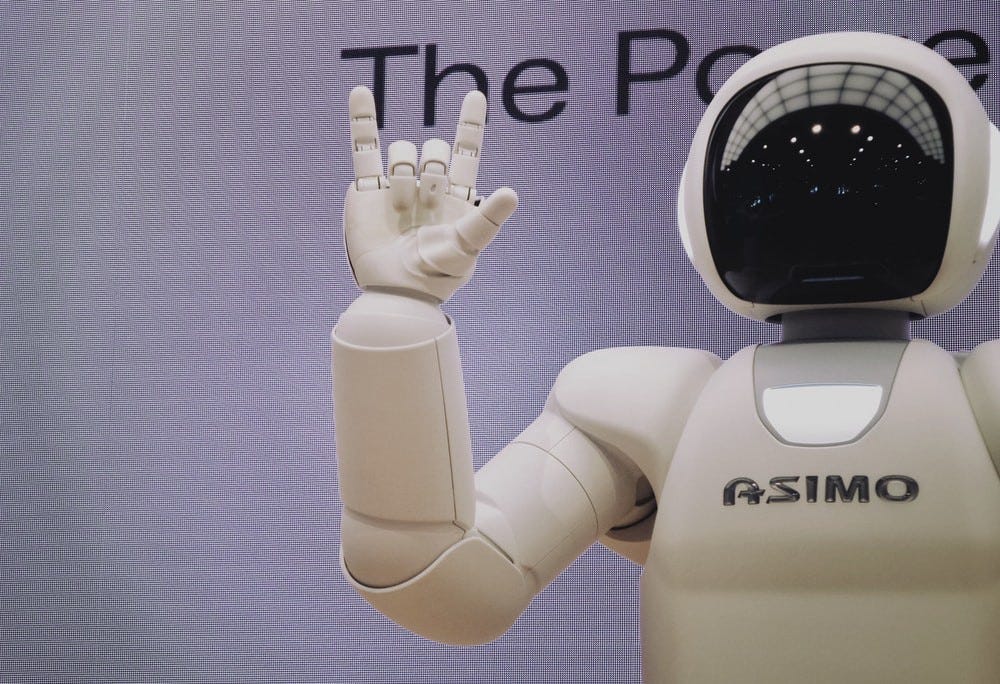
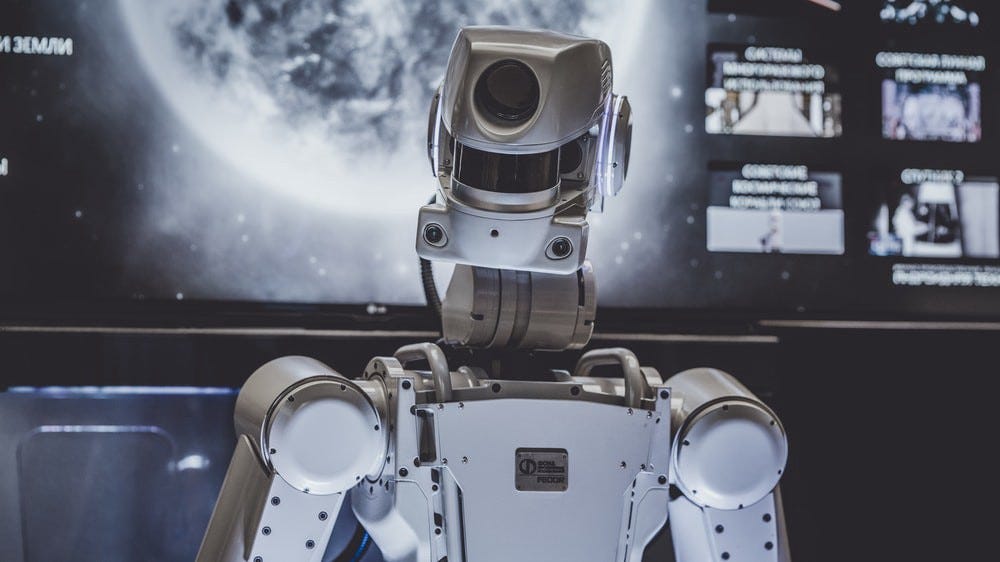
Robotics is a field that deals with creating humanoid machines that
can behave like humans and perform some actions like human
beings. Now, robots can act like humans in certain situations but can they think like humans as well? This is where artificial intelligence
comes in! Al allows robots to act intelligently in certain situations.
These robots may be able to solve problems in a limited sphere or
even learn in controlled environments.
An example of this is Kismet, which is a social interaction robot
developed at MIT’s Artificial Intelligence Lab. It recognizes the
human body language and also our voice and interacts with humans
accordingly. Another example is Robonaut, which was developed by
NASA to work alongside the astronauts in space.
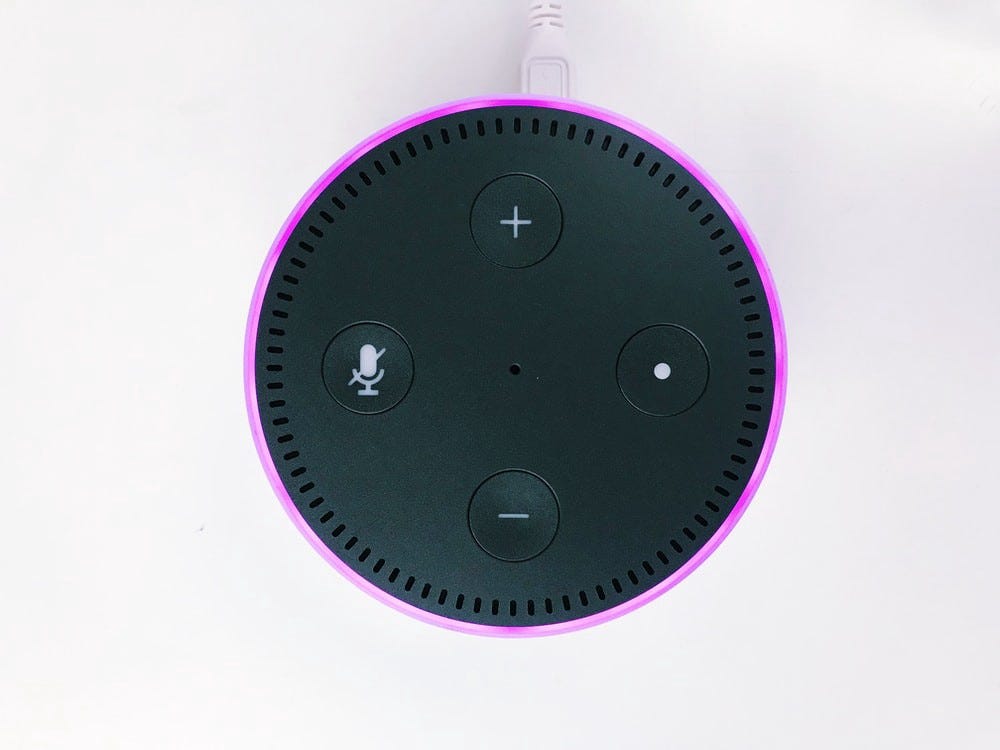
It’s obvious that humans can converse with each other using speech but now machines can too! This is known as Natural Language Processing where machines analyze and understand language and speech as it is spoken (Now if you talk to a machine it may just talk back!). There are many subparts of NLP that deal with language such as speech recognition, natural language generation, natural language translation, etc.
NLP is currently extremely popular for customer support applications, particularly the chatbot. These chatbots use ML and NLP to interact with the users in textual form and solve their queries. So you get the human touch in your customer support interactions without ever directly interacting with a human.
Some of the most popular examples of NLP applications are Alexa from Amazon and Siri from Apple.

When you are using Netflix, do you get a recommendation of movies
and series based on your past choices or genres you like? This is done by Recommender Systems that provide you some guidance on what to choose next among the vast choices available online.
A Recommender System can be based on Content-based Recommendation or even Collaborative Filtering. Content-Based Recommendation is done by analyzing the content of all the items. For example, you can be recommended books you might like based on a description of the item and your own basic profile. On the other hand, Collaborative Filtering is done by analyzing the past reading behavior of people similar to you and then recommending books based on that.
The internet is full of images! This is the selfie age, where taking an
image and sharing it has never been easier. In fact, millions of images
are uploaded and viewed every day on the internet. To make the
best use of this huge amount of images online, it’s important that
computers can see and understand images. And while humans can
do this easily without a thought, it’s not so easy for computers! This is
where Computer Vision comes in.
Computer Vision uses Artificial Intelligence to extract information from images. This information can be object detection in the image,
identification of image content to group various images together, etc.
An application of computer vision is navigation for autonomous
vehicles by analyzing images of surroundings such as AutoNav used
in the Spirit and Opportunity rovers which landed on Mars.
Artificial Intelligence deals with the creation of systems that can learn
to emulate human tasks using their prior experience and without any
manual intervention. Internet of Things, on the other hand, is a network of various devices that are connected over the internet and they can collect and exchange data with each other.
Now, all these loT devices generate a lot of data that needs to be
collected and mined for actionable results. This is where Artificial
Intelligence comes into the picture. Internet of Things is used to collect
and handle the huge amount of data that is required by the Artificial
Intelligence algorithms. In turn, these algorithms convert the data into useful actionable results that can be implemented by the loT devices.
8 concepts you must know in the field of Artificial Intelligence was originally published in Becoming Human: Artificial Intelligence Magazine on Medium, where people are continuing the conversation by highlighting and responding to this story.

 365 Data Science