Labeling Case StudyAgriculture Pigs Productivity Behavior and Welfare Image Labeling

Labeling Case Study — Agriculture— Pigs’ Productivity, Behavior, and Welfare Image Labeling

Facial Recognition

Woodrow Wilson Bledsoe, known as the father of facial recognition, developed a system that could recognize faces by using a 10-inch-square tablet with vertical and horizontal coordinates in the 1960s. For the past 60 years, countries across the world have substantially increased the investment in facial recognition systems. Today, programmers extend facial intelligence to the livestock farming industry, assessing the emotional well-being of pigs.

Pig Face Identification

Alibaba (China’s e-commerce giant) has recently set on automatic identification of pig faces. It can be used for breeding status diagnosis and disease detection as well. Last year Scotland’s Rural College (SRUC) implemented the convolutional neural networks to analyze pig emotion and intention.

Increasing numbers of farms around the world are now using high-tech equipment to record pig’s actions. Pig farms significantly benefited from face recognition as each piglets’ health condition can be accurately controlled since birth. The system also makes individual pig health improvement possible while monitoring its daily feed consumption.
Big Data Jobs

Training Data is the Primary Key of Smart Farming

The key to smart farming is the high-quality labeled data.

Recently, a Korean pig farm is looking for a digital AI system to monitor pigs’ productivity, behavior, and welfare. They cooperated with ByteBridge labeling platform in order to get labeled data.

“The smart AI system should be able to reflect every pig’s health condition from tracking feeding patterns and behaviors. We were looking for a data annotation company to process the data structurally. The tricky part is, we set a very strict time limit for the team. We need the labeling to be done as soon as possible” said the owner of the pig farm.Surprisingly, Bytebridge perfectly resolved this problem and improved our system. After handing out thousands of images, we received their output even sooner than we expected. We got our data labeled within 3 working days.”

Traditional data labeling companies, after receiving similar projects, would call up the tagging team and train them at least for several days based on the customer’s requirements.

On the contrary, ByteBridge, runs the task on the platform with annotation tools for real-time workflow, saving lots of time in communication. The output accuracy rate of labeling reaches 99.5% with 1/4 time spent compared to the others.

Trending AI Articles:

1. Top 5 Open-Source Machine Learning Recommender System Projects With Resources

2. Deep Learning in Self-Driving Cars

3. Generalization Technique for ML models

4. Why You Should Ditch Your In-House Training Data Tools (And Avoid Building Your Own)

ByteBridge: a Human-Powered Data Annotation Platform to Empower Agricultural Industry

ByteBridge owns millions of registered workers with 2D boxing daily outputs to 100,000. The platform takes advantage of task splitting and distribution algorithm, consensus mechanism.

Task Splitting Algorithm

ByteBridge divides the complex work automatically into simple small components to reduce human error.

In the pig farm project, the final delivered data is presented as structured data, including the number, position, and posture of pigs. The task flow is divided into 3 sub-works, i.e. counting pigs, frame pigs, and posture interpretation.

Consensus Mechanism

Each small component adopts a consensus mechanism, which means assign the same task to several workers, and the correct answer is the one that comes back from the majority output. The complete data is reunited automatically before final delivery.

Distribution Algorithm

The automatic distribution algorithm can help avoid the poor quality and capacity shortage caused by specific people, regions, and situations.

Flexibility

ByteBridge, a human-powered data labeling tooling platform with real-time workflow management, providing flexible data training service for the machine learning industry.

On the dashboard, clients can set labeling rules, iterate data features, attributes and workflow, scale up or down, make changes based on what they are learning about the model’s performance in each step of test and validation.
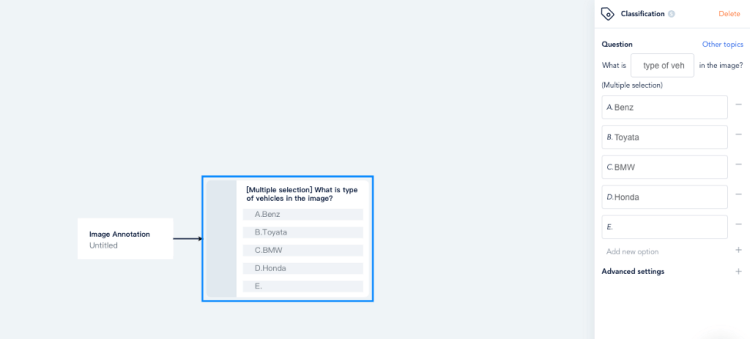
Visualization of Labeling Loop

Progress preview: clients can monitor the labeling progress in real-time on the dashboard

Result preview: clients can get the results in real-time on the dashboard

These labeling tools are available: Image Classification, 2D Boxing, Polygon, Cuboid.

Our expertise can create new recommendations based on the client’s use case. For further information, please visit our website site:ByteBridge.

Don’t forget to give us your ? !


Labeling Case Study — Agriculture— Pigs’ Productivity, Behavior, and Welfare Image Labeling was originally published in Becoming Human: Artificial Intelligence Magazine on Medium, where people are continuing the conversation by highlighting and responding to this story.

Via https://becominghuman.ai/labeling-case-study-agriculture-pigs-productivity-behavior-and-welfare-image-labeling-d776ab511eab?source=rss—-5e5bef33608a—4

source https://365datascience.weebly.com/the-best-data-science-blog-2020/labeling-case-studyagriculture-pigs-productivity-behavior-and-welfare-image-labeling

Dask and Pandas: No Such Thing as Too Much Data

Do you love pandas, but don’t love it when you reach the limits of your memory or compute resources? Dask provides you with the option to use the pandas API with distributed data and computing. Learn how it works, how to use it, and why it’s worth the switch when you need it most.

Originally from KDnuggets https://ift.tt/3sMh12s

source https://365datascience.weebly.com/the-best-data-science-blog-2020/dask-and-pandas-no-such-thing-as-too-much-data

9 Skills You Need to Become Data Engineer

A data engineer is a fast-growing profession with amazing challenges and rewards. Which skills do you need to become a data engineer? In this post, we’ll take a look at both hard and soft skills.

Originally from KDnuggets https://ift.tt/3e92ud2

source https://365datascience.weebly.com/the-best-data-science-blog-2020/9-skills-you-need-to-become-data-engineer

Evaluating Object Detection Models Using Mean Average Precision

In this article we will see see how precision and recall are used to calculate the Mean Average Precision (mAP).

Originally from KDnuggets https://ift.tt/3rhSBh8

source https://365datascience.weebly.com/the-best-data-science-blog-2020/evaluating-object-detection-models-using-mean-average-precision

The Role Of Artificial Intelligence In The Fight Against COVID

Photo by Martin Sanchez on Unsplash

Even before the arrival of COVID, it was clear that artificial intelligence would play a role in fighting with it.

With the arrival of COVID, the battle began on all fronts. The knowledge needed for the effective defense such as creating vaccines was already there. However, the knowledge is not always so easy to utilize. Scientific publications need to be researched. The White House has launched a consortium to analyze tens of thousands of scientific articles to understand how the virus works. Microsoft has participated in the Program among others.

Big Data Jobs

It seems tech companies are ready to use their infrastructure and capital to help the world in the fight. Another example of this is the Chinese eCommerce giant Alibaba. Which has deployed AI to recognize Covid symptoms.

Another evidence of the usefulness of AI is the patient monitoring software. Using these, the doctors are able to avoid the risks of personal contact. This not only protects healthcare workers but also somewhat offsets the shortage of professionals that is a problem in many countries.

Artificial intelligence can speed up drug research

Photo by Adam Nieścioruk on Unsplash

In the production of drugs, the extent to which researchers have been able to map the function of the pathogen is important. With the use of AI, this process, which has usually taken a very long time so far, can now be shortened by years.

Which company is at the forefront of AI-based drug research? Most would mention the name of a large healthcare company. Although, this company is actually Google. DeepMind is a development of a company called AlphaFold, which is owned by Google. This project has made great strides in mapping protein structures that could fundamentally accelerate drug production.

One possible solution: plenty of tests

According to the WHO head, clearly increasing the number of tests is an effective way to protect against the virus. However, testing is costly and time-consuming to perform. This is not to say that it would not be effective, but a more advanced method could test even more people and more easily, which could save lives.

Gauss Surgical is a company founded in 2011 with an artificial intelligence background from California. Gauss has developed a fast, simple, evaluable coronavirus test at home. Combining this with a smartphone, it is relatively easy to be tested for COVID. An easy and contactless test is a way to reduce the crisis.

Trending AI Articles:

1. Top 5 Open-Source Machine Learning Recommender System Projects With Resources

2. Deep Learning in Self-Driving Cars

3. Generalization Technique for ML models

4. Why You Should Ditch Your In-House Training Data Tools (And Avoid Building Your Own)

Quick diagnostics

Once tech giants like Microsoft or Google have boarded, you can’t miss out on Facebook either. As part of a joint research project with the University of New York, they are working on an artificial intelligence-based algorithm that takes MRI images ten times faster. If they succeed, this would make rapid MRI and diagnostics available to many more people. And health professionals are unanimous in saying that effective treatment begins with an early diagnosis.

Artificial intelligence is excellent for pattern recognition. This is why imaging is perhaps the most active area where we can expect to benefit from it in healthcare.

This is just the beginning

Healthcare and COVID are not the only areas where we can use AI. In fact, it does a good job in every industry where we work with a large quantity of data. It will be a great way to spot patterns from consumers ’purchases that we can use to build more products that consumers actually want and need. Another big area that is virtually data-driven is finance. Bitcoin is currently on an upward trend again. With artificial intelligence, we can create models that can predict prices more efficiently, thus building a crypto trading bot that automatically and constantly searches the market for opportunities.

The shortcoming of known chatbots is empathy. Even human support agents sometimes have problems with empathic communication, not to mention an algorithm. Several startups are already working to create an empathetically communicating robot. The current decade may be a big kickstart for artificial intelligence and may become part of the mainstream. We are still ahead of the curve.

Don’t forget to give us your ? !


The Role Of Artificial Intelligence In The Fight Against COVID was originally published in Becoming Human: Artificial Intelligence Magazine on Medium, where people are continuing the conversation by highlighting and responding to this story.

Via https://becominghuman.ai/the-role-of-artificial-intelligence-in-the-fight-against-covid-5bf15fa06c80?source=rss—-5e5bef33608a—4

source https://365datascience.weebly.com/the-best-data-science-blog-2020/the-role-of-artificial-intelligence-in-the-fight-against-covid

The TensorFlow Certification: get official recognition but its hard!

source https://365datascience.weebly.com/the-best-data-science-blog-2020/the-tensorflow-certification-get-official-recognition-but-its-hard

3 Types of Image Segmentation

If you are getting started with Machine Learning or Computer Vision, chances are you have heard the term image segmentation. If you are…

Via https://becominghuman.ai/3-types-of-image-segmentation-2b4c97ab5f84?source=rss—-5e5bef33608a—4

source https://365datascience.weebly.com/the-best-data-science-blog-2020/3-types-of-image-segmentation

15 common mistakes data scientists make in Python (and how to fix them)

Writing Python code that works for your data science project and performs the task you expect is one thing. Ensuring your code is readable by others (including your future self), reproducible, and efficient are entirely different challenges that can be addressed by minimizing common bad practices in your development.

Originally from KDnuggets https://ift.tt/3uQflXD

source https://365datascience.weebly.com/the-best-data-science-blog-2020/15-common-mistakes-data-scientists-make-in-python-and-how-to-fix-them

Getting Started with Distributed Machine Learning with PyTorch and Ray

Ray is a popular framework for distributed Python that can be paired with PyTorch to rapidly scale machine learning applications.

Originally from KDnuggets https://ift.tt/3bah2qY

source https://365datascience.weebly.com/the-best-data-science-blog-2020/getting-started-with-distributed-machine-learning-with-pytorch-and-ray

KDnuggets News 21:n09 Mar 3: Top YouTube Channels for Data Science; Data Science Learning Roadmap for 2021

The top YouTube channels for Data Science; they will help you with Data Science Learning Roadmap for 2021; Another great learning option is Machine Learning Systems Design: A Free Stanford Course; and if you are still using pandas to process large datasets, here are two better options.

Originally from KDnuggets https://ift.tt/3roQBUp

source https://365datascience.weebly.com/the-best-data-science-blog-2020/kdnuggets-news-21n09-mar-3-top-youtube-channels-for-data-science-data-science-learning-roadmap-for-2021

Design a site like this with WordPress.com
Get started