Data AnnotationOutsourcing v/s In-houseROI and Benefits | Analytics Insight

Data Annotation — Outsourcing v/s In-house — ROI and Benefits | Analytics Insight

Data Annotation — Outsourcing v/s In-house — ROI and Benefits

A 2018 report revealed that we generated close to 2.5 quintillion bytes of data every single day. Contrary to popular belief, not all the data we generate can be processed for insights. For data that can be used for training machine learning algorithms, the data has to be classified.

If you ask a layman how Artificial Intelligence models and algorithms work, they would tell you that it involves just three steps:

  1. Data is fed to the algorithms
  2. The algorithms process the data
  3. The desired results are obtained

But in reality, this is not how an AI model works and with this outlook, we are completely missing a crucial layer that defines the entire algorithm’s capability to produce efficient and accurate results — data annotation.

In simple words, data annotation or labeling is a process in which humans (inevitable parts of artificial intelligence) tag or label data to make it easier for the algorithms to understand and process. AI experts tag data such as videos, text, audio, images, and other forms of data through specialized tools with human-in-the-loop. Only when the data is tagged can a machine can actually work on it.
Big Data Jobs

However, the actual debate stems at this point as several companies out there have varied opinions on where they would like to get their data annotated. While some companies lean towards having an in-house team or using existing manpower and resources to annotate data, others prefer to outsource data annotation to third party vendors.

Both have their own set of pros and cons and if you’re someone who is stuck at that exact point in the process, this post will help bring you closer to making the right decision for you.

Trending AI Articles:

1. Write Your First AI Project in 15 Minutes

2. Generating neural speech synthesis voice acting using xVASynth

3. Top 5 Artificial Intelligence (AI) Trends for 2021

4. Why You’re Using Spotify Wrong

The Advantages Of Outsourcing Data Annotation Work

Dedicate Your Team For Greater Purposes

Most data scientists will tell you that the most tedious part of their jobs is preparing the data to train their algorithms. Having to do the janitorial work is not only a redundant task for a data science team, but it takes away valuable time and effort that could otherwise be more meaningfully utilized. The redundant task only takes away valuable man-hours and probably stalls the overlapping processes involved in the development cycle, too. But when you outsource the annotation process, both the processes happen simultaneously, eliminating all scopes in project delays.

Moreover, outsourcing the data annotation process enables your data science team to focus on continuing the development of robust algorithms and pushing the brink of innovation further for the company.

Better Quality

Dedicated experts whose only job is to annotate data for machine learning and AI modeling purposes will — any day — do a better job than a team that has to accommodate more than one task in their schedules. Needless to say, This results in better quality output.

Bulk Volumes Of Data Annotated Seamlessly

Though an average AI model development project involves labeling huge chunks of data in the range of thousands, there are specific projects with respect to healthcare, retail, sports, or more than easily add another zero at the end. As the volume of data to be labeled increases, it adds to the burden of your existing in-house team. What’s worse is you might even have to pull engineers and members from other teams to finish the task. However, that’s not the case with outsourcing companies like Shaip, who have niche dedicated teams and members to handle and scale operations regardless of data volumes because that is their one and only goal!.

Eliminate Internal Bias

A fundamental reason why several AI models don’t work the way they are supposed to, is because the teams working on it involuntarily introduce bias, skewing the output and drastically minimizing accuracy. An AI model under development is like a child and similar to a kid that learns from its parents’ behaviors and surroundings, an AI model learns from what it is also fed. That’s why an objective third-party does a better job at annotating the AI training data for optimized accuracy. With assumptions and bias eliminated, the real-world application of the model becomes more effective and impactful.

When Does In-House Data Annotation Make More Sense?

It’s simple. In-house data annotation makes more sense when the data volumes are less and the cost to get it outsourced is more than the project’s scope, budget, and worth.

Also, in-house data annotation is ideal when more internal inputs are required or when a project is super-specific (first-in-market) and only known to the company and its members. In that case, it is time-consuming to train a third-party vendor, orient them and get the job done.

The Data Security Myth

As a project manager, it is common to get concerned about the confidentiality of data being shared. And this is a crucial factor that decides if the annotation project has to be outsourced or retained within teams. Companies are constantly evolving their approach to data privacy and confidentiality. Understanding the importance of the topic’s sensitivity, several outsourcing vendors and companies come prepared to sign confidentiality agreements and clauses and even have security certificates to prove their adherence. For example, if a company is working with highly sensitive healthcare data, the appropriate data vendors are extremely vigilant and would have HIPAA compliance amongst other regulations under their belt. So, if data security is something that has been making you hesitant about outsourcing a complex project, you need not worry about it.

Final Thoughts

It’s safe to say that data annotation is no simple feat. The best option in hand is to get the job done by the pros and veterans. While we at Shaip take care of the tagging processes, you can work on other equally important tasks that would take your project a step closer to completion.

And just like the factors we mentioned, we check all the boxes on data confidentiality, quality, scalability, timely delivery, and more. Our ‘in-house’ teams of annotators have handpicked industry experts who have been working in this spectrum for years. Our super-exclusive tools are also designed to simplify the complexities involved in our projects.

We highly recommend you to get in touch with us for your data annotation needs today.

Author Bio

Vatsal Ghiya is a serial entrepreneur with more than 20 years of experience in healthcare AI software and services. He is a CEO and co-founder of Shaip, which enables the on-demand scaling of our platform, processes, and people for companies with the most demanding machine learning and artificial intelligence initiatives.

Don’t forget to give us your ? !


Data Annotation — Outsourcing v/s In-house — ROI and Benefits | Analytics Insight was originally published in Becoming Human: Artificial Intelligence Magazine on Medium, where people are continuing the conversation by highlighting and responding to this story.

Via https://becominghuman.ai/data-annotation-outsourcing-v-s-in-house-roi-and-benefits-analytics-insight-cc18bf786902?source=rss—-5e5bef33608a—4

source https://365datascience.weebly.com/the-best-data-science-blog-2020/data-annotationoutsourcing-vs-in-houseroi-and-benefits-analytics-insight

Feature Store as a Foundation for Machine Learning

With so many organizations now taking the leap into building production-level machine learning models, many lessons learned are coming to light about the supporting infrastructure. For a variety of important types of use cases, maintaining a centralized feature store is essential for higher ROI and faster delivery to market. In this review, the current feature store landscape is described, and you can learn how to architect one into your MLOps pipeline.

Originally from KDnuggets https://ift.tt/3axACgE

source https://365datascience.weebly.com/the-best-data-science-blog-2020/feature-store-as-a-foundation-for-machine-learning

Multidimensional multi-sensor time-series data analysis framework

This blog post provides an overview of the package “msda” useful for time-series sensor data analysis. A quick introduction about time-series data is also provided.

Originally from KDnuggets https://ift.tt/3azKAhn

source https://365datascience.weebly.com/the-best-data-science-blog-2020/multidimensional-multi-sensor-time-series-data-analysis-framework

The Keys to Unlocking Healthcare AIs Vast Potential in 2021Healthcare Business Today

The Keys to Unlocking Healthcare AI’s Vast Potential in 2021 — Healthcare Business Today

Healthcare is often thought of as an industry on the cutting edge of technological innovation. That’s true in many ways, but the healthcare space is also highly regulated by sweeping legislation such as GDPR and HIPAA, along with many more local guidelines and restrictions. Those legal hoops complicate the implementation of new tools and technologies such as artificial intelligence, which has become a hotly debated topic in the industry for good reason.

Artificial intelligence has the potential to disrupt industries around the world, but few hit quite so close to home as healthcare. According to a survey from HIT Infrastructure, 91% of healthcare insiders think the technology could boost access to care, but 75% believe it also threatens the data security and privacy of patient information. Consequences could be even more serious, however, and there’s also a concern that improper samples could lead to improper model generation.

Medical decisions are high-stakes, and AI algorithms are only as good as the data they’re trained with. Research from Gartner warns that as many as 85% of AI projects will deliver erroneous outcomes due to bias in data management through 2022. It’s an alarming statistic if those outcomes affect patient health, but it’s also not hard to see why this occurs. High-quality data is difficult to come by, and geographically diverse data even more so. An article published in the Journal of the American Medical Association found that the majority of data used to train AI came from California, New York, and Massachusetts — hardly a population representative of the world.

Big Data Jobs

The Argument for AI

Despite significant obstacles, AI has real promise in healthcare, and it could disrupt everything from diagnoses to how healthcare workers interact with their other technologies. In the field of radiology, for instance, AI is helping doctors pinpoint early indicators of diseases such as cancer and helping radiologists analyze larger volumes of image sets. It’s the same story in pathology, where AI can sort through hundreds of tissue samples to find slides that humans might easily miss.

Thanks to voice-recognition success rates that have reached 99%, healthcare workers can now interact verbally with documentation software, increasing the quality and completeness of documentation while allowing nurses and physicians to spend more time actually caring for patients. With the right digital assistant on the front lines, electronic medical records can auto populate from a simple conversation between a doctor and patient, saving valuable time and freeing healthcare workers from the necessary but tedious task of thoroughly documenting all of their encounters.

Trending AI Articles:

1. Write Your First AI Project in 15 Minutes

2. Generating neural speech synthesis voice acting using xVASynth

3. Top 5 Artificial Intelligence (AI) Trends for 2021

4. Why You’re Using Spotify Wrong

To ensure AI can accomplish the desired outcomes and overcome the obstacles, developers should improve training and ensure compliance by considering these three key elements:

1. Large volumes of accurate training data

Algorithms require massive amounts of accurate data, and that data is often difficult to come by. There are lots of examples of AI accurately diagnosing a disease, but the practice is often limited in scope to a single hospital or area because of training limitations. To create tools that revolutionize medicine around the world, developers need access to a comparatively impressive sample size of data.

2. Diversity of data accuracy to remove bias from results

Since AI’s inception, bias and inequality have plagued it. To overcome these obstacles, developers must collect data that are representative of the greater human population instead of a single city or country. That means gathering and licensing data from all over the globe.

3. Data de-identification to remove PHI and PII

Storing large amounts of patient data from a wide variety of international sources is a recipe for a compliance nightmare — unless that data is carefully de-identified to eliminate all vestiges of identifiable information. De-identified data is no longer considered protected health information, making it easier to store, share, and use for building the next generation of AI tools.

AI has an incredible amount to offer healthcare, but only if developers can successfully navigate the perils it presents. With large, diverse, and de-identified data sets that improve accuracy and eliminate bias, developers can begin to tackle healthcare problems that once seemed insurmountable using the awesome power of AI and machine learning.

Vatsal Ghiya — Co-Founder and CEO at Shaip

Vatsal Ghiya is a serial entrepreneur with more than 20 years of experience in healthcare AI software and services. He is a CEO and co-founder of Shaip, which enables the on-demand scaling of our platform, processes, and people for companies with the most demanding machine learning and artificial intelligence initiatives.

Don’t forget to give us your ? !

The Keys to Unlocking Healthcare AI’s Vast Potential in 2021 — Healthcare Business Today was originally published in Becoming Human: Artificial Intelligence Magazine on Medium, where people are continuing the conversation by highlighting and responding to this story.


Via https://becominghuman.ai/the-keys-to-unlocking-healthcare-ais-vast-potential-in-2021-healthcare-business-today-f45c116d9c04?source=rss—-5e5bef33608a—4

source https://365datascience.weebly.com/the-best-data-science-blog-2020/the-keys-to-unlocking-healthcare-ais-vast-potential-in-2021healthcare-business-today

GPT-2 (GPT2) vs GPT-3 (GPT3): The OpenAI Showdown

Which Transformer Should I Go With: GTP-2 or GPT-3?

The Generative Pre-Trained Transformer (GPT) is an innovation in the Natural Language Processing (NLP) space developed by OpenAI. These models are known to be the most advanced of its kind and can even be dangerous in the wrong hands. It is an unsupervised generative model which means that it takes an input such as a sentence and tries to generate an appropriate response, and the data used for its training is not labelled.

Source

What Is GPT-2?

Source

GPT-2 is an unsupervised deep learning transformer-based language model created by OpenAI back in February 2019 for the single purpose of predicting the next word(s) in a sentence. GPT-2 is an acronym for “Generative Pretrained Transformer 2”. The model is open source, and is trained on over 1.5 billion parameters in order to generate the next sequence of text for a given sentence. Thanks to the diversity of the dataset used in the training process, we can obtain adequate text generation for text from a variety of domains. GPT-2 is 10x the parameters and 10x the data of its predecessor GPT.

Language tasks such as reading, summarizing and translation can be learned by GPT-2 from raw text without using domain specific training data.

Big Data Jobs

Some Limitations In Natural Language Processing (NLP)

There are limitations that must be accounted for when dealing with natural language generation. This is an active area of research, but the field is too much into its infancy to be able to overcome its limitations just yet. Limitations include repetitive text, misunderstanding of highly technical and specialized topics and misunderstanding contextual phrases.

Language and linguistics are a complex and vast domain that typically requires a human being to undergo years of training and exposure to understand not only the meaning of words but also how to form sentences and give answers that are contextually meaningful and to use appropriate slang. This is also an opportunity to create customized and scalable models for different domains. An example provided by OpenAI is to train GPT-2 using the Amazon Reviews dataset to teach the model to write reviews conditioned on things like star rating and category.

Trending AI Articles:

1. Write Your First AI Project in 15 Minutes

2. Generating neural speech synthesis voice acting using xVASynth

3. Top 5 Artificial Intelligence (AI) Trends for 2021

4. Why You’re Using Spotify Wrong

What Is GPT-3?

Source

Simply put, GPT-3 is the “Generative Pre-Trained Transformer” that is the 3rd version release and the upgraded version of GPT-2. Version 3 takes the GPT model to a whole new level as it’s trained on a whopping 175 billion parameters (which is over 10x the size of its predecessor, GPT-2). GPT-3 was trained on an open source dataset called “Common Crawl”, and other texts from OpenAI such as Wikipedia entries.

GPT-3 was created to be more robust than GPT-2 in that it is capable of handling more niche topics. GPT-2 was known to have poor performance when given tasks in specialized areas such as music and storytelling. GPT-3 can now go further with tasks such as answering questions, writing essays, text summarization, language translation, and generating computer code. The ability for it to be able to generate computer code is already a major feat unto itself. You can view some GPT-3 examples here.

For a long time, many programmers have been worried at the thought of being replaced with artificial intelligence and now that looks to be turning into reality. As deepfake videos gain traction, so too is speech and text driven by AI to mimic people. Soon it may be difficult to determine if you’re talking to a real person or an AI when speaking on the phone or commuincating on the Internet (for example, chat applications).

GPT-3 Could Be Called a Sequential Text Prediction Model

While it remains a language prediction model, a more precise description could be it is a sequential text prediction model. The algorithmic structure of GPT-3 has been known to be the most advanced of its kind thanks to the vast amount of data used to pre-train it. To generate sentences after taking an input, GPT-3 uses the field of semantics to understand the meaning of language and try to output a meaningful sentence for the user. The model does not learn what is correct or incorrect as it does not use labelled data; it is a form of unsupervised learning.

These models are gaining more notoriety and traction due to their ability to automate many language-based tasks such as when a customer is communicating with the company using a chatbot. GPT-3 is currently in a private beta testing phase which means that people must sign on to a waitlist if they wish to use the model. It is offered as an API accessible through the cloud. At the moment, the models seem to be only feasible in the hands of individuals/companies with the resources to run the GPT models.

An example of this model at play can be seen when we give the sentence, “I want to go outside to play so I went to the ____”. In this instance, a good response can be something like a park or playground instead of something like a car wash. Therefore, the probability of park or playground on the condition of the prompted text is higher than the probability of car wash. When the model is being trained, it is fed millions of sample text options that it converts into numeric vector representations. This is a form of data compression which the model uses to turn the text back into a valid sentence. The process of compressing and decompressing develops the model’s accuracy in calculating the conditional probability of words. It’s opening a whole new world of possibilities, but it also comes with some limitations.

Some Limitations of GPT-2 & GPT-3

  • While Generative Pre-Trained Transformers are a great milestone in the artificial intelligence race, it’s not equipped to handle complex and long language formations. If you imagine a sentence or paragraph that contains words from very specialized fields such as literature, finance or medicine, for example, the model would not be able to generate appropriate responses without sufficient training beforehand.
  • It is not a feasible solution to the masses in its current state due to the significant compute resources and power that is necessary. Billions of parameters require an amazing amount of compute resources in order to run and train.
  • It is another black-box model. In a business setting, it is mostly necessary for the users to understand the processes under the hood. GPT-3 is still not available to the masses, as it is exclusive to a select number of individuals now. Potential users must register their interest and await an invitation to be able to test the model themselves. This was done to prevent the misuse of such a powerful model. An algorithm that can replicate human speech patterns has many ethical implications on the whole of society.

GPT-3 Is Better Than GPT-2

GPT-3 is the clear winner over its predecessor thanks to its more robust performance and significantly more parameters containing text with a wider variety of topics. The model is so advanced even with its limitations that OpenAI decided it would keep it secure and only release it to select individuals that submitted their reasoning to use the model. Eventually they may look to release it as an API to be able to control requests and minimize misuse of the model.

Also important to note: Microsoft announced in September 2020 that it had licensed “exclusive” use of GPT-3; others can still use the public API to receive output, but only Microsoft has control of the source code. Because of this, EleutherAI has been working on its own transformer-based language models loosely styled around the GPT architecture. One of their goals is to use their own GPT-Neo to replicate a GPT-3 sized model and open source it to the public, for free. You can view GPT-Neo progress on their GitHub repo here.

Artificial Intelligence has a long way to go before it deals a significant blow to the language generation space, since these models still cannot perfect the nuances of the human language. The level of accuracy needed and the type of tasks it needs to learn to tackle are still greater than its current capabilities. However, the rapid advancement in new GPT models is making it more likely that the next big breakthrough may be just around the corner.

Don’t forget to give us your ? !


GPT-2 (GPT2) vs GPT-3 (GPT3): The OpenAI Showdown was originally published in Becoming Human: Artificial Intelligence Magazine on Medium, where people are continuing the conversation by highlighting and responding to this story.

Via https://becominghuman.ai/gpt-2-gpt2-vs-gpt-3-gpt3-the-openai-showdown-71bce28fd431?source=rss—-5e5bef33608a—4

source https://365datascience.weebly.com/the-best-data-science-blog-2020/gpt-2-gpt2-vs-gpt-3-gpt3-the-openai-showdown

What is Derivative of Sigmoid Function

1. What is sigmoid function

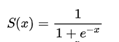
sigmoid function

If you have worked on Logistic regression or Neural network problem you must have heard about Sigmoid function. It takes the input values between -∞ to ∞ and map them to values between 0 to 1. It is very handy when we are predicting the probability. For example, where email is spam or not, the tumor is malignant or benign. More detail about why to use sigmoid function in logistic regression is here

Big Data Jobs

2. Why we calculate derivative of sigmoid function

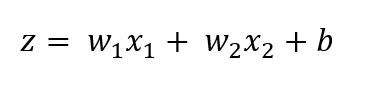
We calculate the derivative of sigmoid to minimize loss function. Lets say we have one example with attributes x, x₂ and corresponding label is y. Our hypothesis is

where w₁,w₂ are weights and b is bias.

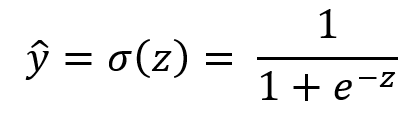
Then we will put our hypothesis in sigmoid function to get the predict probability. i.e. values between 0 and 1.

where y_hat is prediction probability of y being 1. And the loos function will be L(y_hat,y)

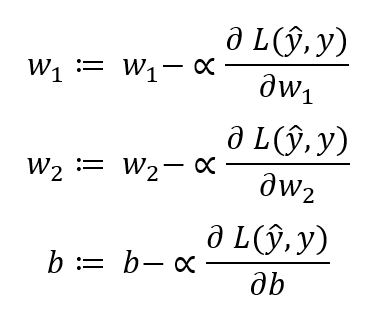
To minimize the loss function we need to do gradient descent, we will calculate the derivative of the loos function with respect to weights and bias and multiple that with learning rate alpha(α)and deduct that from our values of weights and bias. At the next we will use this new values of weights and bias. This iteration goes on until we hit global minima. Here is great article about gradient descent .

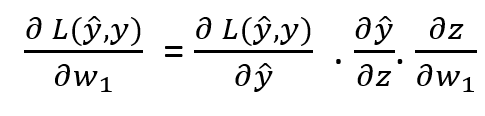
To calculate the derivative we have to back propagate. Because the loss function is depend upon sigmoid, sigmoid is depend upon hypothesis and hypothesis is depend on weight or bias.

w₁→z→ sigma(z) → L(y_hat, y)

By the chain rule of Derivative, derivative of loos function with respect to w₁

In this article we will talk about only middle term derivative of sigma function. Lets put value of y_hat

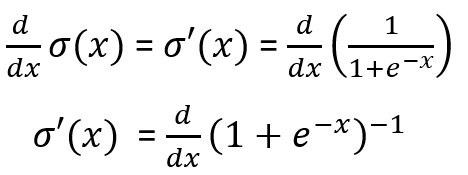
Now we will solve the derivative of sigmoid, We will treat this derivative as total derivative(not partial derivative) for more simplicity.

Trending AI Articles:

1. Write Your First AI Project in 15 Minutes

2. Generating neural speech synthesis voice acting using xVASynth

3. Top 5 Artificial Intelligence (AI) Trends for 2021

4. Why You’re Using Spotify Wrong

3. Derivation

Before going further I will recommend go through first seven Rules of Derivative from here.

Take the derivatives on both sides

Applying power rule and chain rule

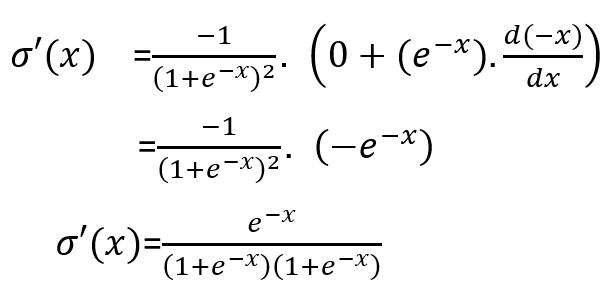
Again by the chain rule

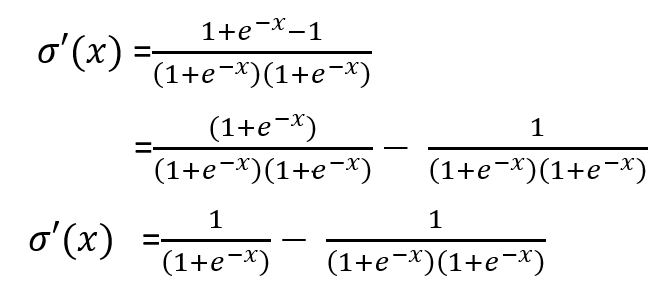
Add and subtract 1 in numerator

Lets take common multiple outside the bracket.

This is derivative of the sigma function

4.Plot

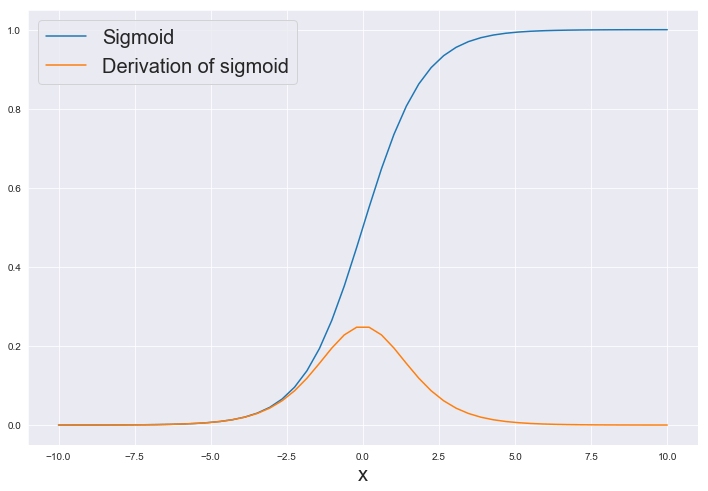
Lets take 50 numbers equality spaced between -10 to 10 and calculate sigmoid and derivatives of sigmoid for every number and plot it.

We know that Derivative is actually slope. Slope is defined as the ratio of change in Y to unite change in X.

We can see in plot at left where X= (-10), as we change X there is very less change in sigmoid(x), that’s why the slope or Derivative of sigmoid is nearly 0

But at the center of the plot, if change the X little bit, there is large change sigmoid(x), Moreover the slope is highest at X = 0,

As we go further right change of Y, to unit change of X is less so, again the slop is nearly zero.

These three conditions are depicted accurately by Derivative of sigmoid function (orange line) in the plot, Therefore we can say that our calculation good to go.

Thanks for reading. Feel free to refer below link’s for more details

5. References

  1. Logistic Regression by Andrew Ng
  2. Cost Function by Andrew Ng
  3. List of Derivative Rules

Don’t forget to give us your ? !


What is Derivative of Sigmoid Function was originally published in Becoming Human: Artificial Intelligence Magazine on Medium, where people are continuing the conversation by highlighting and responding to this story.
Via https://becominghuman.ai/what-is-derivative-of-sigmoid-function-56525895f0eb?source=rss—-5e5bef33608a—4

source https://365datascience.weebly.com/the-best-data-science-blog-2020/what-is-derivative-of-sigmoid-function

6 Data Science Certificates To Level Up Your Career

Anyone looking to obtain a data science certificate to prove their ability in the field will find a range of options exist. We review several valuable certificates to consider that will definitely pump up your resume and portfolio to get you closer to your dream job.

Originally from KDnuggets https://ift.tt/3puDYVJ

source https://365datascience.weebly.com/the-best-data-science-blog-2020/6-data-science-certificates-to-level-up-your-career

Forecasting Stories 5: The story of the launch

New products forecasting can be very difficult – there is no history to start with, and hence no base line. The number of assumptions can be huge. The best way to forecast then, is to try parallel approaches, build different views and triangulate on a common range.

Originally from KDnuggets https://ift.tt/3avC6b0

source https://365datascience.weebly.com/the-best-data-science-blog-2020/forecasting-stories-5-the-story-of-the-launch

Distributed and Scalable Machine Learning [Webinar]

Mike McCarty and Gil Forsyth work at the Capital One Center for Machine Learning, where they are building internal PyData libraries that scale with Dask and RAPIDS. For this webinar, Feb 23 @ 2 pm PST, 5pm EST, they’ll join Hugo Bowne-Anderson and Matthew Rocklin to discuss their journey to scale data science and machine learning in Python.

Originally from KDnuggets https://ift.tt/3s094GA

source https://365datascience.weebly.com/the-best-data-science-blog-2020/distributed-and-scalable-machine-learning-webinar

Design a site like this with WordPress.com
Get started