

Applications of Artificial Intelligence in Social Media

Social networks constantly gather unlimited amounts of data. It is practically unthinkable for humans to sort this data, and examine it, or even utilise it. However, we do have artificial intelligence applications that are embedded in these social media frameworks. As a consequence, this technology takes different forms.

Chatbots

Chatbots are an artificial intelligence software that can maintain a conversation or a discussion with a user using natural language on different platforms such as email applications, websites or mobile applications (Dagnon, 2018; Frankenfield, 2018). Chatbots are able to respond quickly, in very superior and completely assuring expressions in the interaction between computer systems and humans. However, on the technical side, chatbots are only a fundamental evolution of a question-and-answer system based on natural language processing (Frankenfield, 2018).

Applications that use chatbot technology humanise dialogues between machines and people, thereby improving the customer experience. Moreover, they contribute to companies’ great opportunities to develop the customer integration process while optimising customer services.
Big Data Jobs

In order to produce good results, the chatbot has to accomplice two responsibilities. We have to keep in mind that human intervention is required to develop, monitoring and optimising the chatbot’s technology framework. (Dagnon, 2018).

Chatbots have several functions. They can guide potential customers to brands and products in instant messaging applications, think of it as a chatbox when you visit an e-commerce website. The chatbot’s function will help you in navigating the website whilst creating a better user experience for the user with the brand itself. Businesses can use chatbots to have automated interactive conversations with website’s visitors and help them answer their queries 24/7. Chatbots are also great for accomplishing this task; they also track and analyse customer-shopping history. With this overview of Internet users’ behaviour, the brands can at any time, modify and retarget the digital campaigns in favour of the recommendations made by the collected data, thus increasing the rate of conversion. Most customer inquiries and complaints are resolved quickly with chatbots. They can answer FAQs, track shoppers through the numerous processes and render fast and efficient customer service. The use of chatbots can handle simple inquiries, so businesses release sales and customer relationship teams to focus on demanding responsibilities.

Trending AI Articles:

1. Write Your First AI Project in 15 Minutes

2. Generating neural speech synthesis voice acting using xVASynth

3. Top 5 Artificial Intelligence (AI) Trends for 2021

4. Why You’re Using Spotify Wrong

Regrettably, Chat bots won’t succeed humans. Their role is restricted to automating core tasks and enabling marketing teams to focus on more creative work. Chatbots also need updating and regular maintenance. A chatbot technology’s success relies on the collaboration of several stakeholders. These include IT developers, customer service, marketing department, and sales team, to create a tool that allows solving customers’ critical problems. Thus, chatbots are not unique solutions, but instead landing pages have a singular and flexible purpose (Dagnon, 2018).

Social-Selling

Social selling is the art of using social networks to find, interact, understand, develop and take advantage of sales offers. It is the most modern method of developing strong relationships with potential customers to keep the brand in mind (Newberry, 2017).

It is merely the use of social tools to engage in customer relationship techniques. We have to describe what social selling is not. It is not about fooling people with ads, tweets, or unsolicited content. This is spam, and it is definitely not social selling.

Social selling is about acquiring contacts and developing relationships and listening to customers so that companies can present a solution to the current problem while meeting an urgent need to make life easier to the client (Newberry, 2017). Social selling also holds its success using artificial intelligence technology and tools such as chatbots already mentioned before. Social selling makes it possible to have a more straightforward and more fluid sales process. The use of these technologies makes it possible to optimise the digital strategies deployed on social networks and increase the profiles collected, which is the companies’ main objective (Newberry, 2017).

Predictive Analytics

Predictive analytics refers to the use of statistics and machine learning to analyse behaviour and derive predictions. All the same, humans are very predictable because we all have routines like waking up in the morning, brushing your teeth, taking a shower, getting dressed and having breakfast. This aspect of prediction allows the marketing specialists to know what will happen in the future and adapt the marketing campaigns according to the thing (Stelzner, 2018).

Considering we are predictable and have a general perception, machines have made these predictions more specific.

The predictive analysis focuses mainly on the detection of events. For marketing services, forecasts are a time series of events. For example, a marketing specialist can know when to engage a customer service to handle his target’s requests (Stelzner, 2018).

It should be noted that the predictive analyses are more than 70 years old. Most people are surprised to hear that this discipline dates back so long as they think learning and automation are new technologies. However, theories and mathematical formulas have existed for several years (Stelzner, 2018).

The most notable change is the power of data processing and computers’ ability today to leverage data. They can process a lot of data in less time. In theory, predictive analysis is achievable on paper, but it will take a significant amount of time.

AI Generated Content

Targeted advertising has become fundamental. Artificial intelligence is now helping marketers read further data and promote digital campaigns. All this is meant to understand Internet users’ intentions and suggest content better suited to their expectations (Kreimer, 2018).

Artificial intelligence allows marketers to produce content automatically for simple stories, such as ports reports and stock analytics.

Google has also launched new machine learning algorithms, where they create generated content targeted to specific user’s demands.

AI generated content is created through rules. Users provide datasets, and the AI technology will develop narrative around this data. Artificial intelligence can help companies save time and energy and motivate employees to focus on more demanding tasks.

Although the AI’s content seems to be growing, the challenge is great; computers cannot react on their own. They urgently need human help. Because artificial intelligence is not aware of human emotions, a machine will not know what we interpret as funny, even if we introduce these aspects into its rules (Kreimer, 2018).

References

Dagnon S., 2018. Using Chatbots for Social Media Marketing. [online] Available at: https://mavsocial.com/chatbots-social-media-marketing/. [Accessed on 27 February 2019].

Frankenfield J., 2018. Chatbot. [online] Available at: https://www.investopedia.com/terms/c/chatbot.asp. [Accessed on 02 March 2019].

This blog is a project for Study Unit MCS5460, University of Malta.

Don’t forget to give us your ? !


Applications of Artificial Intelligence in Social Media was originally published in Becoming Human: Artificial Intelligence Magazine on Medium, where people are continuing the conversation by highlighting and responding to this story.

Via https://becominghuman.ai/applications-of-artificial-intelligence-in-social-media-7f2db8e9784d?source=rss—-5e5bef33608a—4

source https://365datascience.weebly.com/the-best-data-science-blog-2020/applications-of-artificial-intelligence-in-social-media

How Will AI Change the Face of Digital Marketing in 2021?

Artificial Intelligence — to many it might remind of some “terminator sci-fi” where AI overruns humanity. However, in the real world, artificial intelligence has marked a huge impact in science, economics, and business. Today, brands are very dependent on these AI mechanisms to sustain the market and its trends.

In popular opinion, if there is any change that is really visible in society, it is the scientific development of civilization and human dependence on it. Well, in reference to AI applications in digital marketing, I have expressed myself below.

AI is revolutionizing digital strategies with its operative learning system. It has the ability to store data, analyze it, and learn from the analysis in order to improve. There isn’t any limit to this and due to the speed and accuracy, it is very competitive tech.

It is still in the cocoon phase and advancing every single day. It is definitely a priority for many companies who are focused on the market and want to enhance the digital marketing strategy. This technology provides sufficient customer insights which assist in deeper penetration within the industry.

Apart from that, AI systems are inducted in projects of companies, like Tesla’s auto-driver, Apple’s Siri, Google, etc. It looks like in the forthcoming years it would become the norm to include AI in most of the simple equipment.

Big Data Jobs

Endless numbers of enterprises are involving AI in their business goals. Artificial Intelligence is essential for the future of digital marketing.

The relation between AI and Digital Marketing

Customer Relationship Management is a department that creates a strategy to maximize business with a customer-centric approach. When CRM is combined with Artificial Intelligence, it assists in gaining insights about the targeted customers by maximizing the collection of user data from various platforms. This then can be utilized to identify the needs of the consumers eventually to deploy the most accurate marketing strategy.

Marketers can sort out data after thorough analysis and improve AI algorithms to achieve higher sales. With such a deeply-placed data collection mechanism, companies can access the customers’ behavior and put up the most effective solution for them. This makes the user-experience hassle-free and retention of customers increases for the company.

The aim now is to understand some of the new trends of AI in Digital Marketing that may occur in 2021. Suggested changes are an effort of thorough analysis and aim at preparing every writer or company for 2021.

Trending AI Articles:

1. Write Your First AI Project in 15 Minutes

2. Generating neural speech synthesis voice acting using xVASynth

3. Top 5 Artificial Intelligence (AI) Trends for 2021

4. Why You’re Using Spotify Wrong

Automated Customer Services or Chatbots

Eminent growth in the utilization of chatbots is noticeable in recent years. They have become institutional while dealing with simple inquiries or marketing your products. AI like Alexa for Amazon has already made the search easy for the customers buying from the shopping portal. The popularity of virtual assistants is huge and feels to be comfortable working within the interface.

A Global AI Survey Report of 2016 suggests that these self-learning AI systems are supported by around 86% of people in the US, UK, Germany, and Latin America, collectively. These supporters are curious about trying fresh products based on the system.

In fact, 65% of customers are already interacting with some kind of AI tool. Various companies are trying to develop this chatbot technology and the future for such tech is bright.

Further, here are the top 5 benefits of using chatbot for your business:

  1. 24×7 availability of chatbots

2. Chatbots will save cost on resources

3. Chatbots decrease the chances of error

4. Chatbots are AI-based, unaffected by emotions, thereby guaranteed
customer satisfaction

5. Self-learning program which is faster than any employee

Increased proportion of Voiced Searches

Virtual assistants, like Alexa and Siri, are much better from the previous years. They have encapsulated the customers with their simple user interface and search accuracy. This has eventually drawn a higher number of people to use voice searches. Moreover, this inclination towards hands-free data input is expected to increase even more.

Today, almost 60% of business searches are speech searched. In 2020, more than half of the daily searches were voiced. This year will also replicate a similar trend and predictions are that 50% of every kind of search would be voice-based. This growth is not magic, but the hard work of programmers. They developed critical machine learning algorithms in order to understand human speech which resulted in these kinds of advancements in Artificial Intelligence.

If you remember how Google voice searches were 10 years back, you would know it was underdeveloped. However, Google’s algorithms are at a point where they can comprehend human speech with 96% accuracy.

Doesn’t it boggle your mind?

As human civilization becomes more comfortable with technology, it transcends to adopt an easier lifestyle. Using voice command over type search is very basic, yet changes a lot in the digital marketing industry. Businesses will need to alter their content strategies and SEO work. They will have to focus more on the voice search data in order to align better and land successful campaigns.

Increasing Demand for AR and VR

Virtual and Augmented Reality are much popular in the gaming world, like Xbox gaming and Pokémon Go. Moreover, this technology is more cheered for entertainment purposes than practical.

Further, the incorporation of AI in AR and VR will gain excessive momentum in the coming decade. It will become an important tool to enhance brand learning and marketing.

In digital marketing, this method can bring forth different ways for the customers to interact with the brand and create a connection with it. Use of AI with AR/VR will redefine user experience and build a robust brand identity.

Conclusion

AI is a valuable tool for digital marketers around the work. There is no denying in the fact that AI is influencing the choices of consumers, providing them with relevant recommendations and 24×7 swift customer services.

Finding ways to inculcate AI in a business will enable the growth of the brand, drive sale figures, and meet consumers’ expectations. So, get prepared for 2021 and sharpen your marketing tools with Artificial Intelligence.

Don’t forget to give us your ? !


How Will AI Change the Face of Digital Marketing in 2021? was originally published in Becoming Human: Artificial Intelligence Magazine on Medium, where people are continuing the conversation by highlighting and responding to this story.

Via https://becominghuman.ai/how-will-ai-change-the-face-of-digital-marketing-in-2021-4a43e8e2ddf0?source=rss—-5e5bef33608a—4

source https://365datascience.weebly.com/the-best-data-science-blog-2020/how-will-ai-change-the-face-of-digital-marketing-in-2021

The Best Data Science Project to Have in Your Portfolio

If you are trying to find your first path into a Data Science career, then demonstrating the quality of your skills can be the greatest hurdle. While many standard projects exist for anyone to complete, creating an original data-driven project that attempts to solve some challenge is worth so much more. A good Data Scientist is one that can solve data-related questions, and a great Data Scientist poses original data-related questions and then solves.

Originally from KDnuggets https://ift.tt/3tCI4yv

source https://365datascience.weebly.com/the-best-data-science-blog-2020/the-best-data-science-project-to-have-in-your-portfolio

Top Stories Feb 1-7: How to create stunning visualizations using python from scratch; How to Get Your First Job in Data Science without Any Work Experience

Also: Build Your First Data Science Application; 3 Ways Understanding Bayes Theorem Will Improve Your Data Science; Deep learning doesn’t need to be a black box; Essential Math for Data Science: Introduction to Matrices and the Matrix Product

Originally from KDnuggets https://ift.tt/2O9pcqu

source https://365datascience.weebly.com/the-best-data-science-blog-2020/top-stories-feb-1-7-how-to-create-stunning-visualizations-using-python-from-scratch-how-to-get-your-first-job-in-data-science-without-any-work-experience

Essential Math for Data Science: Introduction to Matrices and the Matrix Product

As vectors, matrices are data structures allowing you to organize numbers. They are square or rectangular arrays containing values organized in two dimensions: as rows and columns. You can think of them as a spreadsheet. Learn more here.

Originally from KDnuggets https://ift.tt/2MCA4Nk

source https://365datascience.weebly.com/the-best-data-science-blog-2020/essential-math-for-data-science-introduction-to-matrices-and-the-matrix-product

Why You Should Ditch Your In-House Training Data Tools (And Avoid Building Your Own)

At Cord, we’ve spent weeks interviewing data scientists, product owners, and distributed workforce providers. Below are some of our key learnings and takeaways for successfully establishing and scaling a training data pipeline.

If you’ve ever dabbled in anything related to machine learning, chances are you’ve used labeled training data. And probably lots of it. You might even have gone through the trouble of labeling training data yourself. As you have most likely discovered, spending time creating and managing training data sucks — and it sucks even more if you can’t find an open-source tool that fits your specific use case and workflow.

Building custom tools might seem like the obvious choice, but making the first iteration is typically just the tip of the iceberg. More start- and scale-ups than we can count end up spending an insurmountable amount of time and resource building and maintaining internal tools. Making tools is rarely core to their business of building high-quality machine learning applications.

Big Data Jobs

Here are things to consider when establishing your training data pipeline and when you might want to ditch your in-house tools.

Is It Built To Scale?

You’ve produced the first couple of thousand labels, trained a model, and put it into production. You begin to discover that your model does poorly in specific scenarios. It could be that your food model infers a tomato as an orange in dim lighting conditions, for example. You decide to double or even triple your workforce to keep up with your model’s insatiable appetite for data to help solve these edge cases. If your tool is built on top of CVAT — like most of the machine vision teams we’ve worked with — it quickly starts to succumb to the increased workload and comes down crashing faster than you can say Melvin Capital.

Cost Grows with Complexity

Machine learning is an arms race. Keeping up with the latest and greatest models require you to re-evaluate and update your training data. That typically means that the complexity of your label structure (ontology) and data grows, requiring you to add new features to your in-house tools continuously. New features take time to build and will be around to maintain long after, eating up precious resources from your engineering team and dragging down your expensive workforce’s productivity. This cost is not immediately apparent when you are first building out a pipeline but can become a considerable drag on your team as your application grows.

Trending AI Articles:

1. Write Your First AI Project in 15 Minutes

2. Generating neural speech synthesis voice acting using xVASynth

3. Top 5 Artificial Intelligence (AI) Trends for 2021

4. Why You’re Using Spotify Wrong

I/O Is Key to Success

A robust pipeline should give you a complete overview of all of your training data assets and make it easy to pipe them between different stakeholders (annotators, data scientists, product owners, and so on). Adequate piping necessitates that the data resides in a centralized repository and that there is only a single source of truth to keep everyone synced. Building a series of well-defined APIs that allows for effective pushing and pulling data is no small feat. Additionally, making a good API is often complicated by attempting to mould training labels produced by open-source tools into queryable data assets.

Label I/O should be as simple as calling a function

Starting from Scratch

When establishing a training data pipeline, the perennial mistake teams make when they spend money on a workforce is starting the annotation process from scratch. There are enough pre-trained pedestrian and car models to cut initial annotation costs drastically.

Even if you are working on something more complex, using transfer learning on a pre-trained model fed with a few custom labels can get you far. An additional benefit is that it allows you to understand where a model might struggle down the line and immediately kickstart the data science process before sinking any money into an expensive workforce. At Cord, we applied this exact method in our collaboration with the gastroenterology team at King’s College London, helping them speed up their labeling efficiency by 16x, which you can read more about here.

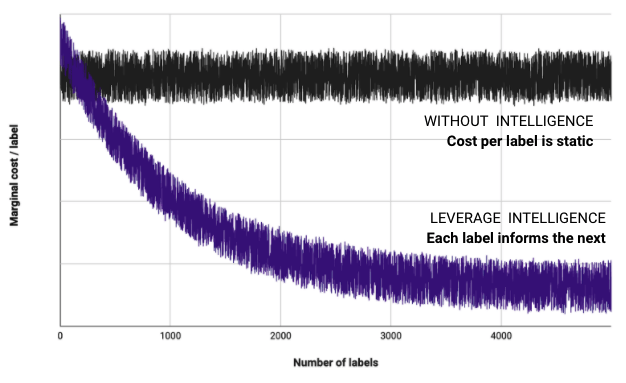
Labeling Pre-Cancerous Polyps Case Study: Marginal cost per label with and without utilizing pre-trained models & data algorithms

Doesn’t Get Smarter With Time

In addition to using pre-trained models, intelligently combining heuristics and other statistical methods (what we like to call ‘data algorithms’) to label, sample, review, and augment your data can drastically increase the ROI on human-produced labels. Existing software doesn’t apply these intelligent ‘tricks’, which means that the marginal cost per produced label remains constant. It shouldn’t. It should fall, even collapse, as your operation scales.

We’ve seen teams attempt baking in some of these methods in their existing pipelines. However, each data algorithm can take days, if not weeks, to implement and often lead to nasty dependency headaches. The latter can be a substantial time suck — we know first-hand how frustrating it can be to line up the exact version of CUDA matching with PyTorch, matching with torchvision, matching with the correct Linux distribution… you get the idea.

Conclusion

If any of the above points resonate with you, it might be time to start looking for a training data software vendor. While the upfront cost of buying or switching might seem steep relative to building on top of an open-source tool, the long-term benefits most often outweigh the costs by orders of magnitude. Purpose-built training data software ensures that all of your stakeholders’ needs are satisfied, helping you cut time to market and increase ROI. If you’re a specialist AI company or a company investing in AI, training data is at the core of your business and forms a vital part of your IP. It is best to make the most of it.

Don’t forget to give us your ? !


Why You Should Ditch Your In-House Training Data Tools (And Avoid Building Your Own) was originally published in Becoming Human: Artificial Intelligence Magazine on Medium, where people are continuing the conversation by highlighting and responding to this story.
Via https://becominghuman.ai/why-you-should-ditch-your-in-house-training-data-tools-and-avoid-building-your-own-ef78915ee84f?source=rss—-5e5bef33608a—4

source https://365datascience.weebly.com/the-best-data-science-blog-2020/why-you-should-ditch-your-in-house-training-data-tools-and-avoid-building-your-own

Top 5 Open-Source Machine Learning Recommender System Projects With Resources

A recommender system, or a recommendation system, is a subclass of information filtering system that seeks to predict the “rating” or…

Via https://becominghuman.ai/top-5-open-source-machine-learning-recommender-system-projects-with-resources-50583c4007c3?source=rss—-5e5bef33608a—4

source https://365datascience.weebly.com/the-best-data-science-blog-2020/top-5-open-source-machine-learning-recommender-system-projects-with-resources

How do machines learn: a simple explanation

How Do Machines Learn: A Simple Explanation

Get the fundamentals straight before you jump into AI

Photo by Brett Jordan on Unsplash

My introduction to the world of data science was through a university course called Introduction to Machine Learning I took during my bachelor’s. And it was, by far, my least favorite class of all time. Even though I was a generally high-scoring student, I struggled with it a lot.

At the time, I blamed the professor of the course for not doing a good job explaining things. Though, in retrospect, I think the main problem was my perspective.

Machine Learning was a new way of approaching problems and I didn’t take enough time to internalize the logic behind how it worked. As a result, I had a hard time learning the ML algorithms and fundamental concepts.

Big Data Jobs

I recognize similar struggles in the newcomers to this field. That’s why I’d like to share a simple explanation of how machine learning works, in hopes that it will make your learning smoother than mine.

By now you have probably heard this explanation: ML algorithms learn like humans. You give it examples and it recognizes and remembers the patterns in them. You need to give it a lot of examples, though, so that it can learn accurately.

Okay, that’s clear. But HOW does it learn?

You have probably also seen this image somewhere:

This image illustrates the sentence above on a more formal level. You provide examples (input) to the model. Based on this input, the model learns and is then able to produce predictions (output).

The learning happens inside the model. And what the model is, is basically a mathematical equation. Like this one:

a*x+b = y

It says a times x plus b makes y. In the context of machine learning, the input we provide would be x and the result of the equation, y, would be the output or the prediction if you will.

The goal of machine learning is to find the a and b values that hold true for all the x and y pairs.

So basically the whole learning process is, getting examples for x and y, and based on those examples, trying to figure out what the a and b values should be by making guesses and improving those guesses.

Trending AI Articles:

1. Write Your First AI Project in 15 Minutes

2. Generating neural speech synthesis voice acting using xVASynth

3. Top 5 Artificial Intelligence (AI) Trends for 2021

4. Why You’re Using Spotify Wrong

Let’s look at a simple example. Let’s say we have a training set of one data point. We know that if x is 5, y should be 12. In a tuple it would look like this: (5,12). We need to find the a, b pair that fits these numbers. As in the equation below.

a*5 + b = 12

From this point on, the model starts its search for the a and b values. But it does not use any prior knowledge. No mathematics knowledge, no assumptions, nothing. To start with, random numbers are assigned to the a and b values.

Let’s say, in our example, a is initialized as 8 and b as 3. This would give us:

8*5 + 3 = 43

Our error is: 43–12 = 31. So this would tell us that our a and b values are too high.

The learning process is basically trial-error mashed up with the hot and cold game (where you tell someone they are getting hotter when they get closer to an item you hid from them and cold when they get further).

The model tries new values each time guided by how much it overshot the actual value and in which direction. As in, was the guess higher than the expected value or lower?

Our model might try 2 and 1 next. This would give us:

2*5 + 1 = 11

This is a much better guess. Our error is only: 11–12 = -1 This error means that now we underestimated the y value. After going with this for a while, let’s say our model tries, 3 and -3:

3*5 + (-3) = 12

Done! We were able to figure out the a and b values! But not so fast. It turns out that there was another pair of x, y values that just came to our attention: (3,4). Plugging in these values in our newly built model, we see a disappointing scene.

3*3 + (-3) = 6

Unfortunately, it doesn’t work. We have an error of 6–4 = 2. After some more guessing, our model will likely come up with the actual value for a and b which is 4 and -8.

So this is how a ML model learns in principal. Here is how some fundamental concepts relate to what we just learned:

Machine Learning models need enough data to learn accurately

What is enough data? It is the amount of data points that will help us find the most accurate explanation (line) for the problem (equation) in our hands. And yes, you guessed it, this amount depends on the complexity of the problem and the model.

Sometimes multiple explanations (or lines) might fit the data but we need enough data to figure out the most accurate explanation. In the above example, our problem could an be represented as a straight line and the model only needs 2 points to find it accurately. One point is not enough because multiple lines can pass through the same point.

Multiple lines pass through the same point.

The actual problems ML deals with is more complex. The relationship between input and output is not linear: making the line non-linear. Additionally, there would be more than one input variable, making the problem multi-dimensional and effectively impossible to plot after the 3rd dimension. This would mean we need many more data points.

Not just any data though, relevant data

We need a lot of data for an accurate model, but these data points we train our model on, need to be comprehensive. They need to represent a significant portion of the real world. Otherwise, even a (seemingly) perfect model would fail in the real world. Just like in our example how we didn’t know that the correct a, b pair was 4 and -8 before we saw the second data point, our model needs to have access to enough diversity in data points to learn an accurate enough estimation of the world.

Neglecting data quality and diversity might cause bias and unfairness in our practice too. One example is a classification algorithm having a bias in favor of men when it comes to classifying who can be the president of a country caused by the training set having 95% of the data points being male presidents and only 5% women.

Inputs might have many shapes

The input can be numerical like in our example here but it can also be categorical. Or it can be text or even an image. A good thing to know is that no matter how the input looks, before we feed it to the model, we translate it into a numerical form. For example, an image of 100×100 pixels will turn into a 100×100=10000 elements long list. Each element representing one pixel’s color with a number.

Machine Learning is an estimation

In data science, we work with problems that do not have a perfect mathematical explanations.

The example we worked with in this article can be solved with a couple of example data points because it is a mathematical formula. But there are cases where the problem is not. Especially in problems where humans are involved. One example is credit risk score calculation. If you want to calculate the likelihood someone will pay their debt back without any problems, you are dealing with the human factor. And no matter how many variables you take into account (employed/unemployed, sex, age, residence, and so on) there can always be someone who lies out of the pattern.

There is randomness to these problems. That’s why, no matter how many data points you give as examples, what we are doing at the end of the day is an estimation. We are trying to come up with a mathematical explanation that can closely estimate what happens in the real world.

The equation looks different in every algorithm

This mathematical equation that needs to be solved is different for each algorithm. For linear regression, it does actually look like the example we worked on. But for example in decision trees, the constant values we are trying to find are values at which the tree makes a decision to make a split. But let’s not get into the details here. Just know that the working logic is the same but the what the constants are is different for each ML algorithm.

And that’s all. How a machine learns on a high level is actually this simple. understanding this helped me greatly when learning about new machine learning algorithms. The trick is understanding what is being optimized and what the value I’m trying to estimate is.

Talking about all this and understanding the logic behind machine learning is one thing but practice is what will get you a job. If you’d like to learn all of this and more in practice, go to Hands-on Data Science: Complete your first portfolio project.

Don’t forget to give us your ? !


How do machines learn: a simple explanation was originally published in Becoming Human: Artificial Intelligence Magazine on Medium, where people are continuing the conversation by highlighting and responding to this story.

Via https://becominghuman.ai/how-do-machines-learn-a-simple-explanation-2edf1fb4830e?source=rss—-5e5bef33608a—4

source https://365datascience.weebly.com/the-best-data-science-blog-2020/how-do-machines-learn-a-simple-explanation

Deep learning doesnt need to be a black box

The cultural perception of AI is often suspect because of the described challenges in knowing why a deep neural network makes its predictions. So, researchers try to crack open this “black box” after a network is trained to correlate results with inputs. But, what if the goal of explainability could be designed into the network’s architecture — before the model is trained and without reducing its predictive power? Maybe the box could stay open from the beginning.

Originally from KDnuggets https://ift.tt/3pU5HAf

source https://365datascience.weebly.com/the-best-data-science-blog-2020/deep-learning-doesnt-need-to-be-a-black-box

Backcasting: Building an Accurate Forecasting Model for Your Business

This article will shed some light on processes happening under the roof of ML-based solutions on the example of the business case where the future success directly depends on the ability to predict unknown values from the past.

Originally from KDnuggets https://ift.tt/2YKWvCv

source https://365datascience.weebly.com/the-best-data-science-blog-2020/backcasting-building-an-accurate-forecasting-model-for-your-business

Design a site like this with WordPress.com
Get started