365 Data Science is an online educational career website that offers the incredible opportunity to find your way into the data science world no matter your previous knowledge and experience.
Developing machine learning models as products that deliver business value remains a new field with uncharted paths toward success. Applying well-established software development approaches, such as agile, is not straightforward, but may still offer a solid foundation to guide success.
Employee training has been around for centuries, in one form or another. Just think about blacksmiths training apprentices, and young men learning to be knights.
But just like society and the world of work as a whole, employee training tactics and tools have been evolving since the Middle Ages. In recent times, employee training programs have benefited from new concepts in educational methodology, educational psychology, and now artificial intelligence (AI), so in 2020, traditional training methods are likely to be as out of date and irrelevant as a blacksmith.
Although the importance of onboarding new hires, teaching employees to use your tools, educating about company culture, and upskilling to keep pace with changing roles hasn’t changed, the way that training programs are implemented and run has altered.
Artificial Intelligence Jobs
Employee experience is increasingly important for employee engagement, according to 96% of HR professionals, and your employee training programs play a key role in that. Today’s workforce considers growth opportunities to be more important than compensation when it comes to choosing a workplace, which of necessity includes training and professional development programs.
If you want to field employee training programs that are efficient, effective, and enjoyable, you’ll need to look for ways to use the revolutionary qualities of AI to upend typical frontal education.
AI supports personalized learning
Everyone is looking for individualized experiences that are customized to their own unique needs. Employee training programs are no exception. Each of your employees has different learning preferences and different amounts of prior knowledge, and wants to learn at different speeds and at different times of the day and week.
AI makes it easy to offer personalized training programs that meet these demands, instead of slotting all your employees into a single training program. Because AI itself learns from its users, AI-powered training programs can automatically pick up on user needs and adapt accordingly. Use AI to provide on-demand, flexible training programs that match your employees’ schedules, prior knowledge, and attention spans.
2. AI training programs are more engaging
The more engaging your training programs are, the greater the chances that your employees will complete them and focus while doing so. With the help of AI, you can mix up the pace and format of information delivery, adding entertaining points like animations and videos.
AI can also enable you to connect learning experiences for multiple employees, without undoing the individualized nature of each one, in order to gamify the process and encourage friendly competition.
3. AI can match employee learning styles
Different employees have different learning styles, including auditory learners, visual learners, and active learners. It can be extremely difficult for visual learners, for example, to understand and take in content that’s presented in text format, but you might not have the time or the resources to convert your training materials into multiple formats.
Here again, AI can step in to quickly alter content across different formats, so that you can teach your employees in ways that make it easiest for them to learn.
4. AI can support active learning
No matter what kind of a learner you are, everyone learns faster from active learning than from passive learning. It’s like the difference between learning to ride a bike by actually getting on one and heading off downhill, or by being taught the theory of balance and acceleration in a classroom. Active learning helps employees acquire skills more quickly and retain them for longer.
AI solutions like chatbots help employee training programs make that leap from passive to active. You can use AI to embed training tasks into everyday workflows, so that employees can “learn by doing” as they complete tasks with the help of timely conversational AI.
5. AI can break learning down into bitesize pieces
It’s always daunting to be faced with a mountain of new material to learn, no matter what the context. Just like all other students, you employees will bring more enthusiasm to their training programs and absorb knowledge more readily when they can consume it in smaller amounts.
AI enables you to break up training information into discrete embedded tasks, or to transmit them through a chatbot which can be consulted at will. This way, employees can dip in and out of the training program, instead of having to set aside significant blocks of time to complete whole units at once, making the entire training program seem more manageable, less overwhelming, and less heavy.
6. Reinforce the knowledge multiple times
Sadly, it’s human nature to forget material. You might not realize just how quickly we do forget new information; research by German psychologist Hermann Ebbinghaus concluded that people forget up to 75% of new material within just 24 hours!
However, Ebbinghaus also discovered that regular review can slow down the rate of memory loss and improve retention of new material. In light of this research, you want to build regular review and repetition into your training programs, but that’s difficult to do when they are run by human teachers or last for an hour or more. Employees are also naturally reluctant to interrupt their work to carry out yet another review of material they covered yesterday.
AI instructional programs don’t get bored when they have to repeat material. You can also use AI wizards and chatbots to deliver popup reminders and integrated hints for employees in the course of their daily work, in order to increase the amount of review that they carry out.
AI brings employee training programs fully up to date
AI is changing everything in the world of work, and employee training programs are no exception. By making them more engaging, personalized, and active, supporting regular review, and breaking training up into smaller units, AI-powered training programs can help you craft a motivated and knowledgeable workforce that’s eager to deliver.
Here, you can view the estimated Cost To Form A Social Media App. This will help your business estimate the costing of an app
Businesses can easily estimate the cost to build a social media app by considering various factors such as app features, functionalities, complexity, and more. Here you can view the estimated cost to form a social media app.
Source: Google Images (quora)
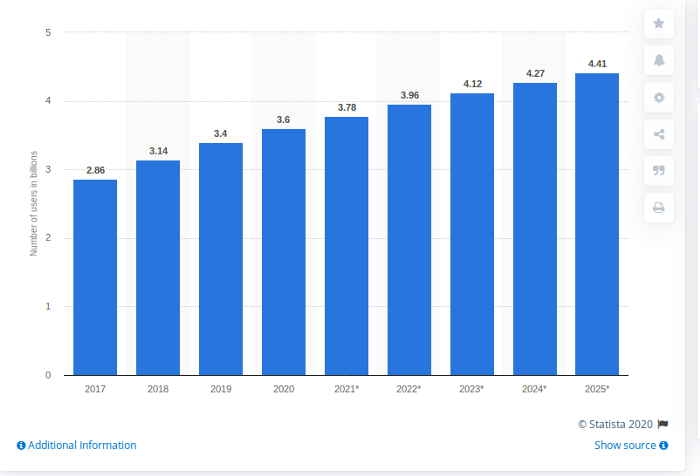
Worldwide approximately 7.8 billion people are there. Out of 7.8 billion people, approx 3.6 billionpeople are active on social media in 2020, and this number will increase reach by 4.41 billion in 2025. This stats clearly defines how social media app usage day-by-day is expanding globally.
Source: Statista
Facebook, Instagram, Twitter, LinkedIn, Whatsapp, and Snapchat, all these social media platforms became the sensation of the town. This is the reason why businesses are nowadays focusing on developing social media apps in 2021.
Startups, SMEs and large enterprises have a question in their mind: How much does it cost to develop a social media app in 2021? In this blog, I have mentioned the details that will help businesses estimate the accurate social media app development costing.
Cost To Build Social Media App
The total Building cost of social media app like Facebook, Instagram, Tumbler, can vary from $35,000 to $50,000+, depending upon parameters like app type, features, complexity, design, software development, the location from where you are availing mobile app development service, and more that affect app development cost.
Artificial Intelligence Jobs
Social Media App Cost Based On Complexity
The social media app cost depends on the complexity of an app, means on which platform the app can run, level of features and functionalities.
Social Media App Cost Range Based On Location
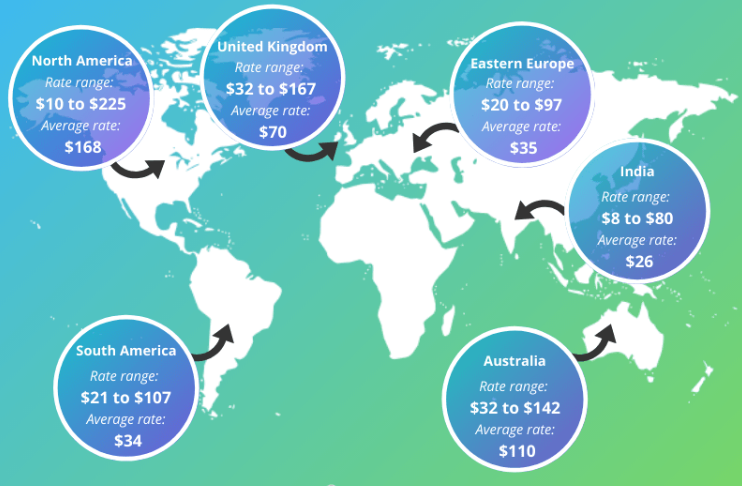
The cost of social media application also depends on the area means from which country, state you are availing the app development service. Each location’s average social media app development hourly cost varies; this thing you can view in the image placed below:
Social Media Apps Must-Have Features And Its Costing
Cost to build social media app depends on various factors like features and functionalities. Here I have mentioned the few vital features that one ideal social media app should contain
Account Verification
Account verification is a crucial foundation of user data and privacy; that’s why it is one of the must-have features of any social app. The social media platform provides several options to create an account like entering email or phone number. This feature also includes password reset and recovery, security, authentication, and other options.
Time Estimation:65–70 hours
Cost of this feature:An average cost of $3,400
Profile Creation
It is another essential feature that one leading app should contain. Social media apps without this feature are incomplete as this feature helps in connecting one person with another. To make a profile on social media apps like Facebook, Instagram, a user needs to enter details that are:
Name
Mobile Phone
Profile picture
Work Profile
Schooling
Address
Email
Website
Birthdate, and more
Time Estimation:50–60 hours
Cost of this feature:An average cost of $2,500
Messaging
Messaging is the essential element of any social media apps, as it boosts engagement. By making use of this feature, one person can get connected with others. Using this feature, you can also share images, files, videos, and more.
Time Estimation:120–140 hours
Cost of this feature:An average cost of $6,500
Photo & Video Upload
This feature allows users to upload photos and videos by using gallery and camera. This is also one of the crucial elements which one leading social media app should contain. Uploading photos and videos feature allows users to filter and edit the images.
Time Estimation:320 hours
Cost of this feature:An average price of $16,000
Search Feature
For doing a quick search, it is important to introduce this feature in the social media app. By using the search options, users can also find trending content, recent posts, groups, and more.
Time Estimation:60 hours
Cost of this feature:An average price of $3,000
Tagging (Location, Friends)
Tagging features help users share content with specific family and friends. It also quickly reveals information (chiefly location) to users you want to communicate with.
Time Estimation:24–30 hours
Cost of this feature:An average price of $1,350
UI/UX
The social media application design is a very crucial part because it mainly attracts users. The mobile app developers can help in finding the appealing UI/UX design for the social media platform.
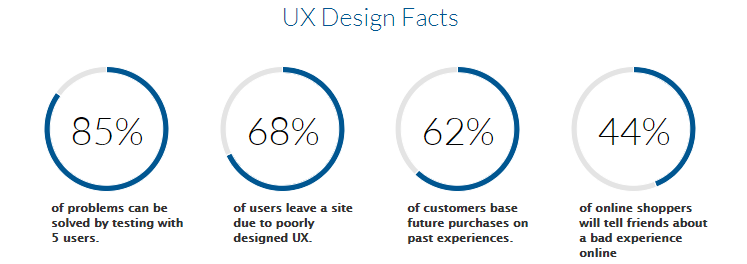
74% of usersarelikely to come back to your siteif it has a pleasant andappealing mobile UX.
Time Estimation:60 hours
Cost of this feature:An average price of $2,750
These are the basic features of social media apps. In order to make your app more unique, you need to include other features like push notification, story sharing, commenting, posting, and more. But on including other features app cost may get increased as per the feature complexity.
Trending Features To Make Your Social App Unique
Building a social media app is a simple task, but building the app with emerging technologies can help you build leading mobile apps. Here are the few trending features and it’s development time/cost that one should consider in 2021.
AR Photo Filters
If you want to build a social media app like Instagram and Facebook, then you can introduce AR filters; this will make your app more appealing. AR filters include multiple facial features.
Back-end development:8+ hours
iOS development:30+ hours
Android development:32+ hours
Pro Photo Editing
This feature allows users to customize their picture by utilizing various photo editing tools.
Back-end development:7+ hours
iOS development:30+ hours
Android development:30+ hours
Location-Based Content
This functionality helps analyze users’ location and reflect content posted by others with the same location tag. You can hire mobile app developers to build this feature by utilizing Google Places.
Back-end development:9+ hours
iOS development:10+ hours
Android development:10+ hours
These are the rough cost and time estimates for building features; it can go less or above depending upon from which mobile app development company you prefer to hire mobile developers, features you are selecting, and complexity of the app you picked to develop. The additional cost to build the back-end app will also be added in the app development cost.
Total Cost to Build a Social Media App in 2021
As per my research, I estimated that the average price of developing a simple app would range from $40,000 to $60,000, the medium complex app cost would range between $61,000 to $69,000, and the complex app cost can go beyond $100,000+.
Well, developing an app by availing the mobile app development service from the mobile app development company can offer cheap development cost.
There is no fixed price of social media app development. Still, with the average $50 per hour costing of the expertise a simple app can be created at $15,000+, the medium app will cost between $20,000- $30,000 and complex apps will go beyond $50,000+ with all the latest features. The app cost may vary on the basis of developers skills, experience, geolocation.
Wrapping Up
Building a social media app like Linkedin, Facebook, Instagram, Twitter, and more will be deserving when you try developing a unique and full-featured app. The cost to build a social media app doesn’t matter when you are finally able to build a leading application as this only supports business in gaining more and more success.
Choosing so many features and functionalities, complexities, and technologies is quite challenging for the non-experienced person, so I will recommend you to look for a top mobile app development company to hire mobile app developers. This will help you in evaluating your business requirements and get the best app solution with an affordable pricing model.
As a core method in the Data Scientist’s toolbox, k-means clustering is valuable but can be limited based on the structure of the data. Can expanded methods like PAM (partitioning around medoids), CLARA, and CLARANS provide better solutions, and what is the future of these algorithms?
The Poisson distribution, named after the French mathematician Denis Simon Poisson, is a discrete distribution function describing the probability that an event will occur a certain number of times in a fixed time (or space) interval.
Also: A Rising Library Beating Pandas in Performance; 20 Core Data Science Concepts for Beginners; How to Create Custom Real-time Plots in Deep Learning; 10 Python Skills They Don’t Teach in Bootcamp
Machine learning models are built on training data and then predictions are done to address the business problems. There are many models (like SVM, Decision tree, Random forest, Logistic regression, Naive bayes ,etc.) which can be built in Machine learning.
Choosing the best model is sometimes challenging as we need to find the right model with optimal parameters. Let us consider applying the SVM model for a particular data set , to optimize this model we have to decide the parameters of kernel, C, gamma, etc. Similarly there will be different parameters for other models which are to be optimized. The optimized models will give the best predictions. This process of optimizing the hyper parameters is called Hyper parameter tuning.
Setting up these parameters and building optimized models is one step and selecting the best model from these would be another. Let us try to learn a way to select the best model through the following example.
In this example we shall use digits data set from sk.learn and build Logistic Regression, SVM, Decision Tree Classifier and Random Forest Classifier models. And let us tune a few hyper parameters to get the optimized models and find the best of those.
Big Data Jobs
Let us get the data with the following code
from sklearn import datasets
digits = datasets.load_digits()
Now let us import the libraries we need to build the above models.
from sklearn import svm
from sklearn.ensemble import RandomForestClassifier
from sklearn.linear_model import LogisticRegression
from sklearn.tree import DecisionTreeClassifier
Now let us create configuration dictionary required for different model setups where we specify the model types and few parameters of those models for digits Data set.
In the above dictionary we are specifying a few parameters for each model. let us see few details of those
Logistic regression: In Logistic regression we will be able to predict the binary dependent variables using below parameters.
Solver is a parameter which can be used to minimize the cost function. Here we are using ‘liblinear’ as the solver’s value since it is a library for large linear classification and this performs well with high dimensionality.
Multi_class is set to auto by default. C is a regularization parameter( the distance to the margin).
C parameter allows you to decide how much you want to penalize misclassified points. The lower the better. By default the value is 1. We can optimize this by considering different values. I have used 1,5 and 10.
To keep in mind that there are many other parameters for Logistic regression which can be optimized but I have used only a few to simplify the explanation.
SVM(Support vectorMachine): The separation of data with a clear margin is SVM. There are many hyper parameters for SVM.
Kernel specifies how the data needs to be transformed. The options can be rbf(radial basis function),linear ,polynomial.
C parameter allows you to decide how much you want to penalize misclassified points. By default the value is 1.We can try with 1,10,20 and see which one gives a better score.
gamma defines how far the influence of a single training example reaches. If the value is low then it is far from the margin.
Decision Tree: For Decision tree there are many parameters by which we can specify the criteria to split like Gini or entropy ,how to split, how far to expand, randomness etc. If we do not specify the values, a decision tree classifier will pick the default ones. Here I have used both criterion gini and entropy.
Random Forest: This is an estimator which fits number of decision trees on various subsets of the data and averages the prediction which improves the accuracy. This classifier will have similar parameters to decision trees and few more can be added. We can specify the number of decision trees, what criteria to use(gini or entropy), how far to go(max_depth). We also can specify bootstrap (whether to use bootstrap samples to build trees) which can be true or false etc. Here I have used 1,10,20 for n_estimators which specifies to consider the number of decision trees. Criteria is gini or entropy and the bootstrap is true or false.
After specifying this dictionary we can iterate over each model and get the accuracy scores for all the above models. We need Grid search cv for this and it can be imported from sklearn.model_selection. ( code snippet below)
from sklearn.model_selection import GridSearchCV
import pandas as pd
accuracy = []
In the above snippet I have used cross validation as 5. That means it uses different test sets every time it predicts and this continues 5 times and gets the average of all. After the GridSearchCV is processed we are getting the model name, best score and best params.
If we look at the results, from all the above models for digits data set, the best model is SVM which is giving 96% accuracy and the best params are C:1 and kernel:’poly’.
Conclusion:
This way of calculating of accuracy scores for optimizing the models will give you data based decision on what model to apply for your business problems. If multiple models have same accuracy, you can consider the model with less computational resource and time.
Although artificial intelligence has been around for a while, it was always thought of as something that is in the early stages of development, and that it would take decades before we could make it work to our advantage. In other words, it was the stuff we would usually see in sci-fi movies. However, artificial intelligence has made some huge leaps, and it’s definitely here to stay if we were to look at the numbers. So, let’s do that. According to research, the artificial intelligence market is set to reach $266.92 billion by 2027, which is nearly ten times more than the $27.23 billion that it was worth in 2019.
Furthermore, according to recent surveys, 91.5% of top businesses have stated that they are currently investing in AI. Simply put, more than nine out of 10 businesses are investing and using AI, which brings its own set of advantages and disadvantages. It also raises numerous questions, from people being put out of work and replaced by computers and machines, to ethical dilemmas and fear that AI might take over and we would witness a Terminator-like scenario. While it’s too early to tell what the future might hold, let’s dispel some of the most common myths about AI in the workplace today.
Big Data Jobs
1. AI Will Replace People on Most Jobs
While many fear that AI will replace us entirely, that couldn’t be further from the truth, at least for the time being. The reality is, AI can only do certain parts of certain jobs, which means that a human element is still as crucial as ever. But, even as AI becomes more powerful, it is simply more likely to change jobs, rather than eliminate or create them. Besides, some jobs, such as writing custom papers or graphic design, are always going to be done by humans. AI might help and make those jobs easier and make the people more productive, but it’s not going to replace them. Not by a long shot.
2. AI Will Handle All the Boring Tasks
This is yet another myth, because even though AI will definitely make for better productivity, it’s not really possible to determine whether or not AI will make jobs more or less boring. For example, AI might help with editing and proofreading. However, that is the easiest task of them all, and the writer will still be required to write pretty much everything, do all of the research, and collect all the data that is useful. AI is not quite there yet. It all depends on the job.
Machines taking over the world is a fertile ground for sci-fi movies, but the likelihood of something like that happening is still very low. It’s not impossible though, but in 2020, there is no evidence that something like that is looming on the horizon. Of course, we can’t predict how artificial intelligence might develop. We might not be able to keep up, but thing is, we might not even have to. It is up to us to control it and make sure that it doesn’t get out of control. As long as we can do that, AI will not be a problem for the human race.
4. AI Will Make Everyone More Productive, Not Replace Them
The first part of this statement is somewhat true because AI can take on some of the repetitive tasks that would take humans hours or days to process, according to BrillAssignment. As for being replaced by AI, we may be asking the wrong questions. For example, imagine a situation where a company that’s introduced AI, which will inevitably make it more productive. Their management can choose between making more of their product while essentially keeping the same staff, or they can make the same amount while cutting jobs and saving money on wages. Ultimately, it’s not about AI, but how the management decides to run things.
5. AI Will Not Jeopardize High-Value Jobs
Again, this is yet another broad generalization that is hard to back with facts and evidence. Sure, AI is great at going through huge amounts of data, doing complex calculations, as well as spotting patterns that humans otherwise wouldn’t be able to identify, but it’s also helpless at doing some of the simplest stuff. For example, no AI exists yet that is able to tie your shoes. On the other end of the spectrum, you have AI that can detect cancer better than doctors in some situations, which is considered a high-value task.
6. AI Won’t Disrupt Human-Centered Jobs
While it’s almost a fact at this point that people don’t like talking to AIs, that might change in the near future. For example, chatbots might not be able to have a normal conversation, but they are perfect for answering frequently asked questions, as well as if you order an item online, and you want to know more about its specs. Also, there are situations where Ai might be preferable over a human, such as talking to an AI instead of a doctor because the issue is too intimate or embarrassing.
7. AI Equals Robots
While there might be some overlap between the two, AI and robots are two separate concepts. Robots are just the most obvious form of AI, but even then, not every robot relies on AI. Most are simply programmed to handle difficult, repetitive tasks, like those in the automotive industry, for example. Also, AI is present in the background of many processes, as well as jobs, which means it really takes an expert to know what AI really does. For example, most people don’t know that AI is behind Amazon’s product recommendations.
8. AI Will Be Much Master than People in Everything
The thing about people is that we are not as specific as AI in terms of intelligence. Sure, people may have different jobs, but just about every person out there knows how to do a ton of things that don’t have anything to do with their education. For example, people can do their job, drive, cook, and make simple and complex decisions, among other things. AIs, on the other hand, are usually very specialized, so it’s not exactly possible to create an AI in a field where there is a lot of diversity, such as medicine or law.
Final Word
While AI is even more present in our lives than we think, there is no reason to panic and to jump to an apocalyptic conclusion. So far, it’s being for very specific tasks, and it has made our lives better. Let’s hope it continues down the same path.
Credits:
Kurt Walker is a London-based term paper writing service, write my assignment, and assignment help writer with three years of experience. He is also an editor, copywriter, and journalist. He likes to write about inspiration, productivity, education, and technology.
How to evaluate the Machine Learning models? — Part 5
This is the fifth aka last part of the metric series where, we will be discussing metrics which are used most mostly in ranking. There are several other metrics which plays a very crucial role in evaluating the model, feel free to reference that also because of time constrained I covered the metrics which are are used widely. This will be a short article where we will be understanding Gini Index, MRR (Mean Reciprocal Rank).
Big Data Jobs
Gini IndexNotebook for Reference:
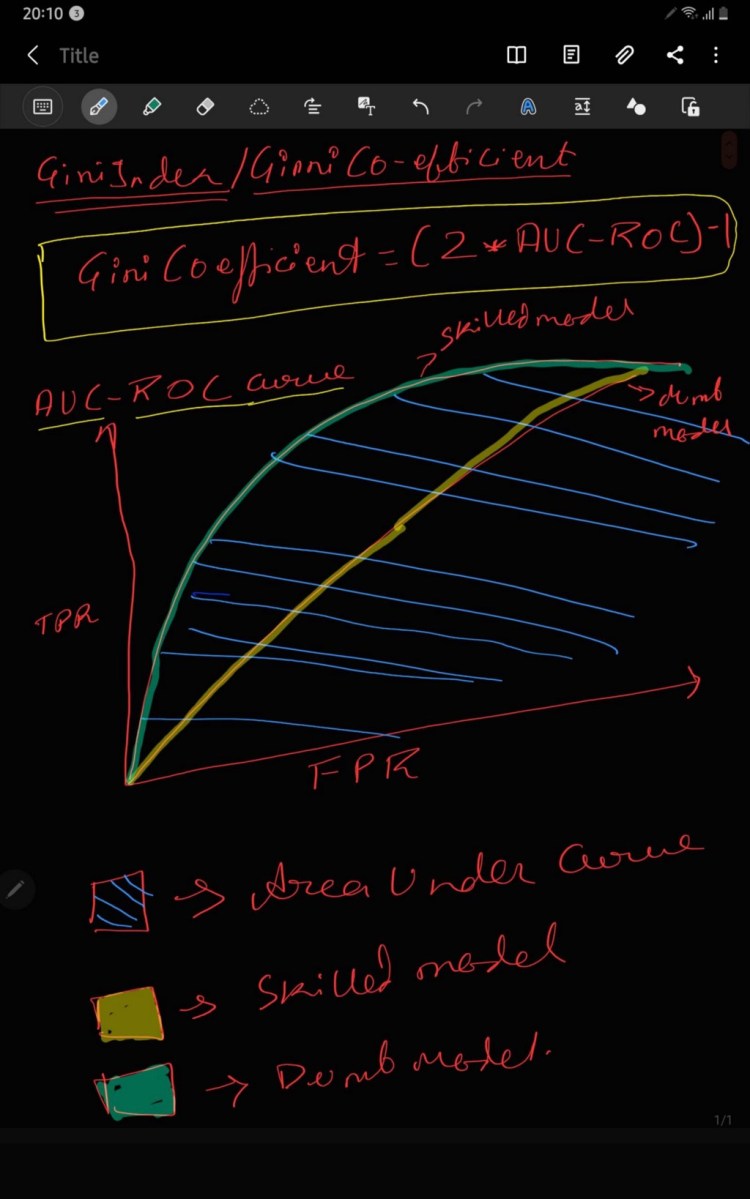
Gini Coefficient is an indicator of how well the model outperforms random predictions or mean prediction. As we have calculated the AUC-ROC in Part-3 metric evaluation. Gini Index is derived from the AUC-ROC curve.It can be also defined how the model exceeded random predictions in term of the ROC.
Fig. 1 Ginni Index
2. MRR (Mean Reciprocal Rank)
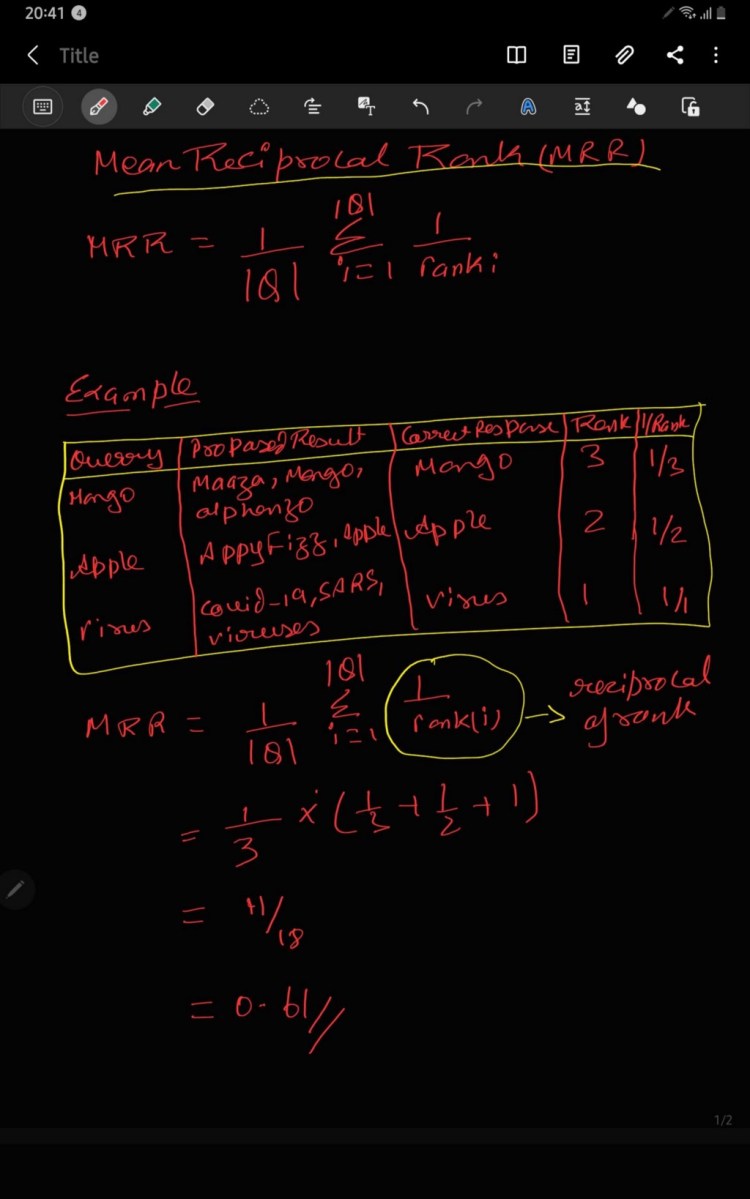
Mean Reciprocal Rank is a measure to evaluate systems that return a ranked list of answers to queries. This is the simplest metric of the three. It tries to measure “Where is the first relevant item?”. It is closely linked to the binary relevance family of metrics.For a single query, the reciprocal rank where rank iis the position of the highest-ranked answer If no correct answer was returned in the query, then the reciprocal rank is 0.
This method is simple to compute and is easy to interpret.This method puts a high focus on the first relevant element of the list. It is best suited for targeted searches such as users asking for the “best item for me”.Good for known-item search such as navigational queries or looking for a fact.The MRR metric does not evaluate the rest of the list of recommended items. It focuses on a single item from the list.It gives a list with a single relevant item, just a much weight as a list with many relevant items. It is fine if that is the target of the evaluation.This might not be a good evaluation metric for users that want a list of related items to browse. The goal of the users might be to compare multiple related items.
Fig. 2 MRR
3. Cohen Kappa
Kappa is similar to Accuracy score, but it takes into account the accuracy that would have happened anyway through random predictions.It is also defined as how model exceeded random predictions in terms of accuracy.
This is the end of the metric series, thought I have not touched the metrics related to the reinforcement learning — we will discuss this topic in a later section when we will discuss reinforcement learning.
Special Thanks:
As we say “Car is useless if it doesn’t have a good engine” similarly student is useless without proper guidance and motivation. I will like to thank my Guru as well as my Idol “Dr. P. Supraja”- guided me throughout the journey, from the bottom of my heart. As a Guru, she has lighted the best available path for me, motivated me whenever I encountered failure or roadblock- without her support and motivation this was an impossible task for me.
Contact me:
If you have any query feel free to contact me on any of the below-mentioned options:












 365 Data Science