

Hi reader!
A note :
This article presumes that you are unreasonably fascinated by the mathematical world of deep learning. You want to dive deep into the math of deep learning to know what’s actually going under the hood.
Some Information about this article:
In this article we’ll discuss and implement RNNs from scratch. We’ll then use them to generate text(like poems, c++ code). I am inspired to write this article after reading Andrej Karpathy’s blog on “The Unreasonable Effectiveness of Recurrent Neural Networks”. The text generated by this code is not perfect, but it gives an intuition about how text generation actually works. Our input will be plain text file containing some text(such as shakespeare’s poem) and our program will generate output similar to the input(poem) which may or may not make sense.
Let’s dive into the mathematical world of RNNs.
So What is the basic structure of RNN?

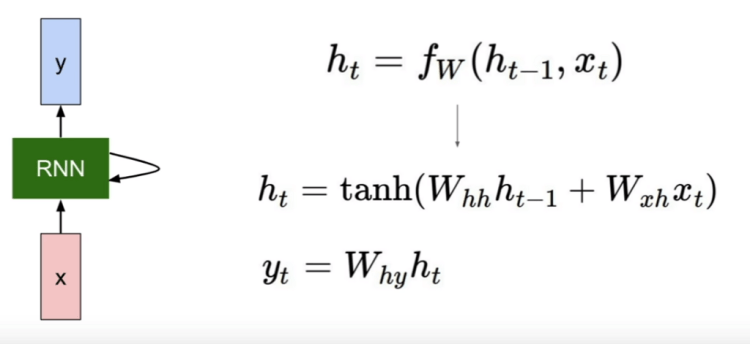
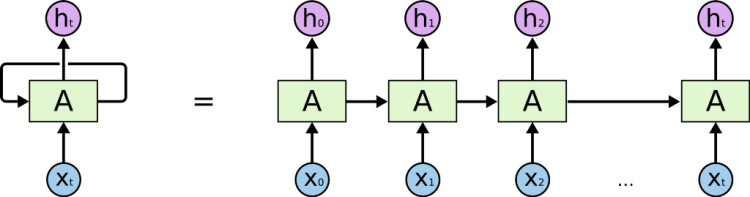
Don’t worry about any of the terms. We’ll discuss each of them. They are pretty easy to understand.
In Fig 1:
h(t): hidden state of RNN at time t=t
fw: non-linearity function(mostly tanh)
Whh: randomly initialized weight matrix. It is used when we move from h to h (hidden state to another hidden state).
Wxh: randomly initialized weight matrix. It is used when we move from ‘x’ to ‘h’ (inputs to hidden states).
Why: randomly initialized weight matrix when we move from ‘h’ to ‘y’ present hidden state to output.
bh(not in the photo): randomly initialized column matrix as bias matrix to be added in calculation of h(t).
by(not in the photo): randomly initialized column matrix as bias matrix to be added in calculation of y(t).
CODE:
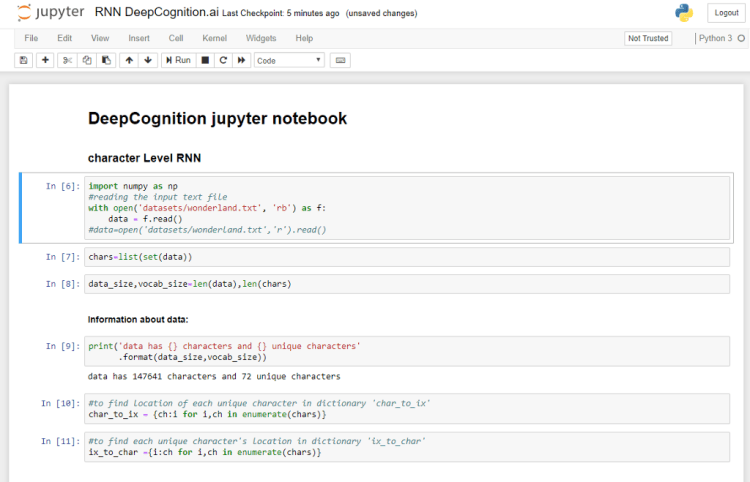
We start by importing data:
download data from here.
https://gist.github.com/Manik9/33b20a1a3d41ab30a2f1f30a000e0afb#file-readinput-py
char_to_ix: it's a dictionary to assign a unique number to each unique character
ix_to_char:it's a dictionary to assign a unique character to each number.
We deal with assigned number of each character and predict number of next character and then use this predicted number to find the next character.
hidden size: number of hidden neurons
seq_length: this refers to how many previous immediately consecutive states we want our RNN to remember.
lr: stands for learning rate.
Initialise the parameters:
Initialise the parameters we discussed above(Whh …… by).
Forward Pass:
xs, ys, hs, ps are dictionaries.
Trending AI Articles:
1. Natural Language Generation:
The Commercial State of the Art in 2020
4. Becoming a Data Scientist, Data Analyst, Financial Analyst and Research Analyst
xs[t]:At time(character) t=t, we use one-hot encoding to represent characters that is all the element of the one-hot vector are zeros except one element and we find location of that element(character) using char_to_ix dictionary. Example: assume that we have data as ‘abcdef’. We represent ‘a’ by using one-hot encoding as
this is what we are doing in 25th,26th line in the code above.
a=[[1],
   [0],
   [0],
   [0],
   [0],
   [0]]
ys[t]: At time(character) t=t,we store the final output of that RNN cell.
hs[t]: At time(character)t=t, we store the hidden state of the present RNN cell.
ps[t]: At time(character)t=t, we store the probability of occurrence of each character.
As you see in the above code, we implemented simple calculations as given in Fig1 for xs[t], ys[t], hs[t], ps[t].
And then finally we calculate the softmax loss.


Backward Pass
dWxh : derivative w.r.t matrix Wxh. We will use this to correct our Wxh matrix. And similarly dWhh, dWhy, dbh, dby, dhnext.
To backprop into y: we subtract 1 from probability of occurrence of correct next character because:
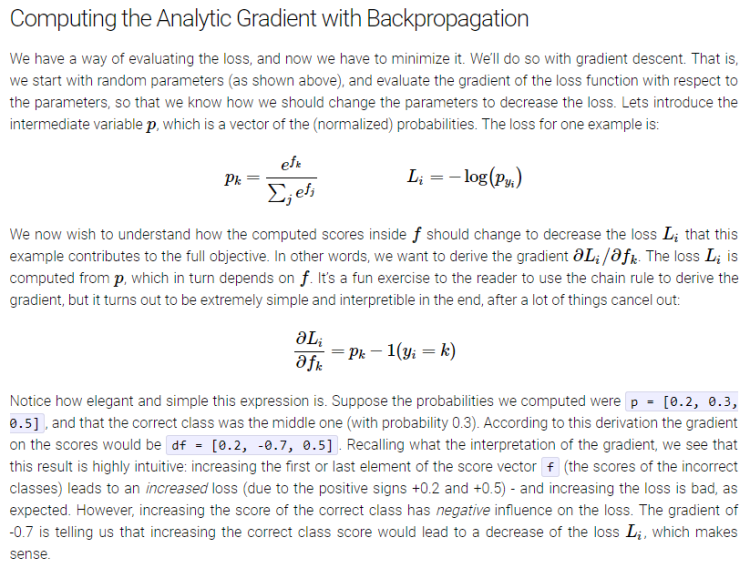

Now:
To calculate:
dy: ps[t]-1dWhy += : dy•hs[t].T
dh += Why.T•dy + dhnextdby += dy (As matrix multiplication term becomes zero in   derivative )#backprop in hs[t] now:
dhraw adds derivative w.r.t tanh(derivative of tanh is 1-tanh^2)
dhraw= (1-hs[t]^2)*dhdbh += dhraw (because derivative matrix multiplication terms is zero w.r.t dbh)
dWhx += (dhraw•xs[t].T)
dWhh += (dhraw•hs[t-1])
finally:
dhnext += (Whh.T•dhraw)
Everything is setup:
It’s time to run program: DeepLearning Studio
RNNs are computationally very expensive. To train our program I used Deep Cognition’s Deep Learning Studio. It provides preinstalled DeepLearning Frameworks such as Tensorflow-gpu/cpu, keras-gpu/cpu, pytorch…and many more. Check it out here.

mbh,mby are memory variables for Adagrad optimiser.
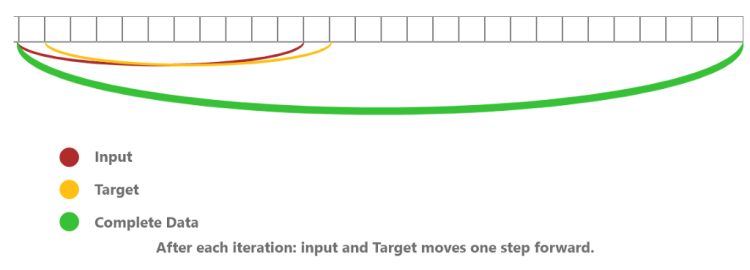
For line number 7–11. Here one-step = seq_length.
Finally loss is calculated from our loss function for different parameters(Why…h(t)) and is subtracted from respective parameters.
line number 5-6 is the way we Adagrad works.
Like in normal gradient descent we do:
theta= theta-lr*grad
1e-8 is used to prevent DivisionByZero exception.
Results of Training:

At epoch zero:Generated text
loss=106.56699692603289
iteration:0QZBipoe.M
prb’gxc]QXECCY“f);wqEnJAVV-Dn-
Fl-tXTFTNI[ ?Jpzi”BPM’TxJlhNyFamgIj)wvxJDwBgGbF!D“F‘bU;[)KXrT km*;xwYZIx-
AX
dDl_zk(QlW(KolSenbudmX.yq
H-(uPUl-B:mj]o’E-ZTjzH)USf:!
sCiTkTMcmgUY)rCj
ZaL*rhWVpS----
---------------------------------------------------
l was  beginning begiginning to Alice walicegininn to geteginninato giteginniito geteginninn to geteginninatg gegeginninasto get beginninnninnigw to gicleaaaa  was ginniicg benning to get a wen----
loss=11.115271278781561
iteration:66200
It begins to learns words like ‘beginning, Alice, was, to, get…’. It’s not perfect at all. But it gives an intuition that we can generate proper text, given some sample data. LSTMs performs much better than RNNs. LSTMs are an extension of RNNs with 3–4 gates. Do check my article on LSTMs
Understanding architecture of LSTM cell from scratch with code. | Hacker Noon
Access to the complete code with datasets on github repo.
Congrats to the reader, now you know in-depth mathematics of RNNs(simple linear Algebra).
Thanks for giving your precious time for reading my article. If you really liked it, do share and clap ?. Follow me on medium and LinkedIn.
Happy Deep Learning.
Don’t forget to give us your ? !




Generate stories using RNNs |Pure Mathematics with code| was originally published in Becoming Human: Artificial Intelligence Magazine on Medium, where people are continuing the conversation by highlighting and responding to this story.

