
Generate stories using RNNs |Pure Mathematics with code|

Source

Hi reader!

A note :

This article presumes that you are unreasonably fascinated by the mathematical world of deep learning. You want to dive deep into the math of deep learning to know what’s actually going under the hood.

Some Information about this article:

In this article we’ll discuss and implement RNNs from scratch. We’ll then use them to generate text(like poems, c++ code). I am inspired to write this article after reading Andrej Karpathy’s blog on “The Unreasonable Effectiveness of Recurrent Neural Networks”. The text generated by this code is not perfect, but it gives an intuition about how text generation actually works. Our input will be plain text file containing some text(such as shakespeare’s poem) and our program will generate output similar to the input(poem) which may or may not make sense.

Let’s dive into the mathematical world of RNNs.

So What is the basic structure of RNN?

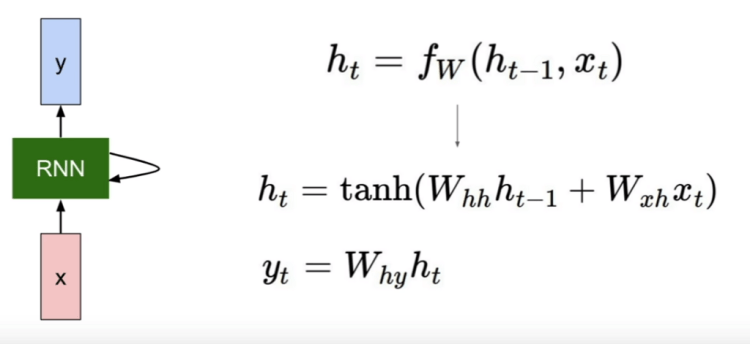
Fig 1 :Vanilla RNN
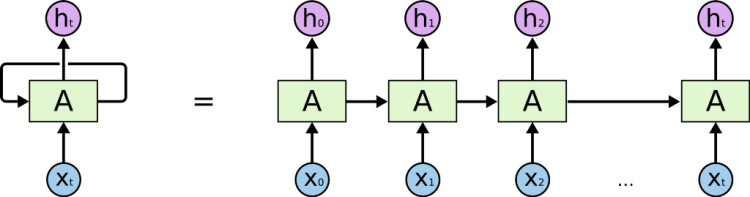
Fig 2: Unrolled Vanilla RNN

Don’t worry about any of the terms. We’ll discuss each of them. They are pretty easy to understand.

In Fig 1:

h(t): hidden state of RNN at time t=t

fw: non-linearity function(mostly tanh)

Whh: randomly initialized weight matrix. It is used when we move from h to h (hidden state to another hidden state).

Wxh: randomly initialized weight matrix. It is used when we move from ‘x’ to ‘h’ (inputs to hidden states).

Why: randomly initialized weight matrix when we move from ‘h’ to ‘y’ present hidden state to output.

bh(not in the photo): randomly initialized column matrix as bias matrix to be added in calculation of h(t).

by(not in the photo): randomly initialized column matrix as bias matrix to be added in calculation of y(t).

CODE:

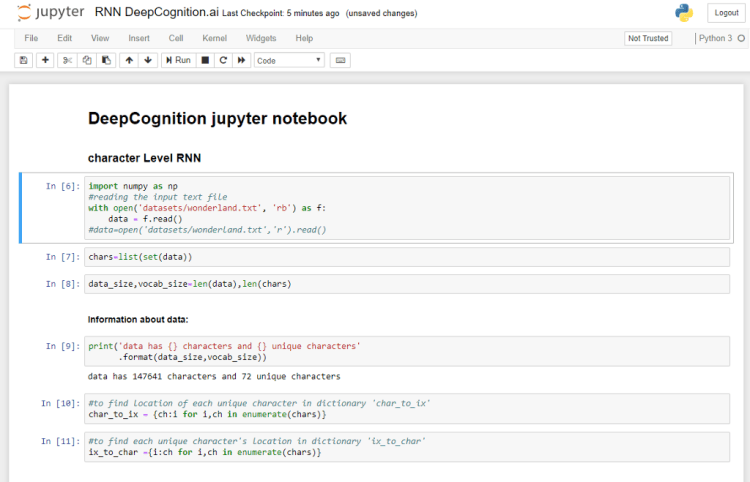
We start by importing data:

download data from here.

https://gist.github.com/Manik9/33b20a1a3d41ab30a2f1f30a000e0afb#file-readinput-py

char_to_ix: it's a dictionary to assign a unique number to each unique character
ix_to_char:it's a dictionary to assign a unique character to each number.
We deal with assigned number of each character and predict number of next character and then use this predicted number to find the next character.

hidden size: number of hidden neurons

seq_length: this refers to how many previous immediately consecutive states we want our RNN to remember.

lr: stands for learning rate.

Initialise the parameters:

Initialise the parameters we discussed above(Whh …… by).

Forward Pass:

xs, ys, hs, ps are dictionaries.

Trending AI Articles:

1. Natural Language Generation:
The Commercial State of the Art in 2020

2. This Entire Article Was Written by Open AI’s GPT2

3. Learning To Classify Images Without Labels

4. Becoming a Data Scientist, Data Analyst, Financial Analyst and Research Analyst

xs[t]:At time(character) t=t, we use one-hot encoding to represent characters that is all the element of the one-hot vector are zeros except one element and we find location of that element(character) using char_to_ix dictionary. Example: assume that we have data as ‘abcdef’. We represent ‘a’ by using one-hot encoding as

this is what we are doing in 25th,26th line in the code above.
a=[[1],
[0],
[0],
[0],
[0],
[0]]

ys[t]: At time(character) t=t,we store the final output of that RNN cell.

hs[t]: At time(character)t=t, we store the hidden state of the present RNN cell.

ps[t]: At time(character)t=t, we store the probability of occurrence of each character.

As you see in the above code, we implemented simple calculations as given in Fig1 for xs[t], ys[t], hs[t], ps[t].

And then finally we calculate the softmax loss.

Forward Pass

Backward Pass

dWxh : derivative w.r.t matrix Wxh. We will use this to correct our Wxh matrix. And similarly dWhh, dWhy, dbh, dby, dhnext.

To backprop into y: we subtract 1 from probability of occurrence of correct next character because:
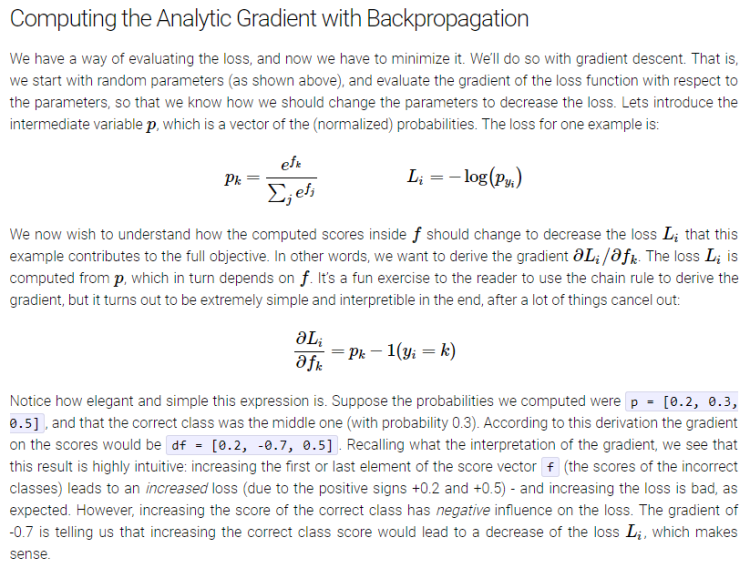

stanford CS231N notes
Big Data Jobs
Now:
To calculate:
dy: ps[t]-1dWhy += : dy•hs[t].T
dh += Why.T•dy + dhnextdby += dy (As matrix multiplication term becomes zero in derivative )#backprop in hs[t] now:
dhraw adds derivative w.r.t tanh(derivative of tanh is 1-tanh^2)
dhraw= (1-hs[t]^2)*dhdbh += dhraw (because derivative matrix multiplication terms is zero w.r.t dbh)
dWhx += (dhraw•xs[t].T)
dWhh += (dhraw•hs[t-1])
finally:
dhnext += (Whh.T•dhraw)

Everything is setup:

It’s time to run program: DeepLearning Studio

RNNs are computationally very expensive. To train our program I used Deep Cognition’s Deep Learning Studio. It provides preinstalled DeepLearning Frameworks such as Tensorflow-gpu/cpu, keras-gpu/cpu, pytorch…and many more. Check it out here.

click on Notebooks and you’re ready to code! ✋

mbh,mby are memory variables for Adagrad optimiser.
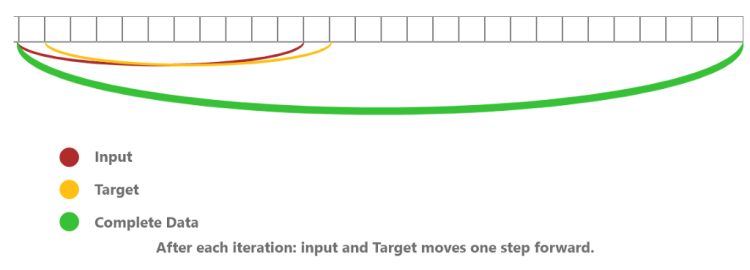
For line number 7–11. Here one-step = seq_length.

Finally loss is calculated from our loss function for different parameters(Why…h(t)) and is subtracted from respective parameters.

line number 5-6 is the way we Adagrad works.
Like in normal gradient descent we do:
theta= theta-lr*grad
1e-8 is used to prevent DivisionByZero exception.

Results of Training:

At epoch zero:Generated text
loss=106.56699692603289
iteration:0
QZBipoe.M
prb’gxc]QXECCY“f);wqEnJAVV-Dn-
Fl-tXTFTNI[ ?Jpzi”BPM’TxJlhNyFamgIj)wvxJDwBgGbF!D“F‘bU;[)KXrT km*;xwYZIx-
AX
dDl_zk(QlW(KolSenbudmX.yq
H-(uPUl-B:mj]o’E-ZTjzH)USf:!
sCiTkTMcmgUY)rCj
ZaL*rhWVpS----
---------------------------------------------------
l was beginning begiginning to Alice walicegininn to geteginninato giteginniito geteginninn to geteginninatg gegeginninasto get beginninnninnigw to gicleaaaa was ginniicg benning to get a wen----
loss=11.115271278781561
iteration:66200

It begins to learns words like ‘beginning, Alice, was, to, get…’. It’s not perfect at all. But it gives an intuition that we can generate proper text, given some sample data. LSTMs performs much better than RNNs. LSTMs are an extension of RNNs with 3–4 gates. Do check my article on LSTMs

Understanding architecture of LSTM cell from scratch with code. | Hacker Noon

Access to the complete code with datasets on github repo.

Congrats to the reader, now you know in-depth mathematics of RNNs(simple linear Algebra).

Thanks for giving your precious time for reading my article. If you really liked it, do share and clap ?. Follow me on medium and LinkedIn.

Happy Deep Learning.

Don’t forget to give us your ? !


Generate stories using RNNs |Pure Mathematics with code| was originally published in Becoming Human: Artificial Intelligence Magazine on Medium, where people are continuing the conversation by highlighting and responding to this story.

Via https://becominghuman.ai/generate-stories-using-rnns-pure-mathematics-with-code-82b5f3cb6cc?source=rss—-5e5bef33608a—4

source https://365datascience.weebly.com/the-best-data-science-blog-2020/generate-stories-using-rnns-pure-mathematics-with-code

Teaching AI to be Evil with Unethical Data

An Artificial Intelligence (AI) system is only as good as its training. For AI Machine Learning (ML) and Deep Learning (DL) frameworks…

Via https://becominghuman.ai/teaching-ai-to-be-evil-with-unethical-data-9980500660e8?source=rss—-5e5bef33608a—4

source https://365datascience.weebly.com/the-best-data-science-blog-2020/teaching-ai-to-be-evil-with-unethical-data

Technology in Agriculture

An overview of AI and ML applications in the field of agriculture

The world’s population is expected to grow to almost 10 billion by 2050, boosting agricultural demand. This is however challenged by the loss of biodiversity, spread of pests and diseases of plants and animals, and most importantly, the challenge of agriculture competing with other industries for shared natural resources such as water and land.

Hence the question arises can we achieve the required production increases, even as the pressures on already scarce land and water resources and the negative impacts of climate change intensify?

We believe we can and technology is the enabler of this. We are living in a time where there is a technology revolution going in the agriculture sector.

In the last months edition — Sensors for Agricultural Utility, we deep dived into the sensors that are available in the market to gauge various atmospheric factors that impact the plant growth. But sensors alone does not provide much information of decision support to the farmers. In this edition, we jump into the Analytics, Artificial Intelligence (AI) and Machine Learning (ML) space, which helps bring meaning to the sensor data. We also explore other technologies that have penetrated this market.

APPLICATIONS:

AI and ML is and can be used in a number of applications in the field of agriculture. Some are mentioned below:

  1. Water and Crop management
  2. Yield Prediction
  3. Crop Quality
  4. Disease detection

Water and Crop Management

There are multiple factors, such as soil, weather, rainfall that impact the level of water that is required for a crop. The most commonly used method is the estimation of the hydrological cycle, using studies such as the water balance, that can help design effective irrigation systems. In simple terms water balance is nothing but a math that the amount of water lost by the plant and the soil surface, is the amount of water replenishment that the plat requires.

Trending AI Articles:

1. Natural Language Generation:
The Commercial State of the Art in 2020

2. This Entire Article Was Written by Open AI’s GPT2

3. Learning To Classify Images Without Labels

4. Becoming a Data Scientist, Data Analyst, Financial Analyst and Research Analyst

This simple analysis is done with the help of knowing various factors such as soil water holding capacity, the rainfall in the farm, and irrigation that has been provided by the farmer previously. In addition factors such as temperature and humidity can help understanding the water loss in the atmosphere.

Once the micro climatic conditions are know for the farm, it is quite easy to know the hydrological cycle. This can help in predicting daily water requirements for the farmers, and additionally help them reduce water usage, while improving the yield.

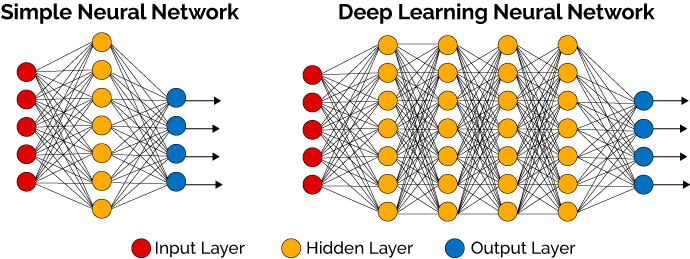
Additionally, while there are multiple ML models such as linear regression, Random Forrest, and Artificial Neural Networks (ANN) can be used to predict the future water requirements. But due to the ANNs ability to simulate non-linearity among the interacting factors in the systems, it is generally considered to be a great model for predicting water requirements for crops, based on weather parameters.

Deep Learning Made Easy with Deep Cognition
Fig 1: Neural Network Representation

2. Yield Prediction

Prediction of crop yield mainly strategic plants such as wheat, corn, rice has always been an interesting research area to agro meteorologists, as it is important in national and international economic programming. There are a lot of yield prediction models that have made and are generally classified into two groups a) Statistical Models, b) Crop Simulation Models. But recently, application of Artificial Intelligence (AI), such as Artificial Neural Networks (ANNs), Fuzzy Systems and Genetic Algorithm has shown more efficiency in solving the problem.

Big Data Jobs

3. Crop Quality

One of the major challenges in Indian Agri eco-system has been a quick check to understand the crop quality, sizes, shapes and defects, without taking the effort to travel to far off farms. On the other hand farmers are also challenged, and end up travelling long distances to sell the produce, only to be rejected by buyers, since either the sizes requirements or quality don’t match the demands.

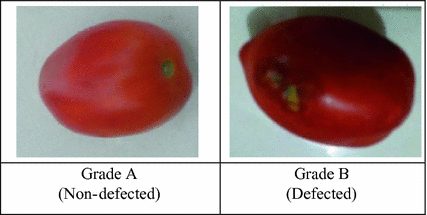
A lot of work is being done in the field of image processing (Computer Vision) to get some parameters of crop quality. Specifically, CV is used for classifying food products into specific grades, detecting defects, and estimating properties such as colour, shape, size and defects.

Fig 2: Representative image of using CV to detect defects in Tomato

4. Disease Detection

Many food producers are struggling to manage threats to their crops like diseases and pests, made worse by climate change, micro cropping and widespread pesticide use.

To overcome this many AI based systems are being developed, which can look at photographs and tell what disease the plant has, and also give recommendations and treatment options to farmers. The technology usage is quite similar to the one used in assessing crop quality. Image processing is being done to correctly identify various diseases and give recommendations to farmers. While this type of detection is reactive in nature (i.e. done only after the pest/ diseases infestations has already occurred). There are studies being conducted on providing preventive warning systems to farmers based on weather conditions. This kind of preventive warning for pests are disease are well documented for grapes and widely used.

Sources of raw data

Lastly, for using any models, it is important to have good and reliable data sources. Some of the sources are :

1. Weather Data — IMD provides historic weather data from multiple stations across India. There are also other free resources that provide free weather and rainfall information. For microclimatic conditions, having a weather station on the farm can help with better analytics

2. Other types of data — data.gov.in, data.world and Kaggle are great resources to get started.

We have only scratched the surface in using these technologies towards agriculture. There is a huge scope for these technologies to help us grow sustainably and meet the future demands.

We at GramworkX help in precision farming including integrating field data, weather patterns to drive agronomic advice to farmers and yield forecasting. We are building smart products at affordable prices for the farmers for a sustainable tomorrow. This company was born from the desire to be ready for an agricultural transformation which has its core values at poverty reduction, food security and improved nutrition. Our solution helps in quantifying and providing analytical insights into water consumption patterns across fields and soil types and providing data support systems into the amount of water required for irrigation. We aim to bring predictability to farming.

Don’t forget to give us your ? !


Technology in Agriculture was originally published in Becoming Human: Artificial Intelligence Magazine on Medium, where people are continuing the conversation by highlighting and responding to this story.


Via https://becominghuman.ai/technology-in-agriculture-5e0b32cc6de5?source=rss—-5e5bef33608a—4

source https://365datascience.weebly.com/the-best-data-science-blog-2020/technology-in-agriculture

A Complete Guide To Survival Analysis In Python part 1

This three-part series covers a review with step-by-step explanations and code for how to perform statistical survival analysis used for investigate the time some event takes to occur, such as patient survival during the COVID-19 pandemic, the time to failure of engineering products, or even the time to closing a sale after an initial customer contact.

Originally from KDnuggets https://ift.tt/2ZMpK84

source https://365datascience.weebly.com/the-best-data-science-blog-2020/a-complete-guide-to-survival-analysis-in-python-part-1

5th International Summer School 2020 on Resource-aware Machine Learning (REAML)

The Resource-aware Machine Learning summer school provides lectures on the latest research in machine learning, with the twist on resource consumption and how these can be reduced. This year it will be held online between 31st of August and 4th of September, and is free of charge. Register now.

Originally from KDnuggets https://ift.tt/2BLw6fU

source https://365datascience.weebly.com/the-best-data-science-blog-2020/5th-international-summer-school-2020-on-resource-aware-machine-learning-reaml

PyTorch for Deep Learning: The Free eBook

For this week’s free eBook, check out the newly released Deep Learning with PyTorch from Manning, made freely available via PyTorch’s website for a limited time. Grab it now!

Originally from KDnuggets https://ift.tt/2Z6ctYM

source https://365datascience.weebly.com/the-best-data-science-blog-2020/pytorch-for-deep-learning-the-free-ebook

Scope and Impact of AI in Agriculture

The major advantage of focusing on AI-based methods is that they tackle each of the challenges faced by farmers from seed sowing to harvesting of crops separately and rather than generalising, provide customised solutions to a specific problem.

Originally from KDnuggets https://ift.tt/38xefVT

source https://365datascience.weebly.com/the-best-data-science-blog-2020/scope-and-impact-of-ai-in-agriculture

Top Stories Jun 29 Jul 5: Speed up your Numpy and Pandas with NumExpr Package; Deploy Machine Learning Pipeline on AWS Fargate

Also: Getting Started with TensorFlow 2; An Introduction to Statistical Learning: The Free eBook; How Much Math do you need in Data Science?; Data Cleaning: The secret ingredient to the success of any Data Science Project

Originally from KDnuggets https://ift.tt/38vs33e

source https://365datascience.weebly.com/the-best-data-science-blog-2020/top-stories-jun-29-jul-5-speed-up-your-numpy-and-pandas-with-numexpr-package-deploy-machine-learning-pipeline-on-aws-fargate

Exploding And Vanishing Gradient Problem: Math Behind The Truth

Gamma Ray burst! source: Google

Hello Stardust! Today we’ll see mathematical reason behind exploding and vanishing gradient problem but first let’s understand the problem in a nutshell.

“Usually, when we train a Deep model using through backprop using Gradient Descent, we calculate the gradient of the output w.r.t to weight matrices and then subtract it from respective weight matrices to make its(matrix’s) values more accurate to give correct output”

But what if the gradient becomes negligible?

When the gradient becomes negligible, subtracting it from original matrix doesn’t makes any sense and hence the model stops learning. This problem is called as Vanishing Gradient Problem.

We’ll first visualise the problem practically in our mind. We’ll train a Deep Learning Model with MNIST(you know this) dataset with 1,2,4 and 5 hidden layers and see the effect of using different architecture on the output(accuracy doesn’t increase always! ?).

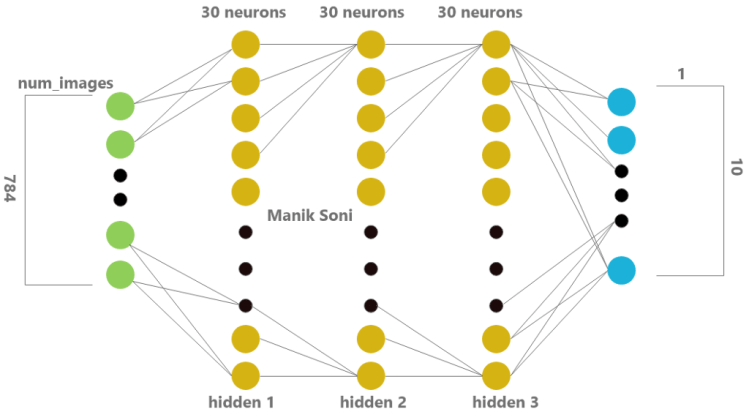
DNN architecture with 3 hidden layers

You can access to the complete code here. For this article I’m just using snapshots of the code. I have used Deep Learning Studio’s Jupyter lab to execute the code. If you’re unaware of this awesome Deep Learning Tool, check out my article on that.

Iris genus classification|DeepCognition| Azure ML studio

Big Data Jobs

Home

Model with 1 hidden layer.

line 1: 784 denotes the input neurons,30 denotes neurons in hidden layer 1, 10 denotes number of outputs.

Accuracy of the model with 1 hidden layer.

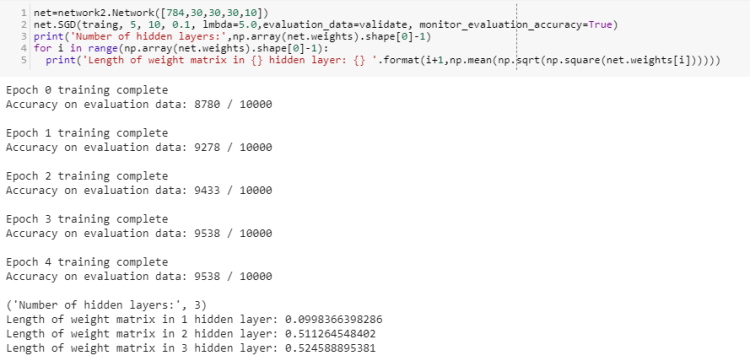
Here the term ‘Length of weight matrix of ‘ith’ hidden layer’ is the magnitude of the weight matrix of first hidden layer. It can be considered as the speed with which a particular hidden layer learns features(roughly).
We’ll use this term to compare the speed of different hidden layers of different models.

Speed of First hidden layer in first model:0.103165(remember this!)

Model with 3 hidden layers:

DNN with 3 hidden layers.

Observations:

  • Learning speed of first hidden layer:0.09983(less than speed of previous model’s 1st hidden layer).
  • Learning speed of ith layer is generally more than (i+1)th layer.

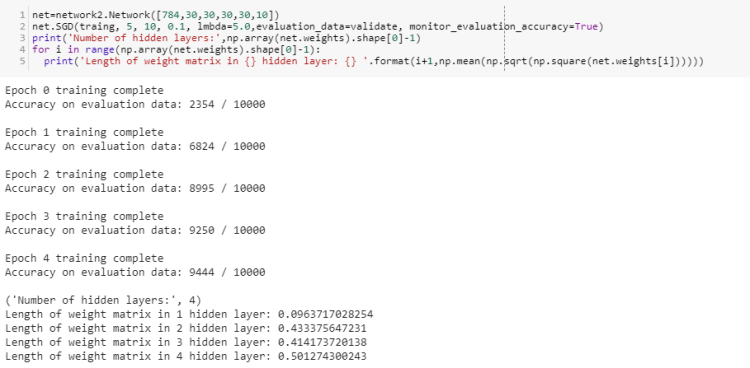
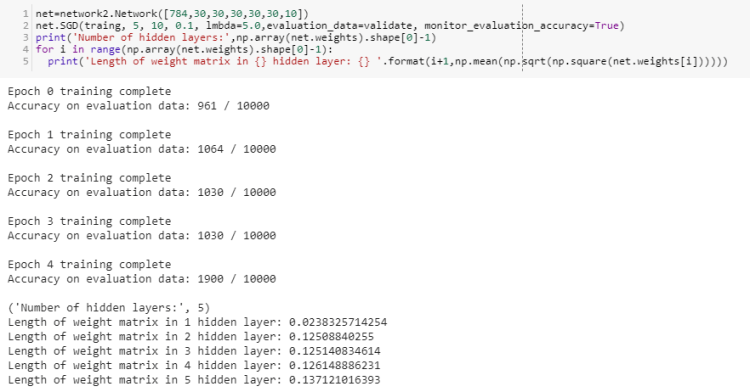
Let’s move on to MNIST with 4 and 5 layers

LEft :MNIST with 4 hidden layers, Right:MNIST with 5 hidden layers.

Learning speed of ith hidden layer keeps on decreasing as we have more deeper models i.e a model with more hidden layers.

Trending AI Articles:

1. Natural Language Generation:
The Commercial State of the Art in 2020

2. This Entire Article Was Written by Open AI’s GPT2

3. Learning To Classify Images Without Labels

4. Becoming a Data Scientist, Data Analyst, Financial Analyst and Research Analyst

In 5 hidden layers we even lose the accuracy of the model.

The Mathematical Reason.

Consider a neural network with 4 hidden layers with a single neuron in each matrix.

Neural Network

The computation graph for the neural network above is:

Forward Propagation

In forward propagation, we just multiply the input with weight matrices and add bias as shown above. We then find the sigmoid of the output.

Backpropagation.

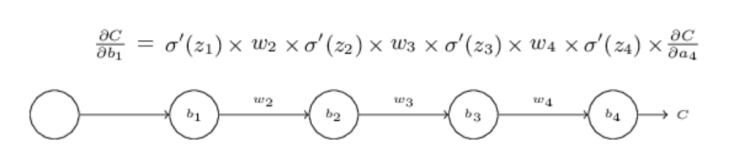
During backprop, we find the derivative of the output w.r.t. different weight matrices in order to make our output more accurate. Suppose that we want to find derivative of C(output) w.r.t weight matrix (b1).

The terms which are going to be included in this are:

Neural Network

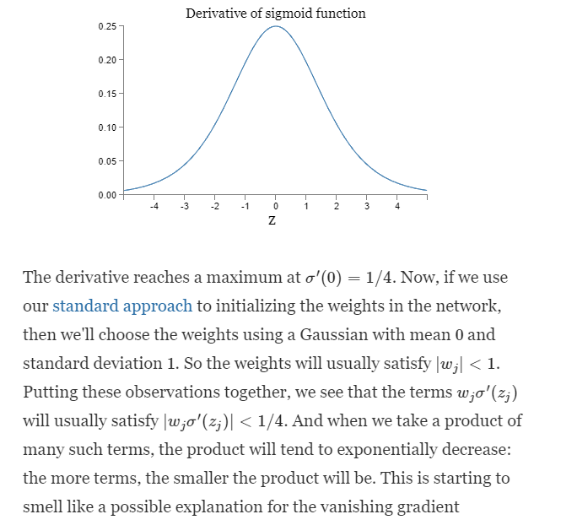
The sigmoid’(z1),sigmoid’(z2).. etc are less than 1/4. Because derivative of sigmoid function is less than 1/4. See below. The weight matrices w1,w2,w3,w4 are initialized using gaussian method to have a mean of 0 and standard deviation of 1. Hence ||w(i)|| is less than 1. Therefore, in derivative we multiply such terms which are less than 1 and 1/4. Hence on multiplying such small terms for a huge number of times we get very small gradient which makes the model to almost stop learning.

The reason that if we have deeper models than starting hidden layers will have low speed of learning is: we move deeper as we reach the starting hidden layers during backprop and hence more such terms are involved which makes the gradient small.

Read it!

Similar is the case with exploding gradient, If we initialize our weight matrices with very large values, then the derivative will be very large and hence the model will have highly unstable training.

Thanks for Reading..guys.

Don’t forget to give us your ? !


Exploding And Vanishing Gradient Problem: Math Behind The Truth was originally published in Becoming Human: Artificial Intelligence Magazine on Medium, where people are continuing the conversation by highlighting and responding to this story.
Via https://becominghuman.ai/exploding-and-vanishing-gradient-problem-math-behind-the-truth-2d17f9bf6a57?source=rss—-5e5bef33608a—4

source https://365datascience.weebly.com/the-best-data-science-blog-2020/exploding-and-vanishing-gradient-problem-math-behind-the-truth

How to Integrate AI into Your Drupal Website the Easy Way: 7 Drupal 8 AI Modules at Hand

Thinking about incorporating AI capabilities into your Drupal 8 website? Here are 7 modules that help you… get the best of both worlds:

Source

How do you take advantage of AI and get the most of Drupal’s content management system? Are there any Drupal 8 AI modules and tools that you could incorporate into your website and… get the most of both worlds?

The best of Drupal as a reliable content repository and of a:

  • chatbot
  • virtual assistant or another type of conversational interface

Or maybe you want to implement AI to boost the various content workflows happening on your website:

  • content that needs to be served to various markets (and thus translated into… various languages)
  • user-generated content that needs to follow a certain editorial guideline (e.g. “adding alternative text to images”)
  • content experiences that need to be tailored to each user’s activity on your site

Nothing easier.

There are at least 7 different modules in Drupal to help you inject AI capabilities into your website:

1. What Are the Biggest Advantages of Artificial Intelligence in Drupal?

How does building AI integrations on top of your Drupal website translate into benefits? Strong, clear benefits…

Well, it all bubbles up to the user experience and to your team’s efficiency:

  • you create and deliver more personalized experiences for your website visitors
  • you streamline and automate your team’s content and marketing workflows
  • you get to boost your targeted marketing efforts
  • you provide more engaging user experience, as well, incorporating smarter features into your Drupal site
Big Data Jobs

2. Build a Drupal Chatbot Fast with 2 Drupal 8 AI Modules

Thinking about delivering a more user-centric experience on your website? Then you must be wondering how you can implement an AI-powered conversational interface in Drupal, right?

You’d then be using Drupal for front UI, content management, user admin…

7 Drupal 8 AI Modules to Integrate AI into your Site: Building a Drupal Chatbot
Source: Drupal Camp Pune

It’s simple:

There are 2 dedicated AI modules in Drupal that help you create a chatbot in no time:

2.1. Chatbot API

Let take this scenario:

You want your “Drupal headless” setup to share content across an entire ecosystem of services: Facebook bot, Dialogueflow, Amazon Echo… Yet, you dread the idea of writing custom code for every single chatbot/personal assistant in this ecosystem.

How do you streamline your content serving efforts? How can you write your code once and… have your content shared with all your target chatbots and?

You install Chatbot API.

It will intermediate the integration of all those services into your Drupal website. And it will ensure that data gets served across the whole network of chatbots.

2.2. Drupal Chatbot

Another useful module to use if you consider creating a chatbot on Drupal data.

Here’s how it works:

It enables you to set up a voice and text-based bot to interact with your website visitors. One that acts as a layer between Drupal and the NLP agent.

You get to choose the block where you want it enabled and to add various functionalities, as well: Latest Article Search, Latest Pages, Top Rated Pages…

How to Integrate AI into Your Drupal Website the… Easy Way: 7 Drupal 8 AI Modules at Hand
Photo by Franck V. on Unsplash

3. Implement a Virtual Assistant with Decoupled Drupal Commerce

What if you want to take the eCommerce experience on your online store to a new level? To turn it into a… conversational eCommerce experience?

How? By integrating a Drupal virtual assistant into your website.

Nothing easier:

You connect a bot to decoupled Drupal Commerce.

Bot Frameworks + Decoupled Drupal Commerce APIs + NLU = A Conversational Interface for your eCommerce website.

Since Drupal:

  • puts a whole collection of APIs at your free disposal (being API-first)
  • provides you with the Commerce Cart API module to leverage

… storing content (and product details) and interacting with shopping carts in Drupal Commerce becomes particularly easy.

Trending AI Articles:

1. Natural Language Generation:
The Commercial State of the Art in 2020

2. This Entire Article Was Written by Open AI’s GPT2

3. Learning To Classify Images Without Labels

4. Becoming a Data Scientist, Data Analyst, Financial Analyst and Research Analyst

And here’s how your Drupal Commerce-powered bot would work:

  • it will trigger “review cart” and “add to cart functionality” via message-based interactions
  • it will unblock search and “explore the products” functionality by connecting itself to the Drupal Commerce APIs

4. Create Personalized Experiences with Drupal Machine Learning

Personalization is the norm these days.

To serve content tailored to your customers’ past activity (what they shared, what content they searched for…) and their profiles.

And for doing it right, you need to incorporate machine learning techniques into your Drupal website.

“Is it possible to do that?”

Of course. And here are just 2 Drupal 8 AI modules that you can tap into for personalizing the web content experience that you provide your site visitors with:

4.1. Acquia Lift Connector

Take it as a convenient 2-in-1 tool at hand: customer data & content.

This way, you get to streamline your content personalization efforts. To scale and share user-tailored experiences across an entire infrastructure of channels and devices.

It’ll “equip” your marketing campaign with all the powerful features you need: behavioral targeting, real-time audience segmentation, A/B testing…

In a nutshell, what this module does is connect your Drupal site with the Acquia Lift personalization tool…

4.2. Azure Cognitive Services API

The go-to module if you consider “injecting” intelligent features — speech, facial and vision recognition, speech and language understanding — into your Drupal website or app.

Your development team can just tap into the machine learning APIs exposed and… turn them into machine learning functionalities to be incorporated into your Drupal application.

7 Drupal 8 AI Modules to Integrate AI into your Site: Azure Cognitive Services API
Source: Drupal.org

It’s a package of 4 different AI modules, in fact:

  • Face API Module
  • Emotion Recognition API Module
  • Computer Vision API Module
  • Azure Text Analytics API Module

The last one, for instance, triggers advanced natural language processing on raw text.

This translates into 3 key features: key phrase extraction, sentiment analysis, and language detection.

5. Streamline Your Workflows with 2 Drupal Intelligent Content Tools

One of the biggest advantages of artificial intelligence is that of streamlining (and automating) your in-house workflows.

Your content and marketing ones…

So, how do you inject “efficiency” into your Drupal content and marketing teams’ various workflows? You integrate these 2 Drupal 8 AI modules into their work.

5.1. Automatic Alternative Text

What if you could implement AI capabilities into the process where users upload their own content?

Just ponder on this scenario for a while:

You can include “Add alternative text images” into your set of editorial guidelines, but you can’t expect users to follow them, as well, when they upload content, right?

And that’s what you have the Automatic Alternative Text module for.

7 Drupal 8 AI Modules to Integrate AI into your Site: Automatic Alternative Text”
Source: Drupal.org

It describes the image that the user uploads. In one sentence.

It generates more than one description for the same image, actually…

Furthermore, it ships with features like:

  • detecting mature content
  • identifying faces in a given image
  • determining the prevailing colors

5.2. Cloudwords for Multilingual Drupal

Another one of those Drupal intelligent content tools that you should turbocharge your team’s workflow with.

Just put yourself into one of your marketers’ shoes:

He/she has to deliver content (lots of it) to an entire ecosystem of markets, in various languages.

And delivering localized, consistent content experiences at a global scale does take plenty of resources…

What this module does is automate the entire content delivery and management process:

Just select the piece(s) of content that you’ll need to localize and let Cloudwords serve it at high speed, to all your target markets.

The END!

And these are but 7 of the Drupal 8 AI modules at your disposal for injecting artificial intelligence capabilities into your website/app.

Have you implemented any AI integrations in Drupal 8 so far? Any chatbots or maybe AI-powered tools for personalizing the content experience on your website?

Don’t forget to give us your ? !


How to Integrate AI into Your Drupal Website the… Easy Way: 7 Drupal 8 AI Modules at Hand was originally published in Becoming Human: Artificial Intelligence Magazine on Medium, where people are continuing the conversation by highlighting and responding to this story.
Via https://becominghuman.ai/how-to-integrate-ai-into-your-drupal-website-the-easy-way-7-drupal-8-ai-modules-at-hand-e84ded415fc4?source=rss—-5e5bef33608a—4

source https://365datascience.weebly.com/the-best-data-science-blog-2020/how-to-integrate-ai-into-your-drupal-website-the-easy-way-7-drupal-8-ai-modules-at-hand

Design a site like this with WordPress.com
Get started