
Five Ways Machine Learning and Artificial Intelligence Will Change your Career in 2020

Source

Are you wondering that you will lose your job due to the COVID pandemic? Candidates are highly looking for careers in 2020. As the downturn is coming by the recent COVID widespread, there are still some job opportunities whose demand is here to stay. Yes, I am talking about Artificial Intelligence and Machine Learning. There is a huge demand for the adoption of artificial intelligence across organizations.

The emerging innovative technologies such as artificial intelligence and machine learning will create more job opportunities for beginners as well as for experts. Artificial intelligence and machine learning have presented an enormous change in the job market. Artificial intelligence is one of the crucial factors in transforming the workspace. Machine learning training and artificial intelligence training will give you an insight into the sector.

In this article, you will learn how machine learning and artificial intelligence will transform your career path. Firstly, let’s understand Artificial Intelligence and Machine Learning.
Big Data Jobs

What is Artificial Intelligence?

Artificial Intelligence is the technology that can execute different intelligent tasks. The intelligence processes by computer systems are known as artificial intelligence. It is a technique that permits computer systems to copy human behavior. AI systems are powered by deep learning and machine learning. AI systems take out value from meaningless information by automating processes.

What is Machine Learning?

Machine Learning is a subpart of artificial intelligence that utilizes statistical ways to authorize computer systems to learn with experiences. Machine learning technology is the science of getting systems to act and grasp like humans do and upgrade by feeding information and data in the form of real-world observations.

How Artificial Intelligence and Machine Learning will transform your career path

The integration of machine learning and artificial intelligence has fully changed the working industries. The demand for AI trainers and machine learning engineers is increasing day by day. Here we will discuss five ways how AI and machine learning will change your career.

  1. Enhancing efficiency

The implementation of AI and machine learning will upgrade output quality and terminate human mistakes. A good algorithm can provide significant information to make decisions on time. Artificial intelligence techniques act as assisting tools for humans to boost their efficiency and productivity. Using machine learning and AI can assist systems to produce more accurate outputs. These technologies will help humans in adjusting and scanning to new data related to service or product. An excellent mechanism can make conclusions faster.

2. Automation requires new skill sets

Artificial intelligence will develop a frame for a new category of job opportunities that can be acquired with certification in artificial intelligence. You can land yourself a job with persistent leaning. AI and machine learning will generate new job opportunities because automation requires new skill sets. Some of the trending job profiles are machine learning engineers, AI trainers, AI experts, natural language engineers and deep learning experts, etc.

Trending AI Articles:

1. Natural Language Generation:
The Commercial State of the Art in 2020

2. This Entire Article Was Written by Open AI’s GPT2

3. Learning To Classify Images Without Labels

4. Becoming a Data Scientist, Data Analyst, Financial Analyst and Research Analyst

3. Decentralized work forces

Artificial intelligence and machine learning will assist ease multitasking. With the implementation of AI you can also go through augmented reality tools. You don’t require it to be variable at a specific place. Hence, AI and deep learning tools help in the decentralization of workforces. With the use of artificial intelligence, humans will simply acknowledge each other in real-time communication. AI and deep learning are meant to transform the work environment. Artificial intelligence focuses on every piece of work. This will make humans focus on the growth of the industry.

4. Artificial intelligence will highlight points of development

AI techniques will give feedback on the area of improvement. It will examine the expertise that you are lacking. With the use of artificial intelligence, you can even do a self-examining test which will further push your career growth. AI tools can also correct your errors.

5. More Innovation

With the implementation of AI in the work environment, humans will have to move to jobs that devices cannot do. This will further push humans to be very innovative. There will be rapid efficiency and innovation in humans as whatever we do will be charged by the information provided by algorithms. Machine learning engineers have the potential to transform a lot of organizations positively. Artificial intelligence can recommend a correct training course for an individual. Artificial intelligence provides methods for skill development and training.

Final thoughts

Machine learning and artificial intelligence are already transforming the way we work. AI and machine learning are not purely devastating. New job opportunities will be generated, existing posts will be again created and changing careers will be a good opportunity. The development of machine learning and artificial intelligence is examined as the industrial revolution. These emerging technologies are reframing and transforming the workplace.

If you are just a starter and want to explore more about machine learning technology then you can check out machine learning for beginners.

Don’t forget to give us your ? !


Five Ways Machine Learning and Artificial Intelligence Will Change your Career in 2020 was originally published in Becoming Human: Artificial Intelligence Magazine on Medium, where people are continuing the conversation by highlighting and responding to this story.


Via https://becominghuman.ai/five-ways-machine-learning-and-artificial-intelligence-will-change-your-career-in-2020-d63a73044959?source=rss—-5e5bef33608a—4

source https://365datascience.weebly.com/the-best-data-science-blog-2020/five-ways-machine-learning-and-artificial-intelligence-will-change-your-career-in-2020

A Laymans Guide to Data Science. Part 3: Data Science Workflow

Learn and appreciate the typical workflow for a data science project, including data preparation (extraction, cleaning, and understanding), analysis (modeling), reflection (finding new paths), and communication of the results to others.

Originally from KDnuggets https://ift.tt/2ZG3M6G

source https://365datascience.weebly.com/the-best-data-science-blog-2020/a-laymans-guide-to-data-science-part-3-data-science-workflow

Exploratory Data Analysis on Steroids

This is a central aspect of Data Science, which sometimes gets overlooked. The first step of anything you do should be to know your data: understand it, get familiar with it. This concept gets even more important as you increase your data volume: imagine trying to parse through thousands or millions of registers and make sense out of them.

Originally from KDnuggets https://ift.tt/38uyvYp

source https://365datascience.weebly.com/the-best-data-science-blog-2020/exploratory-data-analysis-on-steroids

How Do I Get Into AI Development? Where Do I Start? A Complete Beginner Guide to Learning AI

Source

How does a complete beginner get into AI development? What learning resources does he/she use along the journey to learn about artificial neural networks, the basic AI algorithms, the simplest machine learning models and all that?

“How important is a solid math background?” “And what programming language should I learn/deepen my knowledge of?”

Here’s a step-by-step guide for a complete beginner to AI, that should put you on the right track, so can you get started with AI software development… the right way:

1. A Solid Background in Mathematics Is Just… Crucial

Just think about it:

And there are a few more topics that you should add to the list:

  • probability and statistics
  • various algorithms

Learn as much math as you can before you jump into the best courses and other learning resources on AI that you can find.

It will greatly help you…

2. Narrow Your Focus: What Do You Want to Build?

Clearly articulate your goal, make it fit into one simple sentence:

“To develop an algorithm that predicts a person’s blood pressure”, for instance.

It’s only then that you’ll be able to:

  • break your task/problem down into smaller parts
  • narrow your focus (for AI is a discouragingly broad term)
  • identify the specific resources that you’ll need
Machine Learning Jobs

3. Learn By Doing: Try to Solve a Simple Problem for a Start

In other words: try writing a simple neural net first, then gradually focus on more complex ones.

As a start, tackle an easy problem. Experiment with multiple approaches for harnessing algorithmic decision-making while trying to solve it.

Get into AI software development by finding the quickest solution to a given problem:

Train a simple machine learning algorithm and evaluate its performance.

Next, level up your knowledge by optimizing your basic solution. Experiment with upgrading various components and monitor the resulting change.

Try your hand at:

  • building your own simulator
  • writing the AI code for games like Sudoku or Tic Tac Toe
  • developing code for pattern recognition
How Do I Get Into AI Development? Where Do I Start? A Complete Beginner Guide to Learning AI

4. Get Started with Deep Learning: Learn About Artificial Neural Networks

As a newcomer, you must be particularly interested in deep learning, am I right?

Now, if you want to explore this machine learning method, you’ll need to get familiar with the basics of artificial neural networks.

In this respect, you might find this online resource here on Deep Learning enlightening enough.

As for the open-source framework to use for testing the newly acquired skills you have:

  • Google-powered TensorFlow, by far one of the most popular ones; a Python-based one
  • Theano, Scikit-learn, Keras, all Python-based frameworks, as well
  • Deeplearning4j, a Java framework

5. Choose Your Programming Language: Consider Performance and Libraries Availability

“What programming language should I learn to get started with AI development?”

Actually, choosing the language is not that important.

Go for a mainstream language (although you can still do ML/AI with lesser popular languages, as well). One that:

  • provides you with lots of tools and high-quality libraries
  • stands out in terms of performance

So, it could be either Python or C++, either Java or C or Octave. Each one has its own strengths and limitations when it comes to performance and libraries availability.

6. Learn Computational Learning Theory to Get into AI Development

And this is particularly important when you delve deep into the field of Natural Language Processing.

7. Build a Powerful Computing HardWare or Use a Cloud-Based One

Expect some significant hardware requirements for running artificial intelligence and implementing machine learning.

A powerful hardware system, using a bundle of CPUs and high-performing GPUs is a must if you’re thinking:

  • considerably big models; you’ll be testing lots of alternative models before you decide on the final one
  • more and more complex experiments that involve harnessing the power of AI

And here, you have 2 options:

  1. you either put together your own powerful enough supermachine
  2. you go with a cloud-based alternative

Speaking of the latter, here are 2 cloud computing platforms to consider:

  • Cloud TPU: a Google-powered hardware custom designed specifically for carrying out tensor operations in a more efficient way than a GPU or CPU
  • Google CoLab: a Jupyter notebook environment that doesn’t need any setup; you get quick access to the cloud-based GPU for running your scripts to

8. Get Familiar with Most Machine Learning Algorithms

If you’re determined to get into AI development you should be/get comfortable with:

  • support vector machines (SVM)
  • recurrent neural networks (RNN)
  • deep learning (DL)
  • a whole lot of other decision trees and random forests

There’s no shortcut here!

9. Enter a Kaggle Competition

Put your newly acquired skills to the test!

Commit to solving the problems that other AI developers are working on by participating in a Kaggle competition.

Test out multiple approaches and go with the most effective solution.

Not only that you will get to test your skills in AI software development but your collaboration skills, as well:

You’d be joining a large community, asking questions on an AI-focused forum whenever you get stuck while learning artificial intelligence, you’d be sharing your groundbreaking ideas and so on.

10. 2 Free Online Courses to Try Your Hand At

One of the questions at the beginning of this post has been:

“ What learning resources does he/she use along the journey to learn…”

So, here I am now, ready to give you 2 recommendations:

  • Stanford University — Machine Learning: Google Brain’s founder, Andre NG, is teaching this course; it’s loaded with real-time examples of AI-driven technologies, with valuable information that will help you gain a better understanding of how neural networks learn…
  • Learn with Google AI: a Google-powered project including a machine learning course for newcomers (incorporating the TensorFlow library as well)

The END!

Sure hope these 10 tips will help you grow more confident and eager to get into AI development.

Don’t forget to give us your ? !


How Do I Get Into AI Development? Where Do I Start? A Complete Beginner Guide to Learning AI was originally published in Becoming Human: Artificial Intelligence Magazine on Medium, where people are continuing the conversation by highlighting and responding to this story.

Via https://becominghuman.ai/how-do-i-get-into-ai-development-where-do-i-start-a-complete-beginner-guide-to-learning-ai-6a5358bbbcf6?source=rss—-5e5bef33608a—4

source https://365datascience.weebly.com/the-best-data-science-blog-2020/how-do-i-get-into-ai-development-where-do-i-start-a-complete-beginner-guide-to-learning-ai

Predicting Song Popularity Combining Audio Features with Metadata

Leveraging Spotify’s API and other sources for the Hit Song Science research field. The whole project (report and code source) can be viewed here.

Introduction

I decided to use my Master Thesis to apply the concepts of Machine Learning I have been learning over the year with online courses. The idea for me was to use it as a first Data Science project. Being passionate about music, I chose to tackle the Hit Song Science subject which consists in predicting the overall popularity of a track.

Methodology and Results

To do so, I built my own database of Spotify’s Top 2018 and 2019 songs and I extracted additional information from Genius.com, Google Trends, MusicBrainz and LastFM. To define the popularity of a music, I used the continuous variable, provided by Spotify, and a binary one (top 20% of the dataset using the other popularity feature). From those data, I created new features, which includes Google Trends Standard Deviation over a 3-month period ending one week after the release of an album, Peak (indicator of the highest interest position) or Holiday Period (dummy variable indicating the release of a track during the months of May, June, July or August). The idea was to use three different subsets: Audio Features, Artist Metadata and Song Metadata.

Trending AI Articles:

1. Natural Language Generation:
The Commercial State of the Art in 2020

2. This Entire Article Was Written by Open AI’s GPT2

3. Learning To Classify Images Without Labels

4. Becoming a Data Scientist, Data Analyst, Financial Analyst and Research Analyst

First, I did an Exploratory Data Analysis to discover the variable distributions, determine the correlations between them and visualize other kinds of relationships. Pearson and Spearman tests were also performed between the quantitative variables and the song popularity. Then, I tested the following models according to the literature review: Linear Regression, Logistic Regression, K-Nearest Neighbors, Random Forest, Support Vector Machines (linear and gaussian kernels) and a Single-Layer Perceptron. I also used feature selection and regularization (L1 and L2) methods to improve my results and prevent the models from overfitting. The results were finally compared to a dummy model using a Test set. Unsurprisingly, the perceptron yielded the best result with a F1 score of 0.70 (Precision of 0.58 and Recall of 0.88).

Conclusion and Recommendations

To conclude, the audio features are indeed not sufficient to explain the popularity of a track and metadata are essential. The selection methods I used gave me a set of influential features for both kinds of tasks (regression and classification), with a majority of metadata (even if I mostly had song/artist metadata in the dataset). It was interesting to observe that Google Trends features exerted a significant influence on the outcome of the classifiers, increasing the probability for a track to be a Hit. I also found the classification task to be more promising, due to the comparison of the models with a dummy classifier and a dummy regressor.

Artificial Intelligence Jobs

I would like to end this article by presenting some ideas that could be tried for further work on the Hit Song Science research field:

  • Try to constitute a dataset per genre and to train models on each dataset.
  • Build a large dataset, thinking about the distribution of Spotify’s popularity value. There is now an offset limit with Spotify’s API for the search point so I would recommend using lists of Spotify’s track ID that can be found on Kaggle for instance, paying attention to the release date of the tracks.
  • Use detailed audio features which are available on Spotify’s API. The ones I used summarize that information but probably simplify it.
  • Use the market feature to create an indicator of the number of countries where the song is available. Maybe various strategies for launching an artist could be interpreted: is it better to focus on some markets or to promote a track worldwide (use historical data)?
  • Many tags can be obtained from LastFM’s API, which can be useful to understand how the song is perceived by the listeners.
  • Tackle the Hit Song Science problem as a multi-classification task to smooth the definition of popularity.
  • Use a combination of Spotify’s followers, LastFM’s subscribers, Deezer’s subscribers, Genius’s page views or Instagram’s followers to analyse the popularity of an artist.

This project was very interesting, and I learnt a lot as it was my first application of the content I had been working on with online courses since the beginning of the year. I discovered many other resources and books to deepen my understanding of Data Science and I look forward to improving myself and evolving in the field of data.

Huge thanks to Julien Fouquau, my thesis tutor at ESCP Business School and Ulysse Couerbe for giving me a great list of online courses to start learning the basics of Machine Learning.

Don’t forget to give us your ? !


Predicting Song Popularity Combining Audio Features with Metadata was originally published in Becoming Human: Artificial Intelligence Magazine on Medium, where people are continuing the conversation by highlighting and responding to this story.

Via https://becominghuman.ai/predicting-song-popularity-combining-audio-features-with-metadata-f1810dde0ddf?source=rss—-5e5bef33608a—4

source https://365datascience.weebly.com/the-best-data-science-blog-2020/predicting-song-popularity-combining-audio-features-with-metadata

How do humans learn and how does the machine?

The acquisition of new skills and the transfer of knowledge acquired by others was essential to the development of human civilization. Without it, we would not have been able to build cities, cure diseases and certainly would not be able to go into space.

Since the twentieth century, there has been a drastic development in the research of artificial intelligence. A new discipline, machine learning, became independent of it.

What does learning mean?

Everyday vocabulary is mostly seeing it as the acquisition of some new knowledge. The school is closely related to this. This well-known institution is designed to put knowledge into students’ memory by pushing them out of their comfort zone. Learning is essential to the survival of human civilization. Broadly speaking, this includes everyday actions such as when a child learns to tie his shoes, how to behave in company, or even how to talk.

How does one study?

A human relies on his/her memory to develop abilities. We remember how we implemented the sample and at best we also have an idea of ​​what it should be like. Repeat the pattern many times to perfect the ability. This is exactly the process that takes place when we learn to ride a bike. The first few attempts still end in a fall, but we are getting more and more into the sense of balance and there are those who are already doing this as a professional sport.

Learning, of course, is not just an ability applied by humans, animals also change their patterns of behavior based on their past experiences. It is an important element of evolution and vital to survival. General, basic mechanisms of learning include classical conditioning. The father of this mechanism was the Russian physiologist Ivan Pavlov. Everyone is familiar with the experiment in which saliva formation was induced in the dog by sound stimuli.

Trending AI Articles:

1. Natural Language Generation:
The Commercial State of the Art in 2020

2. This Entire Article Was Written by Open AI’s GPT2

3. Learning To Classify Images Without Labels

4. Becoming a Data Scientist, Data Analyst, Financial Analyst and Research Analyst

Conditioning is also a learning path for people. In the event that the pattern of behavior practiced results in an experience that is unsatisfactory, we change the pattern of behavior. If the change already produces the desired result, we will continue to repeat it, which will later result in the formation of a new habit. Through a concrete example: if we reach into the hot water and burn our hands, next time we will beware of this act. So, we learned how to avoid burns when encountering hot water.

What is machine learning?

We are already confident that humans and animals can learn. But what about the machines? Computers, unlike the previous two categories, are non-living beings. They are not the result of evolution, but of human work. Machine learning is a kind of artificial intelligence. Unlike traditional algorithms, they have the incredible novelty of being able to learn from their past experiences. They seek a solution to the problem assigned to them by following several possible paths and moving forward with the result that gave the most successful result.

Artificial Intelligence Jobs

Machine learning learns data based on a predictive model and predicts what will be the next data point. The more data you work with, the more accurate the forecast will be.

Reinforcement learning

Reinforcement learning is a branch of machine learning. Feedback is an essential element of reinforcement learning. We give the system a task, for example, to recognize some patterns. Recognize whether we see an apple in the picture or not. If we give an image of a pear, the system will give an answer. If it answers incorrectly, so if it identifies the pear as an apple, we will give it negative feedback. The more such tests we perform on it, the more accurate its predictions will be.

Reinforcement learning is an area that is already very similar to the learning used by living creatures and the conditioning mentioned earlier. Although Pavlov’s dog did not try to distinguish between apples, he was able to associate the sound of the bell with the food.

How long has it existed?

The term was published as early as 1959, and a book on the application of machine learning to pattern recognition was made in the 1960s. However, it only became known to the general public in the 21st century. Artificial intelligence researchers were very preoccupied with the question of how machines could learn from data and saw machine learning as a viable path through which true “artificial intelligence” could be born. Later, the two sciences separated and in the 1990s, machine learning was reborn as a separate field. The new goal of ML was already a purely problem solution, for which it borrowed models from statistics and probability theory.

Where do we use it?

Agriculture

Machine learning can be used in many areas and it is quite certain that the wonderful potential of it is recognized in even more places. The essence of so-called precision agriculture is that producers try to determine more precisely how much they need for optimal production. Every farm needs water, chemicals and seeds. Machine learning helps to determine the exact amount needed. This not just reduces waste, which is not only cost-effective and also good for the planet but increases production capacity as well. We can go beyond that. If machine learning increases productivity and reduces waste, we can be sure that it will also play an important role in overcoming famine.

Cryptocurrency trading

The emergence of agriculture also marks the beginning of human civilization. In contrast, cryptocurrencies are young assets. This is not to say that machine learning cannot be used here as well. True, only a few companies have attempted to do so. The fintech startup b-cube.ai in Paris uses quantitative models and machine learning to forecast the cryptocurrency market. It works like this: their technology sends signals (forecasts) to the trader and predicts where the market is more likely to move. The signal is then automatically executed by a Bot in the market. It took many unsuccessful attempts at machine learning to develop an algorithm that can already produce nice results:

Where is the industry going?

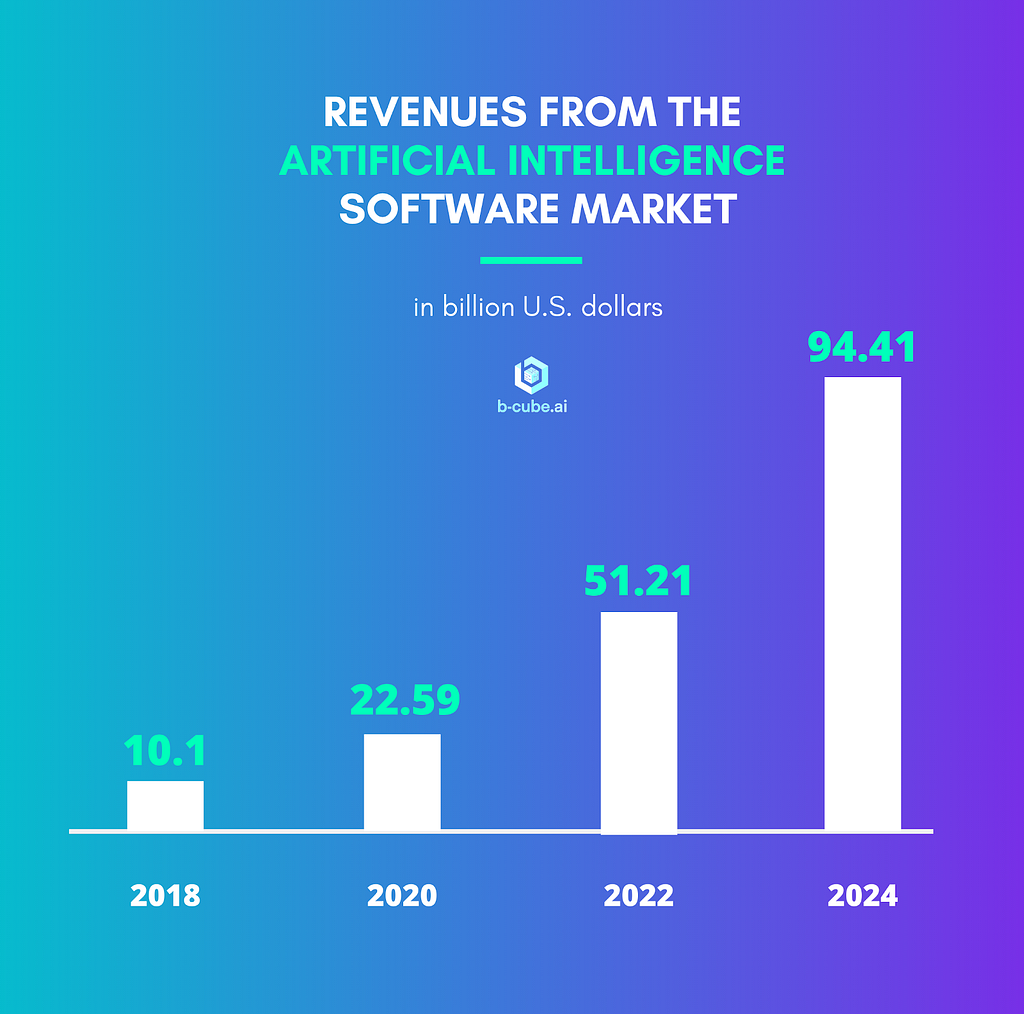
According to the forecasting company Tractica, there is a bright future ahead for machine learning and artificial intelligence in general. The market is growing at a rapid pace and its revenues are expected to double every two years.

This, of course, is just a prediction that we know is not always accurate and cannot be accurate. In any case, we can be sure that the opportunities facing the market exist, that development is consistent and that growth is guaranteed.

Don’t forget to give us your ? !


How do humans learn and how does the machine? was originally published in Becoming Human: Artificial Intelligence Magazine on Medium, where people are continuing the conversation by highlighting and responding to this story.

Via https://becominghuman.ai/how-do-humans-learn-and-how-does-the-machine-a923244b27f6?source=rss—-5e5bef33608a—4

source https://365datascience.weebly.com/the-best-data-science-blog-2020/how-do-humans-learn-and-how-does-the-machine

5 Ways Artificial Intelligence shapes the Future of Test Automation

Introduction:

AI and ML are transforming our daily lives in many ways. Many of the business sectors have already adopted AI and ML to reduce the cost and for automating most of the tasks. In addition to these, AI has even become crucial for many businesses in validating their functionality, security, performance among other things. Machine Learning is very well known for categorizing data, for discovering algorithms and detecting patterns. With the help of ML and AI in automation testing, there will be numerous advantages such as an increase in test coverage, improvement in accuracy, and faster product delivery. This will effectively help to overcome the test maintenance and test coverage.

Five methods AI can change software automation testing:

1. Delivering products with good quality and speed

Automation testing has already reduced human intervention. AI reduces it further by limiting manual work that humans actually perform. Regression testing is well suited for AI, it verifies whether the previously tested modules continue to function properly after code modification, and it serves as a safeguard that no new bugs were introduced during the recent enhancements in the codebase.

AI will be accountable for activities like time-consuming and back-breaking. And it is also responsible for activities such as identifying iterative test cases, ascertain bugs from thousand lines of code and programming regression test cases. Unlike the traditional test methods, the AI methodology is an expert to identify the issues faster in applications. A combination of AI and humans is known as Intelligent Augmentation. It helps testers to produce efficient results and deliver high-quality products on time.

Trending AI Articles:

1. Natural Language Generation:
The Commercial State of the Art in 2020

2. This Entire Article Was Written by Open AI’s GPT2

3. Learning To Classify Images Without Labels

4. Becoming a Data Scientist, Data Analyst, Financial Analyst and Research Analyst

AI is efficient for increasing the scope of the test cases and it monitors the memory, file contents, internal programs, and data tables of the app to verify whether the functionality is needed or not. With the help of AI-powered test automation tools, thousands of test cases can be executed in one test run. This potential of AI effectively helps in speeding up and increasing the test coverage multifold.

2. Maintaining tests without human intrusion and reducing costs

In automation testing, test cases will run automatically, but maintaining those test cases is a time-consuming manual task. These tasks can be automated by Machine Learning using various algorithms. AI-based tools can automatically write the tests for an application by collecting data and by capturing screenshots. Hence, AI-based testing reduces costs and saves time.

Errors in the application can become overpriced when they are not resolved at the earliest. With the help of AI, the errors can be resolved at the earliest and this significantly helps in cost savings.

AI uses the stored data for understanding the everyday behavior of the test cycles. While executing the test cases, the current state of the product is compared with the data collected and if there are certain changes at any point in the execution, the test cases are updated accordingly. In this way, AI helps to maintain test cases without human intervention.

Artificial Intelligence Jobs

3. The self-recovery process removes unconventional tasks

AI performs a self-recovery process and upgrades itself on a regular basis. It stores all the data in memory and uses this memory for self-recovery. It can also predict the future processes and can mitigate risks.

In the self-recovery process, AI identifies and fixes the error before it occurs. AI continuously gathers the data and updates the algorithms. This helps in detecting the behavior of the application and in delivering an efficient product.

4. Independent tasks to obtain higher test efficiency

When tests are dependent on certain modules or responses, it troubles automation and makes it complicated. Earlier pseudo responses were prepared for executing successful test cases. Due to the introduction of AI, pseudo responses are no longer used. After the execution of a few manual tests, AI grasps and store responses from the servers, and those responses were used to remove the dependencies on various modules and servers. So, this helps in obtaining higher test efficiency without errors.

5. Improves accuracy to achieve high-quality products

Even experienced testers can make mistakes while carrying out repetitive tasks in manual testing. Automation testing came into effect to minimize repetitive tasks. When automation is complemented with AI, the repetitive tasks are performed by the AI and the testing teams are furnished with the scope to carry out exploratory activities and find automation solutions. Thus, the time consumption is reduced and the accuracy for achieving quality results increases.

Before investing in AI and ML you should first invest in quality testers. If an organization has the best testing resources, then, with the help of AI and ML it can deliver high-quality products. A combination of knowledge generated by ML and AI and putting that knowledge into action can do wonders for an organization.

Conclusion:

When software testing is automated, it makes AI-based testing smarter, but still, there is a need for progress in implementing the AI-assisted testing effectively for business. AI just automates testing activities based on the data provided by human testers. So, human testers need to understand the significance of their roles in order to efficiently leverage AI-based automation techniques that will shape the future of software testing automation.

Author: Vijayakumar Arunachalam
Stream: QA

Don’t forget to give us your ? !


5 Ways Artificial Intelligence shapes the Future of Test Automation was originally published in Becoming Human: Artificial Intelligence Magazine on Medium, where people are continuing the conversation by highlighting and responding to this story.

Via https://becominghuman.ai/5-ways-artificial-intelligence-shapes-the-future-of-test-automation-71731fbe5981?source=rss—-5e5bef33608a—4

source https://365datascience.weebly.com/the-best-data-science-blog-2020/5-ways-artificial-intelligence-shapes-the-future-of-test-automation

Generating cooking recipes using TensorFlow and LSTM Recurrent Neural Network: A step-by-step guide

A character-level LSTM (Long short-term memory) RNN (Recurrent Neural Network) is trained on ~100k recipes dataset using TensorFlow. The model suggested the recipes “Cream Soda with Onions”, “Puff Pastry Strawberry Soup”, “Zucchini flavor Tea”, and “Salmon Mousse of Beef and Stilton Salad with Jalapenos”. Yum!? Follow along this detailed guide with code to create your own recipe-generating chef.

Originally from KDnuggets https://ift.tt/3goJp4G

source https://365datascience.weebly.com/the-best-data-science-blog-2020/generating-cooking-recipes-using-tensorflow-and-lstm-recurrent-neural-network-a-step-by-step-guide

Design a site like this with WordPress.com
Get started